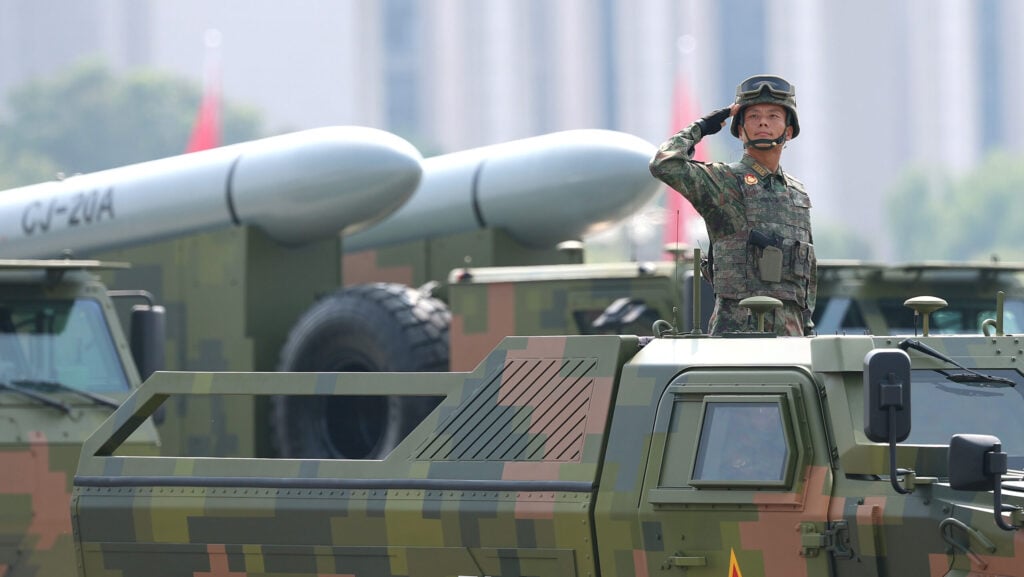
MELBOURNE — China today used a military parade to show off, for the first time, its nuclear triad, including a new Air-Launched Ballistic Missile (ALBM) and two new Inter-Continental Ballistic Missiles (ICBM), joining a previously shown Submarine Launched Ballistic Missile (SLBM).
Also unveiled at the event, commemorating the 80th anniversary of the end of World War II, were a slew of missiles, drones and counter-Unmanned Aircraft Systems (C-UAS) vehicles, and carrier-borne Airborne Early Warning Aircraft.
The parade, held in Beijing’s Tiananmen Square, is annually used to show off new weapons as a signal abroad. It was overseen by Chinese leader Xi Jinping and included several invited world leaders, most notably Russian President Vladimir Putin and North Korea’s Kim Jong-un, both of whom were prominently seated next to Xi.
The biggest items of interest to parade watchers were three new nuclear-capable missiles, including two new road-mobile ICBMs, dubbed the DF-31BJ and DF-61. Little information is available about the systems, both of which were mounted on wheeled eight-axle Transporter Erector Launcher (TEL) vehicles. However, the DF-31BJ is very likely to be an improved DF-31AG ICBM, which was itself only showcased for the first time at a military parade in 2017.
The new JL-1 ALBM will likely be carried by the People’s Liberation Army Air Force’s fleet of Xi’an H-6N bombers and is one two ALBMs in Chinese service along with the YJ-21 anti-ship ALBM.
Also making their debut at the parade were several of China’s conventional missiles, including the YJ-17, YJ-19 and YJ-20 hypersonic anti-ship missiles. Land-based hypersonic missiles were also shown at the parade, including the DF-26D, a development of the DF-26 family of Intermediate Range Ballistic Missiles that already had land-attack and anti-ship variants.
Another land-based missile system seen for the first time at the parade was the HQ-29, with a pair of missiles enclosed in canisters and mounted on a six-axle TEL that was described as part of the PLA’s multilayered air defense systems.
However, given its size, it is possible that the HQ-29 is an anti-satellite interceptor that is also capable of conducting mid-course ballistic missile defense. China has demonstrated its ability to shoot down satellites since 2007, and the development of a system that combines ballistic missile defense capabilities similar to the US Terminal High Altitude Area Defense (THAAD) with the ability to intercept satellites would be a significant development, as it would give China a significant leap in capabilities.
Other air defense systems that caught the eye were specialist c-UAS systems. One of these was a gun and missile system with a turret that mounted an autocannon along with two banks of 12 missile canisters.
The system, which was on a 6×6 truck, appears to be similar to the state-run China Aerospace Science and Industry Corporation (CASIC) FK-3000 system on display at the 2022 Zhuhai Airshow, although one bank of missiles on that vehicle was packing a total of 48 smaller missile canisters.
This means that the design can carry 96 interceptors, potentially giving it significant magazine depth against swarming drones when used alongside the autocannon.
Other c-UAS systems at the parade included a microwave weapon and a vehicle mounted laser. Another notable laser weapon system on display was the shipboard LY-1 High Energy Laser system that has been seen mounted on an amphibious assault ship that is believed to be part of a trial.
Breaking Defense Video