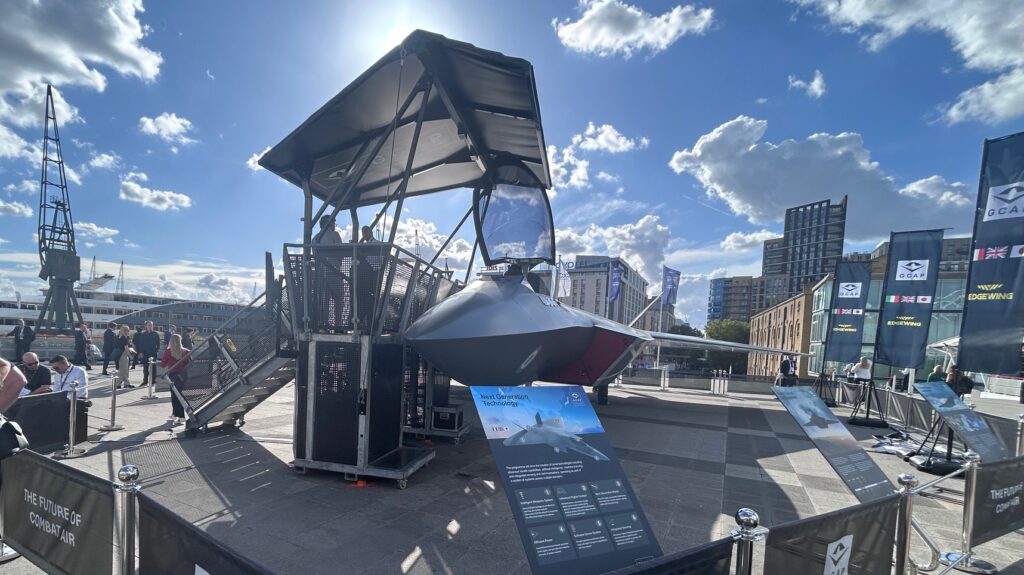
DSEI 2025 — An industry official in a newly formed consortium established to deliver sensors and communication systems for the trilateral Global Combat Air Programme (GCAP) has all but ruled out the potential for other major industry partners to join the program, as questions percolate over public “tension” inside GCAP’s rival European fighter effort.
The UK-led consortium, known as GCAP Electronics Evolution (G2E), launched here at the DSEI trade show in London on Tuesday and comprises Leonardo UK, Leonardo Italy, ELT Group, alongside Japan’s Mitsubishi Electric.
Speaking to reporters about the new consortium, Andrew Howard, director of future combat air at Leonardo UK, poured cold water on the idea that there could be a major shakeup in GCAP’s development team this late into the process.
“[T]hat period where joining the program, leaving the program, defining the workshare, the commercial constructs, was relatively easy, has kind of closed, because we’ve just reached an agreement now on our structures,” Howard told media. “We understand the engineering challenges that we face, and whilst we recognize that change can happen, that the governments [of Italy, Japan and the UK] may direct change, it isn’t our current expectation that the core team will change.”
Howard’s comments come as GCAP’s rival French, German and Spanish Future Combat Air System (FCAS) program faces turmoil because of an ugly industrial dispute between Airbus and Dassault over how to move ahead with a forthcoming technology development phase.
RELATED: ‘Difficulties’ between Airbus and Dassault again hit sixth-gen fighter effort
FCAS sensor development activities are split between Indra Sistemas (prime for Spain), Thales (French lead) and a collection of four German companies (Hensoldt, Diehl Defence, ESG and Rohde & Schwarz) that make up the Future Combat Mission System (FCMS) consortium. Should FCAS falter to the point of collapse, in theory at least, this vast collection of sensor specialists would be free to join GCAP.
But Howard predicted that the FCAS team would weather the storm and that the “German, French, Spanish [FCAS] consortium will deliver what I’m sure will be a very good capability.” (For their part, FCAS industrial leaders have said they’re committed to the project.)
Regarding next steps for G2E, the consortium is targeting the signing of a first “international contract,” though an exact timeframe was not shared. Once the contract is in hand, the consortium will be in a position to “deliver the solution that the GCAP program demands, that the global situation requires,” added Howard.
Edgewing, the threeway industrial joint venture established by BAE Systems, Leonardo and Japan Aircraft Industrial Enhancement Co. Ltd. must first accept and approve a proposal from G2E for sensing and communication requirements, before the new contract is agreed. Howard said that the G2E proposal has not yet been sent to Edgewing.
The sensor consortium is also looking to scale up sensor based aircraft activities that have primarily been the domain of the UK’s Flight Test Aircraft (FTA) Excalibur — a modified Boeing 757 commercial airliner.
Of note, Italy’s “current focus” involves interest in a Gulfstream aircraft, while it is too early to “say exactly what kind of aircraft” Japan will select, said officials from Leonardo Italy and Mitsubishi Electric.
An industrial team behind GCAP’s engine program, made up of Avio Aero (Italy), IHI (Japan) and Rolls-Royce also announced a “major” partnership expansion on Tuesday to hasten the pace of the next generation fighter jets power and propulsion.
“This step represents the transition from national contracting to fully integrated international collaboration, laying the foundation for the detailed design and development of GCAP’s all-new fighter engine,” said Rolls Royce in a company statement. “This development builds on the successful progress of the all-new centreline GCAP engine demonstrator.”
The new agreement gives the trilateral group freedom to directly engage with Edgewing.
Rolls Royce added that “advancing technologies in additive manufacturing, cooling systems and high-pressure compressor design” have all contributing to delivery of engine demonstrator progress.
Breaking Defense Video