
STOCKHOLM — The next Swedish government may consider bringing back an old idea: the government taking an ownership stake in national defense champion Saab.
Peter Hultqvist served as defense minister from 2014 to 2022, and with surveys showing the red-green opposition bloc leading the incumbent right wing government by more than 10 percentage points, he could well end up taking his old seat back following Sweden’s Sept. 13 parliamentary elections. (Asked about his interest in the role, his response was, “I’m available.”)
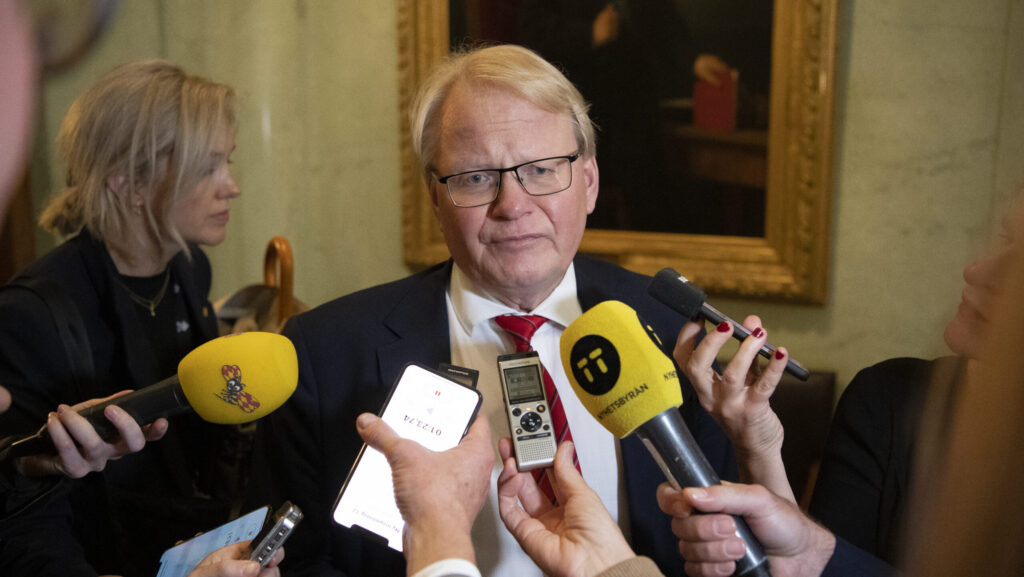
Speaking to Breaking Defense on the sidelines of a June 12 meeting of the Swedish Defense Commission (Försvarsberedningen), Hultqvist, his party’s representative to the commission, threw his weight behind the idea that the government should have some ownership of one of Europe’s biggest defense industries.
“Well, technically speaking, exactly how it would be done is something we can come back to when it becomes relevant. But we [the Social Democrats] have said that we are interested, from our side, in part-ownership in, for example, Saab — because Saab is an industry that is so important to Sweden, and moreover has responsibility for submarines, sensors, and fighter aircraft,” Hultqvist said in an interview.
He added that these defense platforms are Swedish “core interests and essential security interests. So I think state part-ownership in Saab would be natural, while at the same time signaling strong Swedish team-building in international contexts.”
Saab spokesperson Mattias Rådström told Breaking Defense, “We have taken note of the information regarding the proposal, but we will not comment on it further. Owner-related matters are for the owners to address.”
The idea has support from Hultqvist’s Social Democrats, but also from a potential supporting partner, the Left Party (Vänsterpartiet).


MQ-9B and Gambit Series: Advancing European Defense Capabilities
GA-ASI will build Gambit aircraft in Europe, partnered with European-based companies, with airframes available for international procurement starting in 2027.
“We are positive about it,” the Left Party’s representative on the Defense Commission, Hanna Gunnarsson told Breaking Defense. “Total defense must be built as a whole together with all the different parties: the state, business and industry, the voluntary non-profit sector, and the municipalities.”
However, Gunnarsson emphasized, “We’re probably not talking about nationalization or anything like that.”
The Moderate Party, which has led the current government since the 2022 election, is less convinced.
“I think it would be a very bad idea, to put it mildly,” said Jörgen Berglund, chairman of the Defense Commission. “The Swedish defense industry has survived and remains strong precisely because it is private.”
In 2000, the Swedish state sold its 25 percent ownership stake (61.7 percent of the votes) in the defense group Celsius to Saab as part of a larger acquisition deal. The transaction completed the privatization of much of Sweden’s defense industry, shifting major production capabilities in submarines, missiles, and artillery from state control to private ownership under Saab.
Hultqvist is perhaps most famous for his longstanding opposition to Sweden joining NATO, having developed the so-called “Hultqvist doctrine,” which eschewed joining the alliance in favor of bilateral defense cooperation with the United States and the United Kingdom, as well as with other nations on NATO’s northern flank.
“There will be no applications for any membership as long as I am part of a Social Democratic government,” he stated at the Social Democrats’ party congress in November 2021. “I will definitely never, as long as I am [the] Minister of Defense, participate in such a process. I can guarantee that to everyone.”
However, Hultqvist changed his position after Russia’s full-scale invasion of Ukraine. His government applied for NATO membership in May 2022, and Sweden formally joined the alliance in March 2024 under the current right wing government with Pål Jonson as defense minister.
If Hultqvist returns, there should be no risk of an attempt to disengage from NATO, as the Social Democrats have remained openly supportive of the alliance since joining.
Other signs of where Sweden may go in defense were on display Friday, when the Försvarsberedningen released its preliminary report. The full report will come sometime after polls close in September, no later than Nov. 20.
The cross-party commission’s joint statement warned that the security policy situation remains serious, with a clear “risk of rapid deterioration.” Russia is described as the determining long-term threat, and the report cautions that Russian military actions – such as testing NATO’s cohesion and Article 5 – “could occur in the relatively near future if the Kremlin sees favourable political conditions.”
The warning comes after Sweden’s Supreme Commander, Gen. Michael Claesson, has repeatedly raised the alarm about a possible Russian attack in the Baltic region. In April, he told the media that Russia could seize a Baltic island such as Gotland “at any time” or “as soon as tomorrow” to test NATO’s cohesion and Article 5. He repeated the message in May.
The joint statement from the commission stresses the importance of urgently continuing the strengthening of Sweden’s total defence and underlines that sustained, substantial Swedish support for Ukraine remains central.