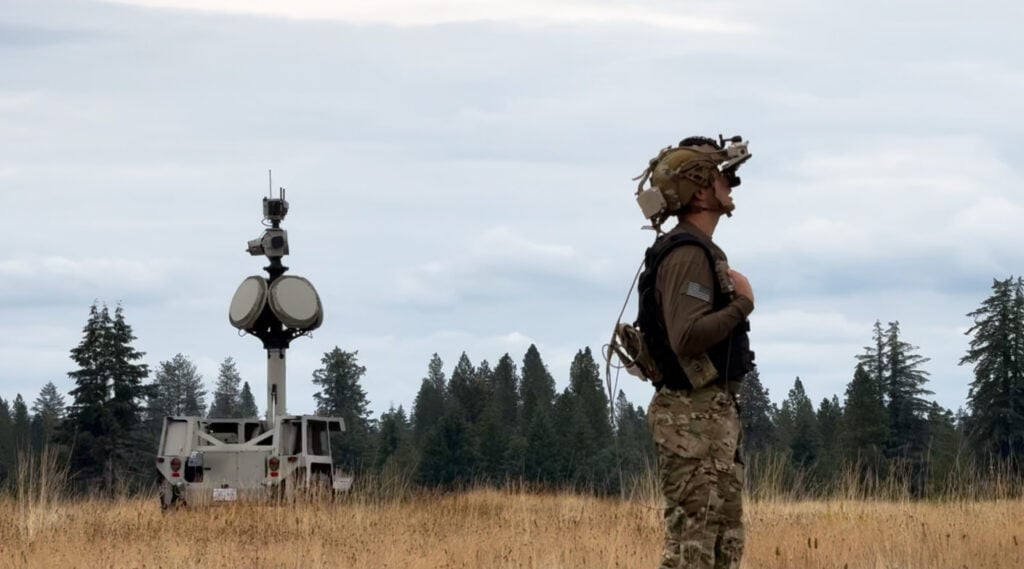
WASHINGTON — The US Army has selected an Anduril team and startup firm Rivet for its Integrated Visual Augmentation System (IVAS) redo, and will ask them to deliver hundreds of mixed-reality, heads-up displays for testing, according to a trio of industry and service sources.
Now called the Soldier-Borne Mission Command (SBMC), an Army official confirmed last week that the service was planning to ink deals with both competitors, and two industry sources now say those deals are done.
“We have an incredibly legitimate solution that exists today, and one that we’ve tested in the field numerous times, including with Army soldiers in operational conditions,” said Rivet CEO David Marra, who previously headed up the Microsoft team that held the original IVAS contract. “We’ve proven that it is a viable solution that exceeds the Army’s requirements.”
Based off photos on its website, Rivet, a new startup funded in part by Palantir, is focusing on heads-up displays that closely resemble glasses. Marra said his company now has a signed a $195 million contract with the Army that will cover an 18-month rapid prototyping sprint. Those dollars, he said, will be used to continue engineering and testing work, and the production of 470 “production representative” devices.
Rivet’s design, he added, is meant to be comfortable for soldiers to wear for the “duration of missions,” is ruggedized to operate in austere conditions, increase situational awareness and comply with a host of regulations governing supply chain and security regulations.
However, as a new firm, Rivet faced steep competition in getting selected, as it is going up against two darlings of Silicon Valley in Anduril and Meta, who announced in May a partnership to “design, build, and field” a range of integrated XR products with military applications.
Palmer Luckey, who rose to prominence after developing the civilian Oculus augmented reality headset, eventually sold that company and device to Facebook (now Meta) in 2014. After a well-documented political fallout with people inside the company, Luckey set off and launched Anduril.

Power at the sprocket: it’s the transmission that gives tracked vehicles their control
Army vehicles like Bradley need greater power at the sprocket for speed, braking, and manueverability.
While Anduril and Meta did not disclose their SBMC bid plans, the Anduril founder has been teasing a new mixed-reality device called Eagle Eye. A company spokesperson previously said that Eagle Eye is actually an ecosystem of augmented reality devices and will be the centerpiece of the duo’s bid.
While an Anduril spokesperson declined to disclose if the company has signed a deal with the Army for continued SBMC development, an Army official and an industry source have confirmed that the team has also been selected.
The Army did not respond to multiple requests for comment on the state of the program to include if there could be other contract awards in the wings.
Today’s news comes after years of questions about the fate of the IVAS program. In 2018, the Army picked Microsoft’s commercially available HoloLens 2 heads-up display for the IVAS program and eventually awarded the company a 10-year, $22 billion production deal. The idea was to produce a mixed-reality capability suitable for both combat and virtual training, including under the cover of darkness.
While the Army kept plugging away on IVAS development, the device was plagued with problems that ranged from soldiers complaining of cyber sickness symptoms like nausea and visual discomfort to software glitches.
Then after years of fits, starts, and redesigns, the service moved ahead with a plan to recompete the hardware earlier this year and officially asked industry to submit viable options for the SBMC competition.
In April, Anduril officially assumed oversight of the original multi-billion-dollar IVAS production deal which is expected to home in on the data architecture.
“There’s no new hardware on the existing IVAS contract that Anduril is responsible for delivering, but what we’re going to be delivering is the software functionality on top of those existing headsets,” Anduril’s Senior Vice President of Engineering Tom Keane said at the time. Despite the contract novation, the service continued onward with SBMC, ultimately selecting the two teams.
Breaking Defense Video