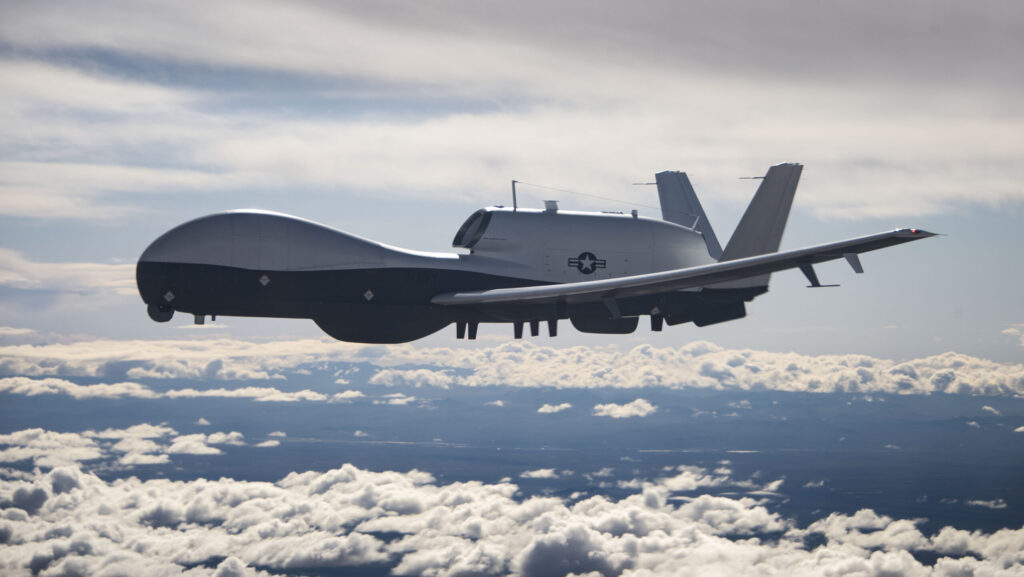
WASHINGTON — The US Navy failed to correct certain issues with its new unmanned surveillance aircraft ahead of green-lighting it for operations, according to a recently published government audit.
“These aircraft have deficiencies that could prevent them from accomplishing missions,” a new Defense Department Inspector General report on the MQ-4 Triton reads. “The Navy has also spent $83.1 million to retrofit two MQ-4C Triton unmanned aircraft to the latest version and will need to spend additional money to retrofit the MQ-4C Triton to correct the open deficiencies.”
MQ-4C Triton is an unmanned aircraft produced by Northrop Grumman and focused on intelligence collection. The program, initiated in 2008, has delivered 20 aircraft to date, which were the focus of the DoD IG’s report, with plans to procure 27 in total.
Auditors in the Sept. 4 report said the Navy “did not effectively manage the operational capabilities” of the aircraft program. They also found the service pushed ahead with declaring initial operational capability — a Pentagon acquisition milestone indicating a program is ready for early use — without correcting a redacted number of known deficiencies.
“This occurred because the Navy determined that the MQ‑4C Triton was beneficial to the fleet despite the open deficiencies and therefore declared Initial Operational Capability (IOC) in August 2023 before conducting” initial operational test and evaluation (IOT&E), according to the report.
In a response attached to the DoD IG’s report, Robert Kimble, a senior Navy civilian overseeing air and ground programs, wrote that the service is working through correcting remaining deficiencies on Triton and anticipates it will complete IOT&E by November 2025.
Kimble “partially concurred” with the DoD IG’s recommendation to distribute guidance to “limit the circumstances” when a program declares IOC prior to completing the associated test and evaluation. He wrote that while the Navy agrees with the “intent” of the recommendation, current policy allows program managers to approve a “tailored structure of programs” in the interest of balancing risk against the need for a capability.