Networks & Digital Warfare

Army eyes larger all-source intelligence support to EW

As the Army improves its EW acumen, it needs more intelligence sources to support operations.

U.S. Army Spc. Henry Fridy, assigned to 1st Armored Brigade Combat Team, 3rd Infantry Division, configures the Beast+ electronic warfare system during Combined Resolve 25-02 at the Joint Multinational Readiness Center on Hohenfels Training Area, Hohenfels, Germany, May 7, 2025. (U.S. Army photo by Pfc. Carlos Marquez)

AUSA 2025 — Electronic warfare has come to dominate the modern battlespace, and the Army is going to need greater all-source intelligence — using information from humans, signals, satellites and more — according to an army official. looking at greater all-source intelligence to support and inform electromagnetic warfare.

“We have to look at how all-source is supporting EW. We have to look at how HUMINT [human intelligence] is supporting EW through battle letter and through how their questions are flowing out to individuals that they’re interviewing,” Col. John Shemer, Army capability manager for intel sensors at the Intelligence Center of Excellence, said during a presentation at the annual AUSA conference. “We have to look at how counter intelligence is supporting EW, because they provide the baseline that is going to give all of our EW services … the protection that they need in order to be effective.”

Overall, Shemar said the Army needs to “look holistically internal[ly] to intelligence. In the past we would call it IEW. It’d be largely SIGINT [signals intelligence] related support to electromagnetic warfare. But when you look at the Department’s electromagnetic spectrum strategy. It’s more holistic than that.”

The service divested much of its electronic warfare capability after the Cold War. In the years since, the Army has sought not only to rebuild its arsenal, but its acumen in the spectrum against adversaries that are adept at maneuvering in the invisible domain, and it is now looking at more mature methods to inform its electronic warfare forces.

Signals intelligence and electronic warfare have been tightly coupled as there is a fine line between the two. But the battlefield of the future will be much more complex, and more sources will be needed to inform forces of their battlespace and what targets to jam. This will be important given that once forces decide to jam, they reveal their location to the enemy as well.

A potential example of all-source intel aiding the service, Shemer noted, is how geospatial intelligence could help inform units that what might look like an emitter on the battlefield based on its electromagnetic signature, could actually be something else.

“A GEOINT capability would detect that the emitter is not actually the target that you’re looking for. It’s not tank. It’s something else. It may look like a tank and smell like a tank, but through some geo technique, it is not a tank,” he said. “Then that flows through the all-source and that then informs the EW targeting layer that is going to go out and do their work on the battlefield.”

PHOTOS: AUSA 2025

PHOTOS: AUSA 2025

A view of a show floor at the 2025 Association of the US Army's Annual Meeting & Exposition in Washington, DC, Oct. 13, 2025. (Rachel Cohen/Breaking Defense)
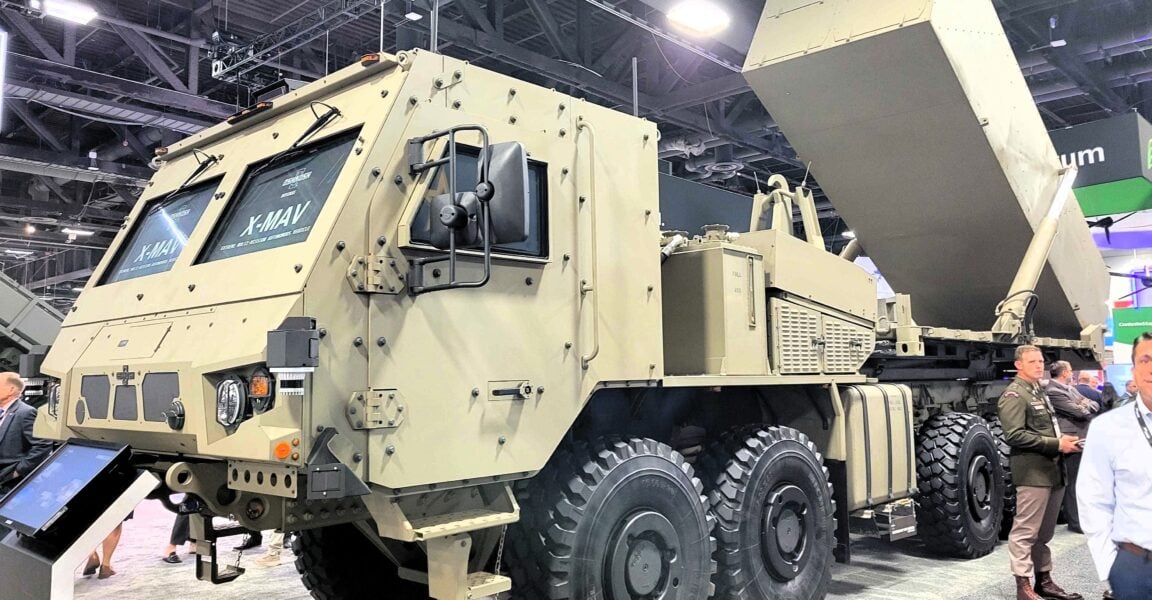
Oshkosh Defense debuts its Extreme Multi-Mission Autonomous Vehicle (X-MAV), an "autonomous-capable launcher solution that is engineered to support the future of long-range munitions," Oct. 13, 2025, at the Association of the US Army's Annual Meeting & Exposition in Washington, DC. (Rachel Cohen/Breaking Defense)
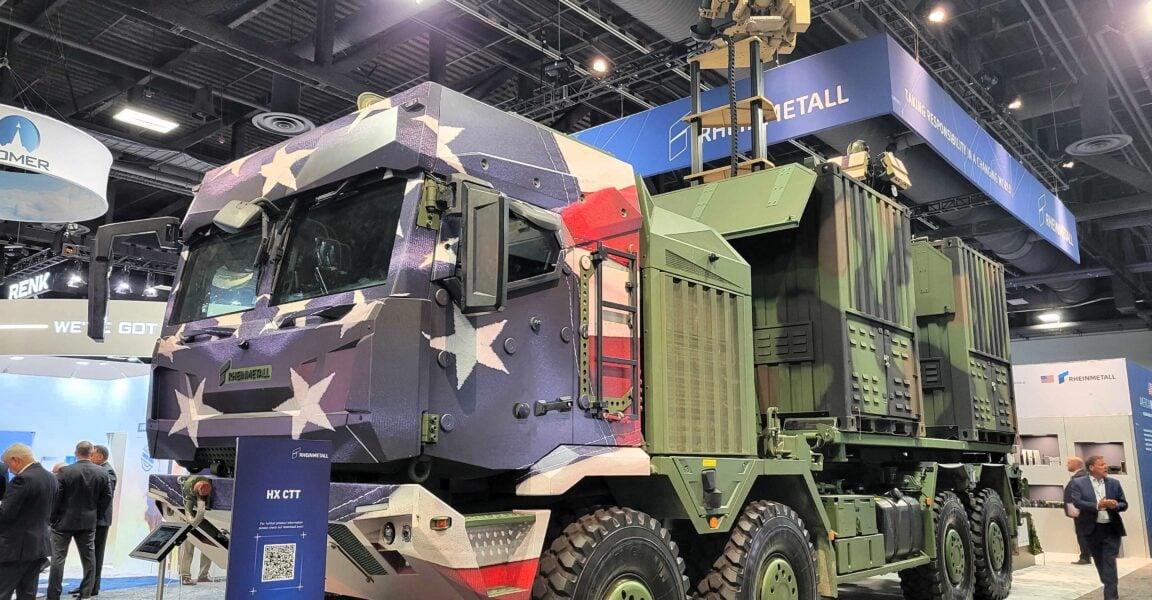
Rheinmetall brought its HX Common Tactical Truck, built in partnership with GM Defense, to the Association of the US Army's Annual Meeting & Exposition, Oct. 13, 2025. (Rachel Cohen/Breaking Defense)
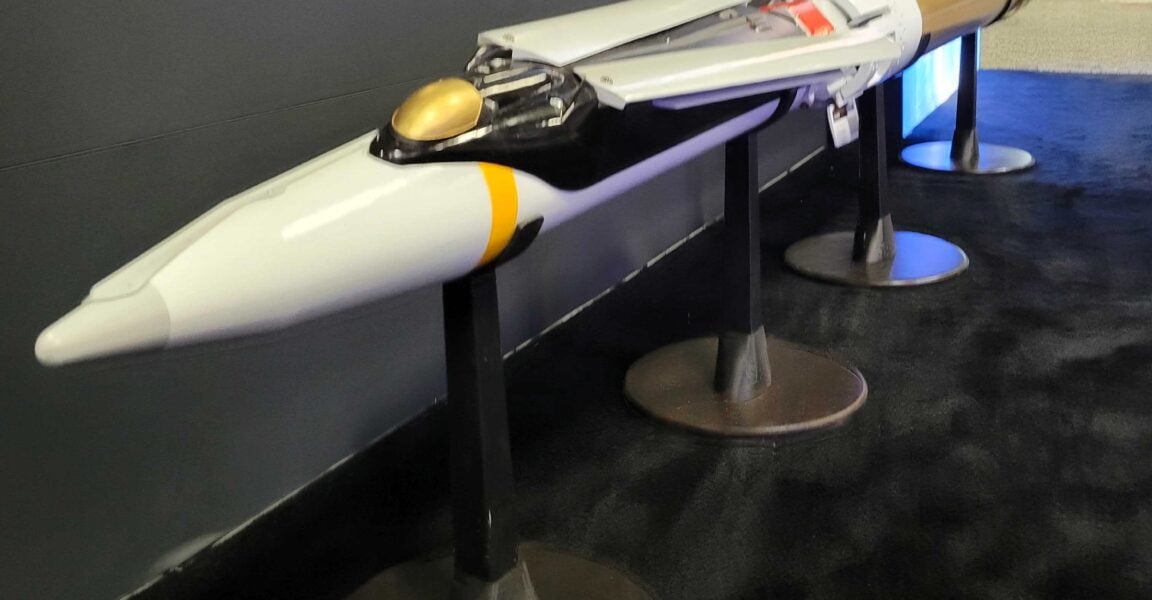
Saab's Ground-Launched Small Diameter Bomb is based on Boeing's SDB and Lockheed Martin's Multiple Launch Rocket System. (Rachel Cohen/Breaking Defense)
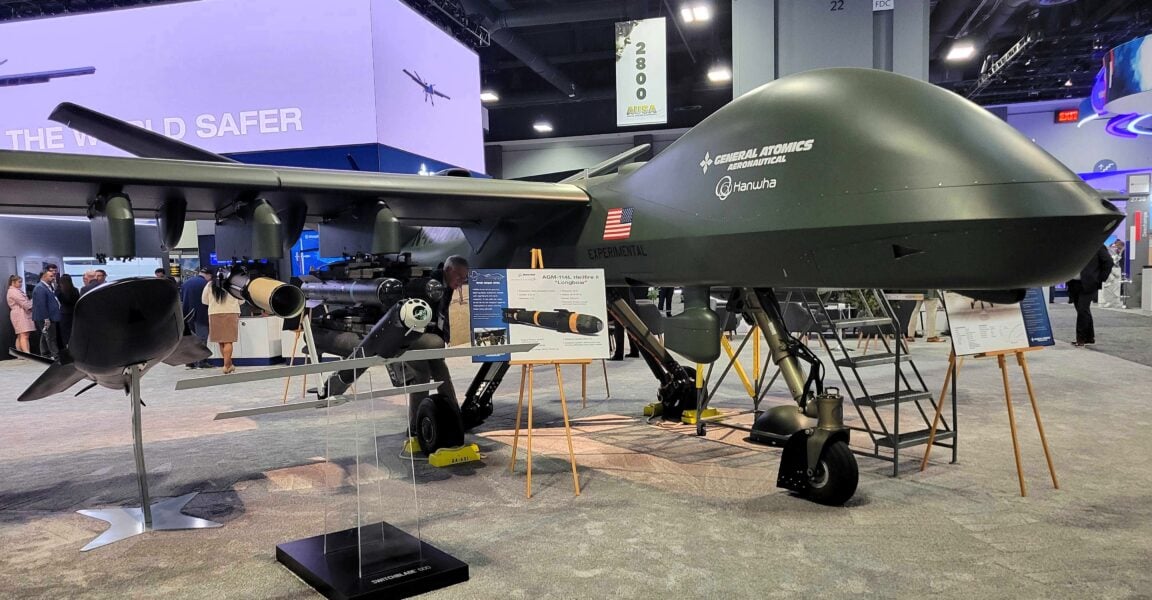
General Atomics Aeronautical Systems and Hanwha Aerospace are collaborating on a short takeoff-and-landing version of the MQ-1C Gray Eagle drone. (Rachel Cohen/Breaking Defense)
Rafael's Iron Beam is a 100kW-class laser weapon on track for operational use this year. (Aaron Mehta/Breaking Defense)
Honeywell's SAMURAI anti-drone system is one of myriad counter-drone technologies on display at AUSA 2025. (Daniel Woolfolk/Breaking Defense)
Hanwha Defense USA pitches its 155 mm, 52-caliber K9 Thunder self-propelled howitzer at the Association of the US Army's Annual Meeting & Exposition in Washington, DC. (Rachel Cohen/Breaking Defense)
Conference attendees try out Trijicon's firearm sights and scopes. (Aaron Mehta/Breaking Defense)
Attendees roam the halls of the Walter E. Washington Convention Center in downtown Washington, DC, Oct. 13, 2025. (Daniel Woolfolk/Breaking Defense)
The Bell 505 Jet Ranger X is a contender for the Army's Flight School Next program. (Daniel Woolfolk/Breaking Defense)
GM Defense's Infantry Squad Vehicle-Utility is based on the Chevrolet Colorado ZR2 and can be adapted to carry mortars, counter-drone equipment and more. (Aaron Mehta/Breaking Defense)
Name a more iconic duo. I'll wait. (Aaron Mehta/Breaking Defense)
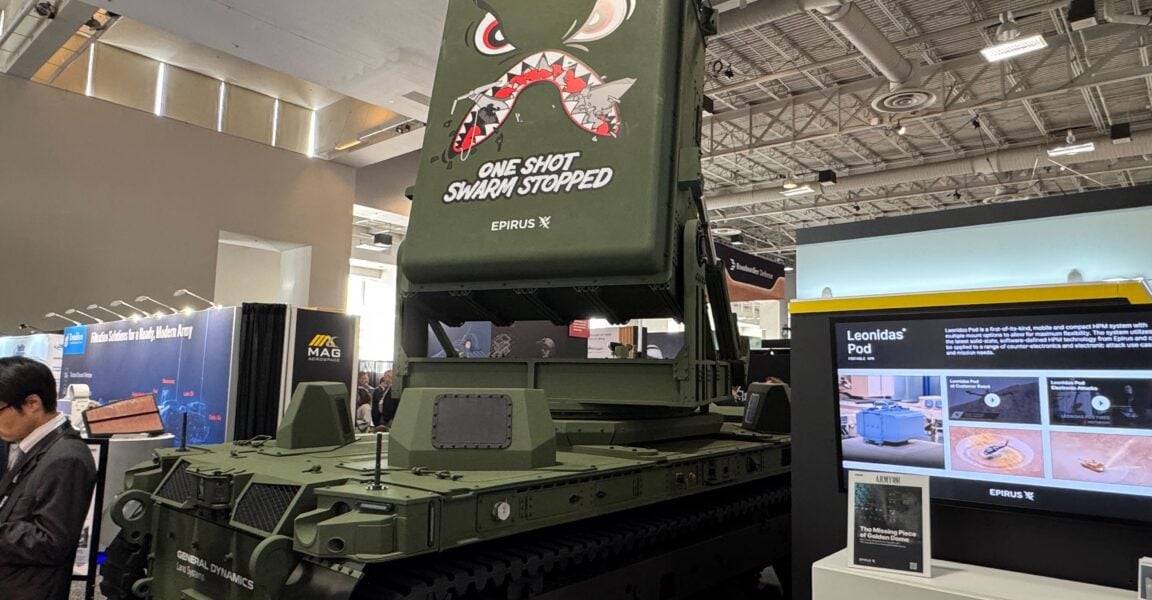
Epirus’s Leonidas high-powered microwave system is mounted on top of a General Dynamics land vehicle. (Michael Marrow/Breaking Defense)
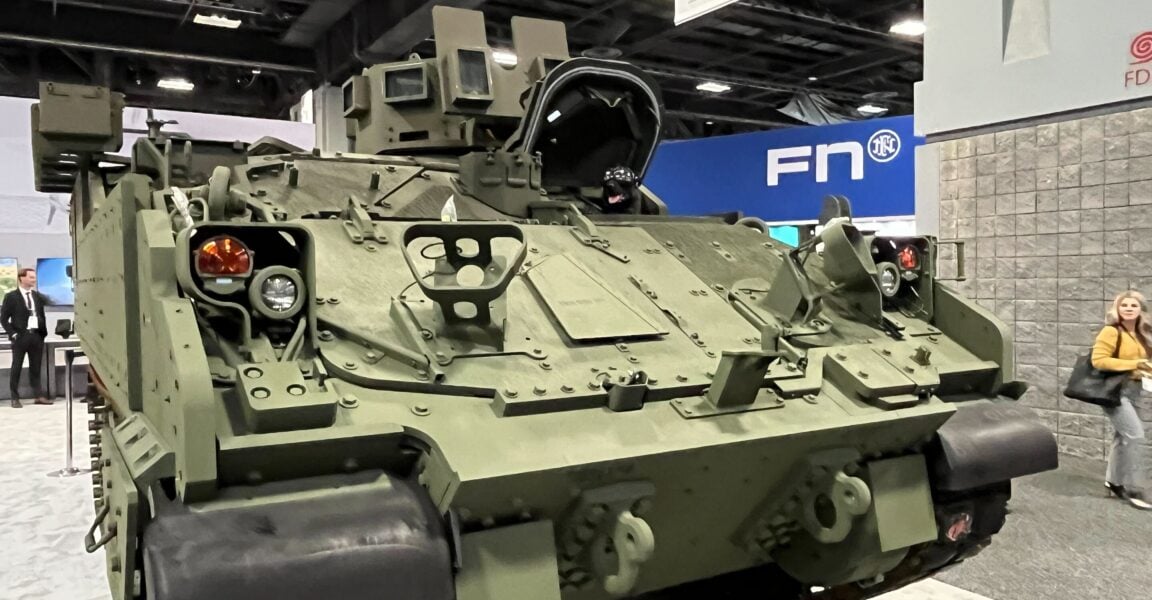
A four-legged attendee checks whether the infantry carrier variant of BAE Systems' Armored Multi-Purpose Vehicle can also carry canines. (Sydney Freedberg/Breaking Defense)
It wouldn't be a defense trade show in 2025 without a robot dog on hand. (Aaron Mehta/Breaking Defense)
Honeywell showcases a hybrid quadcopter/fixed-wing drone on the show floor. (Aaron Mehta/Breaking Defense)
RTX displays its missiles and a Lower Tier Air and Missile Defense Sensor. (Aaron Mehta/Breaking Defense)