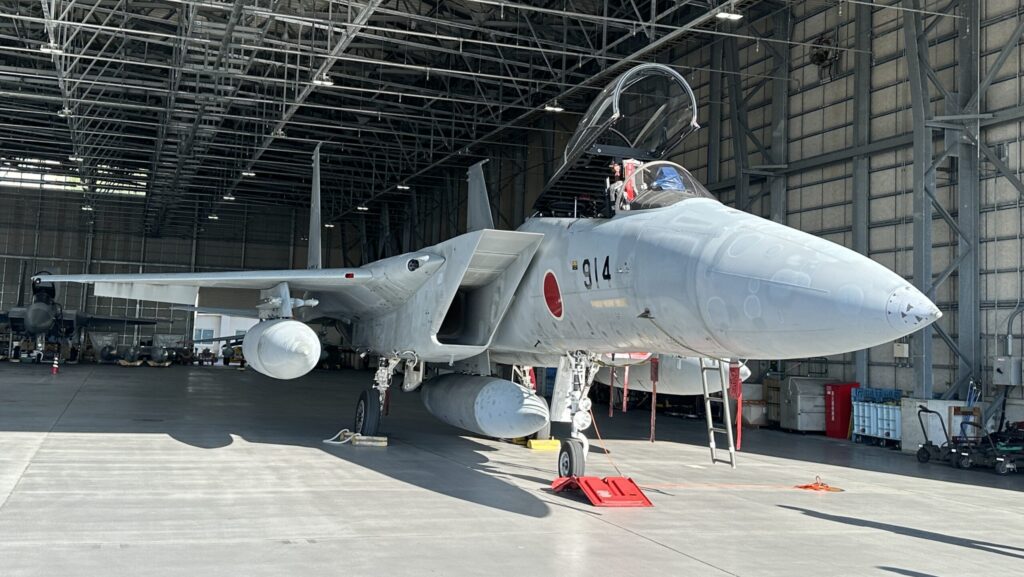
NAHA, Japan — Two of the nine Japan Air Self Defense Force (JASDF) frontline fighter squadrons are responsible for an average of between 60 to 70 percent of occasions where Japan scrambles its fighter jets to investigate unidentified aircraft in its air defense zone in recent years, primarily from China, according to the chief of staff of the regional air defense command. This year, however, they fell just shy of that number.
The two squadrons, the 204th and 304th Hikōtai, operate from Naha Air Base on the island of Okinawa, the largest in an archipelago that stretches from southern Japan to Taiwan and makes up JASDF’s Southwestern Air Defense Force. Both units fly the Mitsubishi F-15J Eagle interceptor, which is similar externally to the US Air Force’s F-15C, along with a handful of F-15DJ twin-seaters and Kawasaki T-4 trainers with each unit having approximately 20 aircraft on strength.
Col. Hideo Kiyonaga, chief of staff at the headquarters of the Southwestern Air Defense Force, told Breaking Defense during a visit to Naha Airbase that his command was responsible for securing an area of Japan’s Air Defense Identification Zone (ADIZ) measuring some 920 by 780 kilometers (575 by 488 miles), which he noted could fit the entirety of Honshu, the largest of Japan’s three main islands, within it.
Other JASDF assets based at Naha include a squadron of Northrop Grumman E-2C/D Hawkeye Airborne Early Warning and Control (AEW&C) aircraft and CH-47J Chinook helicopters and U-125 aircraft belonging to its Air Rescue Wing.
Given its location, Naha has been the main base from which the JASDF has reacted to increased Chinese military air activity for more than a decade, with the base’s F-15s scrambling on 411 occasions during the last Japanese fiscal year (which runs from April 1 to March 31 the following year).
This represents 58 percent of the 704 scrambles the JASDF undertook over the last fiscal year, for which 464 were activated in response to Chinese aircraft in Japan’s ADIZ. Last fiscal year’s figure falls just short of the average of 60-70 percent.
In addition to its air assets, the Southwestern Air Defense Force also has five ground-based radar stations and four sites for ground-based air defense systems located in its area of responsibility, and Kiyonaga said that air policing was the fundamental mission of the command.
“We conduct surveillance of Japan’s airspace in the area on a 24/7 basis and maintain readiness for any situation by utilizing all the systems and assets available to us,” he added.
Its area of responsibility also includes the airspace over the Senkaku islands in the East China Sea, which is also claimed by China and whose own ADIZ overlaps with Japan’s in the area. A country’s ADIZ is not its territorial airspace but self-declared airspace where unidentified aircraft are tracked, located, and/or identified in the interests of its national security.
The JASDF’s requirement is for the first Quick Reaction Alert (QRA) fighters to be airborne within five minutes upon being activated during a scramble. Despite the operational demands placed on it, the Southwestern Air Defense Force is the smallest of JASDF’s four regional commands in terms of air strength and airbases, according to Kiyonaga.
According to data published by Japan’s Ministry of Defense, JASDF scrambles against Chinese aircraft in its ADIZ started picking up in 2012, when it started to surpass that of Russia’s, which had, until then, been the leading cause of Japan launching its fighters against aircraft in its ADIZ.
At that time, the only JASDF fighter squadron at Naha was the 204th Hikōtai, which bore the brunt of such scrambles until 2016, when the 304th was reassigned to Naha from its former home at Tsuiki in Japan’s southern main island of Kyushu.
This was also the year overall JASDF scrambles peaked, with the 851 out of 1,168 JASDF scrambles conducted against Chinese aircraft driving the number, and Kiyonaga noted that approximately 80 percent of those were flown out of Naha.
“Conducting scrambles requires a lot of effort, but it is important to show our strong intention to protect Japan’s airspace,” said Kiyonaga, who added that “it got to the point [at the peak of the scrambles] where we had to rotate F-15 crews from elsewhere to Naha to fly some of the scramble missions.”
It was also around this time the Japan revised the triggers for scrambling its aircraft to reduce the strain on aircraft and personnel, instead relying more on monitoring unidentified aircraft in its ADIZ and only scrambling fighters if they appeared to pose an imminent threat.
The JASDF’s current fleet of almost 200 F-15s were built by Mitsubishi under license from McDonnell-Douglas between 1980 and 1998. Japan is beginning to replace some of the older F-15s with the Lockheed-Martin F-35A Lightning II Joint Strike Fighter, with a F-15 squadron at Komatsu in Japan’s west coast currently transitioning to the fifth-generation fighter.
Japan also has plans to upgrade some of the newer aircraft, which were built to what is known as the Multi-Stage Improvement Program (MSIP) standard, with new avionics including a new mission computer, BAE Systems’ Eagle Passive Active Warning Survivability System (EPAWSS) electronic warfare suite and Raytheon AN/APG-82(V)1 Active Electronically Scanned Array (AESA) radar.
However, the program has faced several hurdles including skyrocketing costs, which has led Japan to downsize the number of aircraft that will undergo the upgrade from 68 to 54, according to the country’s latest Defense White Paper.
Both Naha squadrons operate a mix of pre- and post-MSIP aircraft, although Col. Kiyonaga declined to answer questions on whether the squadrons will receive F-35s or upgraded F-15s, instead referring Breaking Defense to Japan’s defense ministry.