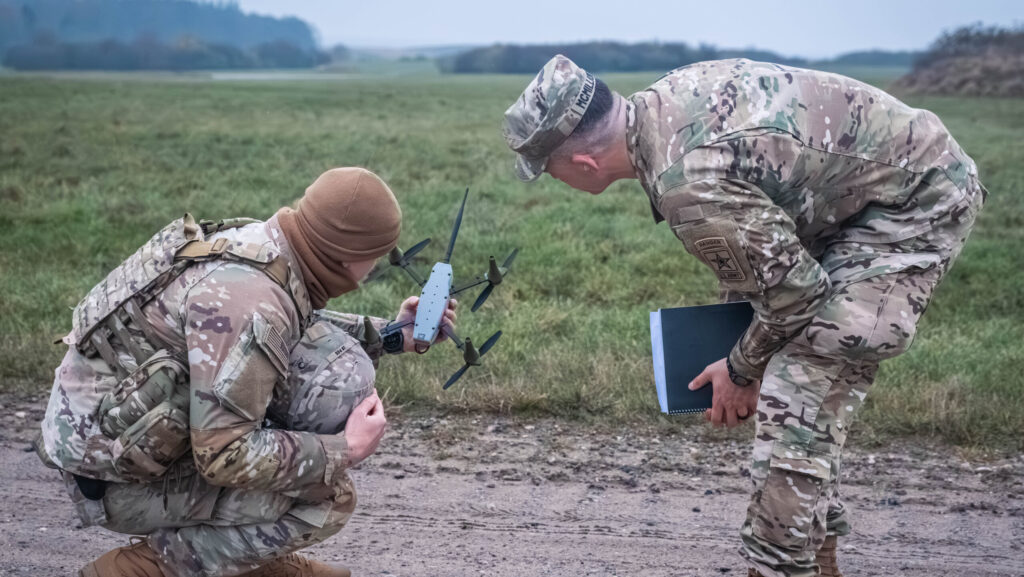
WASHINGTON — As Eastern European nations look to guard against the ever-growing threat from unmanned systems, a US Army contingent on the continent recently evaluated a host of industry counter-unmanned system offerings, choosing a handful of winners to join a fast-track acquisition system, while other US soldiers drilled with allied nations to refine c-UAS tactics.
“Both these efforts were about strengthening NATO’s Eastern point deterrence line against the drone threats, specifically against what we’ve called one-way attack drones,” Brig. Gen. Curtis King, chief of the 10th Army Air and Missile Defense Command, told a small group of reporters today.
During one exercise, Project Flytrap 4.5 which took place from Nov. 10 – 21 in Germany, the US Army and vendors from the US and allied nations hosted a competition to counter simulated threats from Group 1-3 (small- to medium-sized) drones operating in NATO airspace. It’s a hypothetical not too far from recent reality, in the wake of several incidents of suspicious drones sightings over key sites in Europe.
For the latest edition of Flytrap, the Army was keen to evaluate systems that could either detect, discriminate or defeat drones using active sensors, passive sensors or kinetic interceptors.
Project Flytrap is an ongoing exercise led by the US Army intended to showcase innovative c-UAS solutions with NATO countries.
Out of the 20 companies who showcased their platforms, four companies were awarded $350,000 and were entered into the Army’s new Global Tactical Edge Directorate (G-TEAD) Marketplace where Army units and allied nations can go in and purchase a capability. The marketplace is a part of the larger G-TEAD program, a new acquisition pathway designed to speed up the delivery of operationally ready equipment and software to the Army and allied and partner nations.
RELATED: Army on the hunt for counter-drone tech as firms show off c-UAS solutions

The uncrewed revolution: MQ-9B and Gambit Series forge a path to regional air dominance
The MQ-9B and Gambit Series represent parallel capabilities that address global challenges for security head-on.
The Army identified the winning firms as AG3 Labs for its threat simulation tools, Armaments Research Company for its AI-enabled sensor capabilities, MatrixSpace for its suite of radar capabilities and Mountain Horse Solutions for its passive seeker and sensing systems and non-kinetic/kinetic engagement platforms.
After the culmination of Flytrap, the four companies’ products were left behind in soldier’s hands, allowing commanders to continuously assess the equipment and provide feedback to industry, according to Col. Christopher Hill, senior director of the G-TEAD program.
“The expectation is [that] those companies would have made iterative improvements to their capability based on direct feedback from the soldiers,” Hill told reporters. He added that during this iteration of Flytrap, industry was able to make updates right there in the field while embedded with soldiers, including improving user interfaces and data flow.
“Based on our soldiers and our industry partners talking and working together, we did things in 24, 48 [or] 72 hours,” he said. “If we’d done this through our normal processes, it might have taken us six months.”
The whole point of G-TEAD and its respective marketplace, Hill said, is to “bring the Army acquisition enterprise to the tactical edge.”
“There’s been a lot of press over in the United States about how slow our acquisition process is and how bureaucratic it can be, and how fast warfare moves, and how the acquisition process cannot keep up with the pace of warfare. So, what we were asked to do was to put together a very small, focused team, which we have, and we brought [that] here to Europe,” he said.
Drone-On-Drone Take Downs
Meanwhile, as Flytrap 4.5 was going on, other American soldiers from the 10th Army Air and Missile Defense Command joined their Polish and Romanian counterparts to train together for 10 days, learning how to operate the American-made Merops counter-drone platform.
The platform, which was developed by the US company Project Eagle, launches an interceptor drone called the Surveyor from the back of a military vehicle. Using a variety of sensors and artificial intelligence tools, the Surveyor then finds and intercepts drone threats.
The platform has been used in Ukraine to defeat Russian drone threats, King said, adding that they are mostly used against the ubiquitous cheap, Iranian-made one-way attack drones known as Shahed. King explained that the days of using multi-million dollar interceptors to take down drones worth at most thousands of dollars are likely over.
“This may become the optimal or this might become the first choice to engage [Shaheds] because it’s lethal, but also because it costs about a tenth of what a Shahed drone costs,” King said. “So we’re also demonstrating how we’re being cost effective. We’re maintaining our lethality, but we’re also being cost effective as we move forward.”
Though Ukrainians have successfully fired the Merops system for over 18 months, it takes time to integrate the sensors and set up the network for the system, King said. So after 10 days of training, US, Polish and Romanian soldiers were able to successfully facilitate a live demonstration of the platform for the first time on Nov. 18, King said.
“We trained on the system, and we configured the system technically based on how the Ukrainians had done it and then to have a successful live fire demonstration, that shows that we’re moving very quickly with industry,” King said. “To be able to not just get a capability here, but to make rapid adjustments to those systems, whether that be a radar, whether that be an effector, we were able to make adjustments to the software to ensure that we optimize that system to be very lethal.”