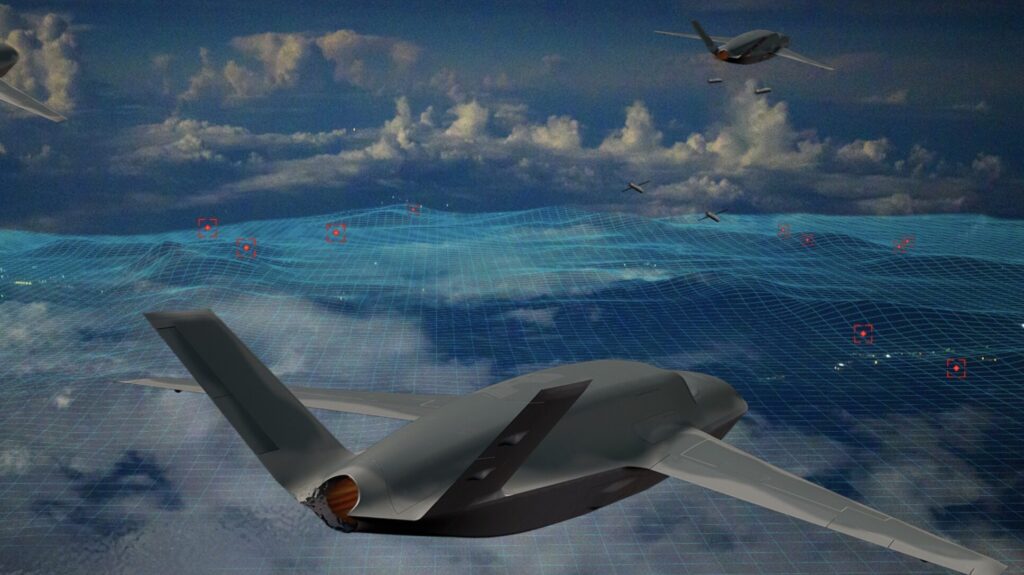
ROME — Manufacturer General Atomics Aeronautical Systems, Inc. (GA-ASI) expanded its Gambit unmanned Collaborative Combat Aircraft (CCA) series today with a new platform built for air-to-ground operations.
The Gambit 6 drone was announced at the Defence IQ International Fighter conference in Rome and is built around the concept of “getting after” Suppression of Enemy Air Defense (SEAD) and deep precision strike missions, said Patrick “Mike” Shortsleeve, vice president of DoD strategic development at General Atomics.
Western air forces, including the US Air Force, are eyeing CCAs or drone wingmen to increase combat mass, through high levels of automation and reduce reliance on crewed fighters.
“The modular architecture and signature-reducing internal weapons bay of Gambit 6 allow for easy integration of advanced autonomy, sensors, and weapons systems, ensuring the aircraft can adapt to a wide range of operational scenarios,” GA-ASI president David R. Alexander said in a supporting company statement.
GA-ASI added that international customers will be able to acquire Gambit 6 from 2027, ahead of European “missionized versions” eligible for delivery in 2029.
The foundation of Gambit is a common “core” that comprises systems including landing gear, avionics and chassis. Together these systems, say GA-ASI, encompass around 70 percent of the entire aircraft cost. This approach, stresses company literature, enables cost reduction, enhanced interoperability and speeds development of Gambit variants.
Shortsleeve noted that mass producing the core means that a wider range of subsystems can be integrated from “different wings” to “different engines” and it can also support outer mold line changes.
“We’ve done that in several designs, but we’re actually doing [this] in [the] real world,” scenarios, he shared and as exemplified through development and flight testing of the XQ-67A, which sits under the US Air Force’s Off Board Sensing Station (OBSS) program.
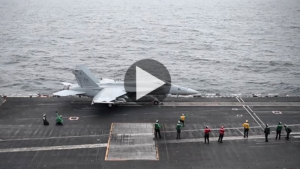
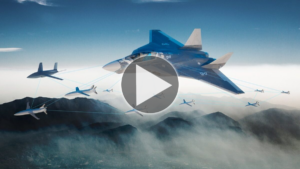
Gambit 6 builds off the existing product family that covers long range ISR, air-to-air combat, advanced trainer, stealth combat reconnaissance and ship-based/carrier-capable CCA types.
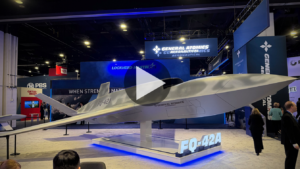
In August, Gambit 2, the air-to-air variant, made its maiden flight, with “multiple flights” taking place since then, said Shortsleeve, in reference to the company’s YFQ-42A. A second of the type has also taken flight, he shared, without disclosing additional details. That aircraft is one of two candidates competing for the somewhat heated US Air Force’s CCA Increment 1 program, alongside Anduril’s YFQ-44A.
Outlining a future operating picture, Shortsleeve said that “five years from now” CCA swarms, like those involving the Gambit series, will deliver “true human-machine teaming” in conjunction with crewed fighter jets.
He further forecast that “distributed autonomy” will be made a reality by the mid-2030s. At that point, “You’re going to see full formations of unmanned aircraft flying cooperatively around different battlespaces doing ISR [Intelligence, Surveillance and Reconnaissance] jamming, strike, you name it,” he noted.
A decade later, quantum sensing “is going to be a real thing,” said Shortsleeve, stressing that technological advances will let CCA’s autonomously complete “real-time tasking” in communication with one another.
Breaking Defense Video