
WASHINGTON — Defense firms are largely locked and ready to go with their bids to be the Army’s Flight School Next vendor, rushing towards an Oct. 31 deadline to get responses in for the right to train the next generation of helicopter pilots.
Thanks to the government shutdown, that deadline has been pushed back, with the service now aiming for a final initial solicitation at the end of November; the Army now says the program has been placed in an “exception” status for the shutdown, meaning once bids are in, the service can begin working on the program “immediately.”
But the timing does raise a question: Given there are several changes already underway to the Army’s aviation fleet, why is the Army prepared to launch a costly, time-consuming competition with at least half a dozen bidders? For Maj. Gen. Clair Gill, commanding general of the Army Aviation Center of Excellence at Fort Rucker, Alabama, the answer is simple: Wait any longer, and not only will the effort become even more expensive, it won’t get the service the results it needs.
“If I could have done this two years ago, I would. There’s a lot of challenges to going through and doing the analysis,” Gill told reporters earlier this month at the annual AUSA conference. “Why now? Because if we don’t, we’re going to have to recapitalize the fleet that we have, and we’re going to spend more money to create the same aviator, not a better aviator.”
Flight School Next is the Army’s new program for training aviators down at Fort Rucker. The program is looking for a new aircraft and also a new curriculum, with the service wanting to make an award by the end of September 2026, per a new notice published Monday. It’s looking to provide training for 900 to 1,500 rotary wing pilots per year with a period of performance of 26 years.
Currently, Airbus’ UH-72 Lakota serves as the training aircraft for Army aviators. But in a rarity for defense technologies, the issue is that the Lakota is actually too effective for training, as it’s a “very sophisticated aircraft that almost flies itself,” Vice Chief of the Army Gen. James Mingus said earlier this year. With the Army wanting to get aviators back to basic skills to avoid future accidents, at a time when helicopter accidents have been more prevalent, Gill told reporters that the service is looking for a “very simple aircraft.”
“One of the things that we’ve noticed over the last couple years is our accident trends are moving in the wrong direction. When Army senior leaders go out and talk to experienced aviators, they say, ‘What’s going on out here?’ They say, ‘We have a very talented population that’s coming out. They’re inexperienced. They’re very good at systems operations. They’re not very good at flying fundamentals,’’’ Gill said. “So some of that we attribute back to the fact that we have a very advanced trainer.”

The uncrewed revolution: MQ-9B and Gambit Series forge a path to regional air dominance
The MQ-9B and Gambit Series represent parallel capabilities that address global challenges for security head-on.
With Flight School Next, the Army is also looking to shake up the way it acquires both the aircraft and the curriculum. According to a draft commercial solutions opening (CSO), Flight School Next will have a contractor-owned, contractor-operated (COCO) model, which allows the company to own and run the program instead of the government.
With the COCO model, some helicopter vendors are looking to serve as the prime contractor for Flight School Next, but most are serving as a subcontractor. The primes will be responsible for the finances, big-picture repairs and logistical support, while the subs will handle supplying the helicopters, supply chain management, component-level repairs and most of the flight school curriculum.
The reason for having a prime take care of the big-picture logistics is likely so the Army has one entity to blame if things go askew, one industry player said.
“I’ve heard even a number of generals say the train of thought is, they want one throat to choke when things start to go, you know, get messy, and performance is bad,” Ryan Weeks, president and CEO of MD Helicopters, who is planning to compete for Flight School Next, told Breaking Defense.
In the current draft CSO, the Army is requesting that the aircraft for Flight School Next meet a slew of requirements, but the three most prominent are that the aircraft have a turbine single-engine, counterclockwise-rotating rotor system and Instrument Flight Rules (IFR) certification. The certification, awarded by the Federal Aviation Administration, takes around 12 months to complete; it requires certain equipment to be installed for various situations such as low-visibility environments, equipment for anti-icing or de-icing, appropriate warning systems, enforcements for dual generators or backup batteries, and more.
Ahead of the planned Oct. 31 deadline, Breaking Defense spoke with six companies who plan to enter their helos into the competition: Airbus, Bell, Leonardo, Robinson Helicopter Company, MD Helicopters and Enstrom Helicopter. Breaking Defense reached out to additional helicopter vendors, but did not receive a response on if they are planning to compete for Flight School Next.
The Incumbent: Airbus’ UH-72A Lakota
The UH-72A Lakota helicopter has been used by the Army since 2016 for its flight school, following the replacement of the Bell TH-67 training fleet.
While the Lakota is IFR certified and has a counterclockwise rotating system, it has a dual engine, making it unsuitable for Flight School Next if the current requirements hold.
Airbus Director of Washington Operations Steve Burns told Breaking Defense that the Army should not make the training fleet more basic, but if the service is going to change the aircraft, it should not buy a whole new aircraft. Rather, it should modify the Lakota, which the Army already has invested to procure.
“[The Army has] an aircraft now that has the ability to remove all the pilot assist, the stability augmentation and the autopilot features in a very simple way. It is a technique that has been adopted by other countries to include the United Kingdom,” Burns said.
“When looking hard at this, you can’t escape the fact that the Army already owns Lakota and everything else would be … either call it an acquisition, call it a lease agreement, call it a COCO contract, but a new fleet of aircraft is going to have to be produced, and somebody’s going to have to pay for that.”
However, Burns said he doesn’t think the Army should try to make its training fleet more basic because the service is fielding increasingly complex and dual-engine aircraft like the Black Hawks, Apaches and the MV-75s, with the latter the most complex helicopter the service will buy to date. (The MV-75, made by Bell, is the service’s solution to the Future Long-Range Assault Aircraft program. The first prototypes of the MV-75 are scheduled to be delivered at the beginning of fiscal year 2027.)
Bell: The 505
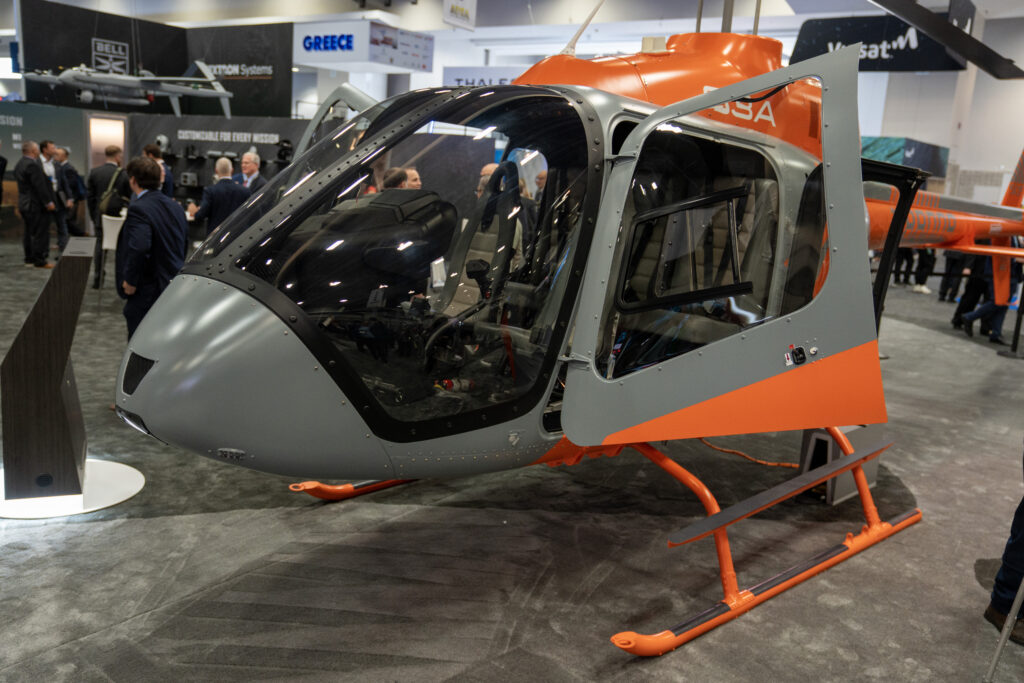
Bell is throwing its 505 model helo into the ring for the competition. The 505 is an upgraded version of the company’s 206 model, which was redesigned to the TH-67 and flown in the Army’s flight school prior to 2016 procurement of the Lakota.
The company will be competing as a prime, Carl Coffman, vice president of military sales and strategy at Bell, told Breaking Defense in an interview.
“We’ve been involved in training Army aviators all the way through, since the inception of Mineral Wells flight training here in Mineral Wells, Texas, all the way to Fort Rucker, Alabama. So we know how to train,” Coffman said.
The 505 is a single-engine aircraft, has a counterclockwise-rotating rotor system, but is not currently IFR certified. Coffman said Bell is “in the process” of obtaining its IFR certification right now.
Leonardo And Boeing Team Up On TH-73 Helo
Italian defense firm Leonardo will team up with Boeing to deliver their solution for Flight School Next. Leonardo will serve as subcontractor, providing its TH-73 trainer, and Boeing will be the prime contractor responsible for “fleet management,” large scale repairs, logistical support, simulation training and more, John Chicoli, senior director of US Army, Marine Corps and special operations and missions at Boeing, told Breaking Defense.
The TH-73 has a single engine, a counterclockwise-rotating rotor system and is IFR certified, making it the only aircraft provided by the six vendors that Breaking Defense spoke to that currently meets all three prominent requirements. It has flown over 100,000 flight hours and has completed 40,000 autorotations to the ground, Andrew Gappy, VP of Leonardo, told Breaking Defense.
Leonardo won a contract to provide the TH-73 trainer fleet to the Navy, Marines and Coast Guard in 2020. The company has since completed the delivery of the aircraft for that contract, Gappy said, adding that the aircraft is manufactured in Philadelphia, but the company has a large facility only 90 miles away from Fort Rucker.
“We have a very strong single-engine helicopter that’s all made here in Philadelphia, and we went out and got the first IFR certification on a single engine helicopter in 30-plus years and basically gave the Navy exactly what they were looking for,” Gappy said.
“It’s working extremely well for one service. It’s only 90 miles away from Fort Rucker. It’s proven itself with over 100,000 flight hours,” he added.
Further, Boeing currently provides training for its AH-64 Apache fleet with “live, virtual and constructive” simulation, according to a company release.
The Subcontractors
The decision to seek a less-capable aircraft has opened the competition of lesser-known helicopter firms.
Robinson Helicopter Company, MD Helicopters and Enstrom are all throwing their hats into the ring to be subcontractors for Flight School Next. Each company has an aircraft that has a single engine and a counterclockwise-rotating rotor system, but is not IFR certified.
Robinson is submitting the R-66 aircraft, David Smith, president and CEO of the company told Breaking Defense. Smith declined to comment on who would be the prime contractor for the company.
Smith said the R-66 is designed in a way that does not require constant maintenance, which allows the aircraft to keep “flying the mission instead of occupying the hangars” and does not strain the supply chain.
“Our customers tell us they’ve tried the other products. They come back to Robinson because they just work like a car. You don’t think much about car maintenance anymore,” Smith said. “That’s how our helicopters have been designed from the beginning, to be less dependent on mechanics from day to day.”
MD is submitting its 530 model, which has almost all of the prominent requirements for Flight School Next, but it may not have the production capacity. Weeks told Breaking Defense that right now they are producing 530s in the single digits to dozens, and have produced a maximum of 30 to 35 per year when the company was under contract to build the aircraft during the Afghanistan conflict.
“It’s honestly going to be a challenge for everybody. Since COVID, there are still supply shortages around the world,” Weeks said. “Is it going to be easy for anybody to overcome that and crank out a couple hundred aircraft? No. But everybody in our supply chain has said, with a little bit of lead time, that they’ll be able to get up to these kinds of volumes.”
Enstrom Helicopter is putting up its 480B model for Flight School Next, Charles Wade, Enstrom’s senior VP of product, sales and customer excellence told Breaking Defense in a recent interview. He also declined to tell Breaking Defense who the prime contractor for Enstrom will be.
The 480B model, Wade explained, was designed for the Army’s next training helicopter (NTH) program back in the early 1990s, but ultimately lost to Bell’s TH-67 helo. Apart from that, Wade said the 480 is currently used by Japan, the Czech Republic and Thailand in various “military training environments.”
Wade said he suspects the aircraft will be “pretty close” to IFR certification within 12 months.
“The aircraft was built for this mission. Other than the IFR [certification],we’re sitting really well,” Wade said.
‘Moving Fast’ May Not Be So Easy
Gill, the Army general, said service senior leadership “supports moving fast” on Flight School Next. But, he cautioned, things won’t be so easy, even before the shutdown put things on pause.
“They’ve told me to go fast. There are a lot of aspects that I’ve got to take into account, you know, to do this in a legal way, do it in a way that we can budget it, get all the approvals that we need. So, [there are] a lot of factors involved that are outside of my control that I wish I could go faster,” he said.
Still, that hasn’t seemed to dissuade the competitors from keeping ready and making a play for a potentially lucrative business deal, whether they’re primes or not.
“Just because the Army is taking longer doesn’t mean they’re going to give us a bye on [the] schedule, right? We’ve got to continue to move,” Coffman said. “We’re preparing that right now, and look, we’ve been working this [for] longer than a couple of months ago. We’ve been working this for quite a while in anticipation.”
CORRECTION: 11/05/2025 at 3:38 p.m. ET. This story has been corrected to include that the UH-72A has a counterclockwise rotating rotor system.