JERUSALEM — Israeli experts and politicians are reacting to news that the US may sell the F-35 Joint Strike Fighter to Saudi Arabia with a mix of concern and pragmatism, with the general consensus seeming to be a cautious “wait and see.”
Experts point to two key questions: how capable the Saudi F-35s may be, and just how long their arrival may take.
The White House officially announced that it would sell the F-35, long-sought by Riyadh, to the Saudis during a Nov. 18 meeting between US President Donald Trump and Saudi leader Mohammed bin Salman. Notably, Trump seemed to indicate that the Saudis would be sold the same caliber of F-35 as the Israelis operate.
“When you look at the F-35, and you’re asking me is it the same, I think it’s going to be pretty similar, yeah,” Trump said. “This is a great ally, and Israel’s a great ally, and I know they’d like you to get planes of reduced caliber. I don’t think that makes you too happy,” Trump said, directing his comments to bin Salman.
“We‘re looking at that exactly right now, but as far as I’m concerned, I think they are both at the level where they should get top of the line.”
That statement would seem to fly in the face of a requirement that the US always maintains Israel’s Qualitative Military Edge (QME), a policy that became law in 2008. And while a US official was quoted in local media as saying the Trump administration “will not breach” the QME law, there is still plenty of concern in Israeli circles.
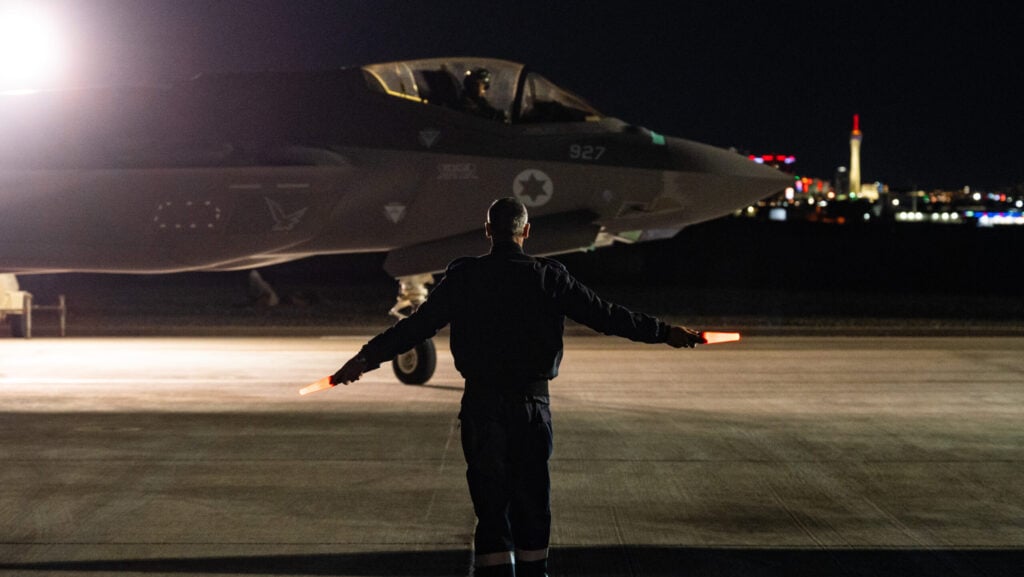
Israel was an early acquirer of the advanced plane, signing a deal in 2010 and receiving its first two aircraft in 2016; it is believed to have been the first country to use the plane in combat in 2018. The warplane was a backbone of strikes against Iran, the Houthis and other adversaries over the last two years of war.

Weaponizing the supply chain for a liquid-fueled howitzer-fired munition that flies 150 km
The goal of such weaponization is to tie warfighter needs to the RDT&E cycle.
Officially, the Netanyahu government is being cautious. A spokesperson for Israel’s Prime Minister responded to a question about the F-35 sale Thursday, saying “The Prime Minister and the President of the United States and Israel have a longstanding understanding, which is that Israel maintains the qualitative edge when it comes to its defense. That was true yesterday, that has been true today, and the Prime Minister believes that will be true tomorrow and in the future, of course.”
Israel’s Ynet, a major daily paper, noted that the Israeli Air Force has concerns about the F-35 deal, writing that “Air Force officials stressed that the F-35’s advanced detection, data-processing and networked systems give Israel an edge unmatched by any other country in the region.”
Breaking Defense reached out to several members of Knesset from the coalition and opposition parties and did not receive a response, except for opposition leader Yair Lapid, whose office pointed to an X post that reads, “it cannot be that because of the government’s weakness we will give up Israeli security interests and allow the F35 deal.”
Expert Reaction: Acceptance, But Concerns
Among experts and former officials more willing to talk, the Saudi news has been met with mixed responses, at best.
Yaakov Amidror, a former major general and National Security Advisor now at Washington-based Jewish Institute for National Security of America (JINSA), noted that Israel can’t realistically dictate to the US who to sell warplanes to. But, “in the end of the day we have concerns because it is clear that this plane in the hands of another country in the Middle East will be problematic, because we will lose some uniqueness we had of having this capacity and plane.”
Amidror, who is also a senior fellow at the Jerusalem Institute for Strategy and Security (JISS) emphasized how important QME is to Israel. “It was understood years ago that Israel is a small country with limited demography and the only way to bridge the gap of asymmetry is QME and that is technology, training and experience.”
If Trump holds true to his statement that the Saudis will get the same level of F-35 as Israel, Amidror noted that the QME could be maintained through the addition of some other capability that would give Israel an edge over the Saudis.
Time also plays into this, with Amidror predicting it will take five to 10 years for the Saudis to get their first F-35s. That’s a timeline echoed by Yoel Guzansky, a senior researcher and head of the Gulf program at the Institute for National Security Studies (INSS), who noted that if the F-35 sale is tied up in the Saudis normalizing relations with Israel, that could also impact the timeline.
The F-35 is “a status symbol, it’s important to MBS to show he get the plane first in the Arab countries,” Guzansky said, noting the UAE has also sought the F-35. As a result, Riyadh will need to keep up good relations with the US, potentially caving on normalization.
“They will need the US beside them and this bonds them with the US. I think it’s in Israel’s interest to have the US more present,” he said.
Charles Wald, a retired US Air Force general, said at a briefing hosted by JINSA this week that it would take time for Riyadh to get the plane and that Israel has developed the plane to a degree that it would likely retain QME, while noting that the sale could be beneficial and aid integration with the Abraham Accords. “I think the F-35 being in Saudi Arabia, if the Abraham Accords come about, would be a good thing. But like I said, it’s going to take a while,” he said.
In contrast, Eric Mandel, the director of the Middle East Political Information Network and the senior security editor of the Jerusalem Report, noted to Breaking Defense that “even a slightly downgraded fifth-generation F-35 in Saudi hands would be a strategic game-changer. The Israeli Air Force, along with U.S. intelligence and defense officials, believes such a sale would undermine Israel’s military dominance and its control of regional airspace.”
He said, “any F-35 delivery should be absolutely contingent on Riyadh distancing itself from China — America’s primary strategic adversary — with whom the Saudis recently held joint military exercises. Beijing is eager to gain access to this transformative technology.”
Israel, Mandel insisted, should receive “meaningful compensation for this shift should include both full normalization with Saudi Arabia and participation in the shared R&D of America’s sixth-generation fighter, the F-47.”
Breaking Defense Video