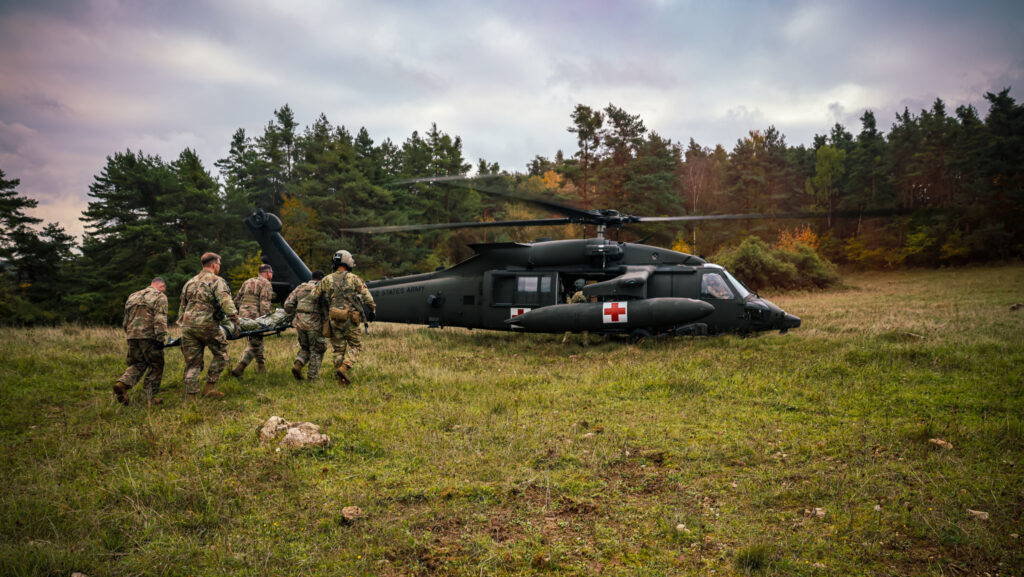
The US Army has spearheaded much of combat medicine’s development since our battle-worn nation fired its first shots at Lexington, evolving with every conflict since. America’s most modern combat medicine was developed in the Global War on Terror fighting a series of counter-insurgency operations (COIN), however as the 21st century continues, the rise of large-scale combat operations (LSCO) like what is seen now in Ukraine forces several life or death lessons onto American combat medicine.
The Russo-Ukrainian war stands as the starkest example of large-scale combat operations in recent decades, causing hundreds of thousands of casualties on both sides. While the war carries echoes of large-scale conflicts of the past, new technology and threats have forced Ukrainian medics, many of whom have received NATO training, to adapt.
As detailed in a report from the Center for Army Lessons Learned, the most obvious of these changes is the rise of drone warfare. From small quadcopters and FPVs to long-range single use suicide drones like the Geran-2, drones have altered not only how the war is fought, but how it claims its victims. First, the death-to-wounded ratio is much higher in this conflict versus others, with Russia suffering a ratio of 1:1.3 in some sectors, as reported by the Institute for the Study of War citing purported leaked Russian documents. This is in part because FPV drones are less like traditional artillery that causes huge quantities of fragmentation wounds, and more like point weapons that hunt down individual infantrymen with explosive payloads large enough to ensure wounds likely to lead to death.
Drones have also made logistics extremely difficult, with patient evacuation times greatly expanded and resupply significantly strained. These factors combined lead to more serious wounds with less logistical support and longer lead times on evacuation, when the delay of hours or even minutes can determine an injured soldier’s fate. As such, medics have had to learn longer-term nursing skills to treat patients in the field until casualty evacuation can be secured and proactively ration specific resources to ensure they will not feel the bite of delayed resupply.
This has been partly addressed in American training, with nursing skills and higher-level medical treatments like airway management, escharotomies, and more taking a more central focus in 68W medic training. However, even that will need to be expanded. Such training should include, but not be limited to, medium-term care for infections, medium-term pain management, integrating telehealth operations at the lowest levels, and more.
Despite this, drones are not purely bad news for logistics. Small drones have also been used to resupply frontline medics with small quantities of high-impact supplies, such as medications, which may prove critical in a logistically contested environment. The cutting edge of robotic ground vehicles technology also promises to help evacuate wounded casualties, with Ukrainian soldiers reportedly successfully evacuating a wounded soldier 64 kilometers inside of an unmanned ground drone, which was even hit multiple times during its escape. Adapting this technology and intensifying its maturation may pay dividends in conflicts to come.
Ukraine’s second large change has been the proliferation of air defense, in part to counter the drone threat and as well as long range precision munitions. Air defense networks have evolved to be more dense, more responsive, more adaptable, multilayered, and affordable in mass. This rise in air defense, however, has an additional casualty: the helicopter.

The uncrewed revolution: MQ-9B and Gambit Series forge a path to regional air dominance
The MQ-9B and Gambit Series represent parallel capabilities that address global challenges for security head-on.
Air medevac platforms have been the cornerstone of American and allied evacuation of the wounded through the Global War on Terror, and earlier eras like the Gulf Wars and Vietnam. Unfortunately, in a future peer large-scale combat operation environment such a conflict with China, increased air defenses will force difficult new realities on the use of airborne medical evacuation.
In Ukraine, this has resulted in high reliance on ground-based casevac, both due to the limited number of helicopters available but additionally due to the extremely dangerous mission set these aviators now face in Ukrainian skies. Russia is said to have already lost at least 166 helicopters, largely as a result of modern air defense systems. Long-range precision fires likewise have cut into the helicopters’ usability, with helicopters often taken out on the ground and their logistical nodes targeted by increasingly capable and prolific munitions.
This has forced rotorcraft aviation to be stationed further behind the front line, cutting into their combat radius and loiter time. As such, relearning the use of large-scale ground-based medevac may be a necessary lesson for American medics heading to the next large-scale engagement, as will the ability to treat wounded soldiers for longer periods of time before evacuation. While new American helicopters like the tiltrotor MV-75 Valor, with its increased range and speed, and the new unmanned versions of the Blackhawk both offer compelling progress in this problem, the truth remains that the skies of future conflicts will be more dangerous than ever.
As mentioned, there’s also been a focus in the Ukraine conflict on long-range fires. This broad category encompasses many different types of munitions, such as ATACMS, glide bombs, smart artillery shells, Russia’s kalibr cruise missiles, long-range one-way attack drones like the Iranian-made shaheds, a wide range of Western cruise missiles, and more. These munitions allow for the precise targeting of logistical nodes, hospitals, power grids, airbases, and more far from the front line. As such, these munitions have forced increasing decentralization in C2 nodes, the disbursement of medical treatment centers, and critically pushed logistics trains further behind the front lines on both sides.
Despite the rise in air defense largely to counter this threat, Russia continues to often launch hundreds of strikes daily, with the civilian power grid often used to power medical facilities commonly targeted. Advisory forces often see military medical facilities and even civilian ones as valid targets, meaning these munitions pose a direct threat to medical infrastructure and personnel. As such, the disbursement of medical treatment centers has been necessitated, leading to inefficiencies in treatment, transportation, and logistics.
The role of the medic, therefore, may expand, requiring medics working in battalion aid stations or further in the field to take on tasks usually reserved for medical professionals with more training who may be unavailable in future conflicts due to these constraints. This may include minor surgeries, suturing, laboratory work, imaging capabilities like mobile MRI and x-ray, and more. This will be empowered via the increasing use of telemedicine, though that alone will not compensate for the increased load on the shoulders of the average medic. As such, the Army will need to emphasize education and more, higher-end equipment for lower levels of the formation going forward.
The need to fully prepare to work with less logistical resupply, longer evacuation times and delays, dispersed medical infrastructure, deadlier wounds, longer term treatment, and more has made itself evident. The American medic has demonstrated their capacity to rise to the challenge repeatedly throughout our history, and they will need to once again should the US find itself in a modern large-scale combat situation, while threatened — and aided by — constantly evolving technology, tactics, and doctrine.
Zachary Hilmer is an officer candidate aiming to branch military intelligence in the Connecticut Army National Guard and has served as a combat medic for over five years. This article is reflective only on his personal views, and is not representative of the US Army, the CT National Guard, or any other organization.