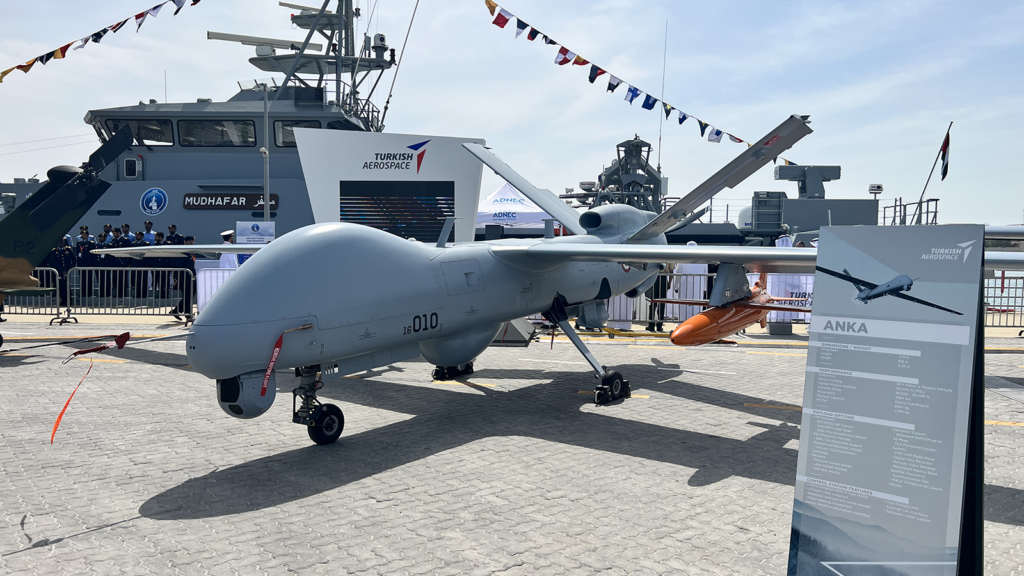
BEIRUT and BELFAST — Turkey’s Turkish Aerospace Industries and the UK’s BAE Systems have inked a plan to team up and assess “joint opportunities” related to developing drones.
“We have signed a strategic Memorandum of Understanding (MoU) with BAE Systems to collaborate on the development of uncrewed air systems,” TAI said in a Thursday post on its X account.
The firm added that under the MoU, both firms “will target joint opportunities in the field of future uncrewed air systems.”
The new agreement “will see both organisations determine objectives, responsibilities and goals to explore opportunities to collaborate in uncrewed air systems (fixed wing, rotary and hybrid) and related technologies,” a BAE Systems spokesperson said.
A TAI official told Breaking Defense that as part of the pact, TAI will share its experience in unmanned aircraft development and production, while BAE Systems will support through coordination of regional sales to Europe and other regions. The agreement between the two firms will cover TAI’s entire UAV product range and not a single aircraft, the official said.
“It’s a long-term process, and we are still at the very beginning. Both companies will act jointly — we have the UAVs, and they have the connections. Together, we’ll see what can be achieved,” the official said.
The agreement comes amid Turkey’s increasing defense ties with Europe, exemplified by its recent deal to procure 20 Eurofighter Typhoons worth $10.7 billion, and after Spain’s cabinet approved the procurement of 45 Hurjet trainers worth $3.62 billion. In July, TAI inked a strategic partnership agreement with Airbus, formalizing the collaboration on joint production of the Hurjet.
For BAE, the latest drone tie up with TAI comes two months after it announced plans, under the company’s FalconWorks rapid prototyping division, to link arms with Lockheed Martin’s Skunk Works to codevelop a family of autonomous drones, beginning with an aircraft equipped with electronic attack capabilities.
FalconWorks drone portfolio also includes the fixed wing Koios Intelligence, Surveillance and Reconnaissance (ISR) system, the Malloy Aeronautics produced T-Series all electric designed, heavy lift cargo type and the PHASA-35 High Altitude Pseudo Satellite (HAPS) platform.
BAE is also set to flight test an Autonomous Collaborative Platform (ACP) in the next year, after revealing a design of the drone wingman in 2024, according to Flight Global.
The ACP program is guided by the UK’s strategic defense review and is based around the premise of acquiring systems that are capable of collaborating with in-service and future generations of combat aircraft, like the trilateral Global Combat Air Programme (GCAP) sixth-generation platform, while also being able to operate off British aircraft carriers.
The latest European-Turkish drone partnership also bears similarity to Italy’s Leonardo and Turkish prime Baykar’s move to establish a drone joint venture, in a bid to take advantage of a European aerial uncrewed systems market valued in excess of $100 billion.