ALAMO ACE — The Air Force could finalize plans for major reorganization of weapon systems that roll up Program Executive Offices (PEOs) into new Portfolio Acquisition Executives (PAEs) within days, a service official said, as part of the Pentagon’s broader push to realign decision-making authority higher in the chain.
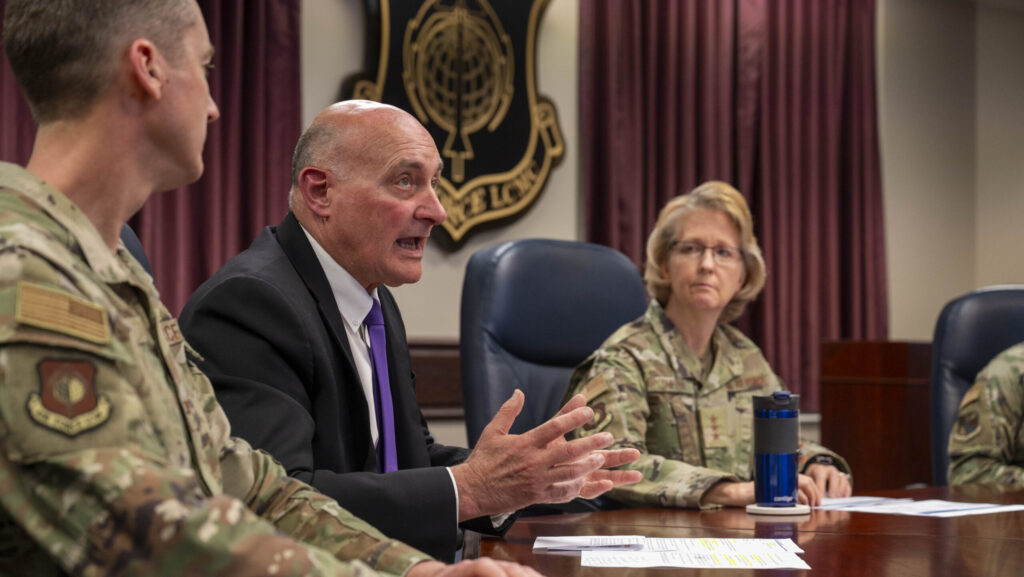
“They’re still moving forward with the PAE concept of rolling the PEOs under the PAE structure, but they have not finalized that yet,” Air Force Lifecycle Management Center (AFLCMC) Executive Director Dennis D’Angelo said at the Alamo ACE conference on Thursday. “That probably will not be finalized for the next couple of weeks. They’re looking at how they outline not only the responsibility of the PAE, but what authorities they will be responsible for because [there is] an attempt to bring more authorities up to their level so they can make decisions with program management.”
D’Angelo noted that AFLCMC Commander Lt. Gen. Donna Shipton skipped the conference because she was “in the middle of that structure,” underscoring how central the reorganization has become. He also referenced recent remarks by senior Air Force acquisition leaders at the I/ITSEC conference — also taking place this week — who stressed that PAEs are expected to carry significantly more weight.
“One of the things [leadership] wanted to do is give the PAE more responsibility and authority for them to be able to accomplish their mission so they would have more authority in how they would be able to move money, move people and all that,” said D’Angelo. “The issue is how much authority will they be given, and that’s still up for debate.”
EXCLUSIVE: The Army is changing its acquisition structure. Here are the details.
The outcome, he suggested, will shape how quickly the Air Force can shift resources inside major portfolios as threats, technology and budgets change.
Zero Trust For Weapons, Different Rules Than IT
That same push to delegate authority and move faster is colliding head-on with another mandate from above: implementing the cybersecurity mantra of Zero Trust across the force, including on weapon systems.
While traditional Department of Defense information technology environments are already on the clock for Zero Trust compliance by 2027, with operational technology like industrial control systems next on the docket for Zero Trust, D’Angelo cautioned that applying the same model to aircraft, missiles, and other platforms is far more complicated.
“Zero Trust cannot be applied to weapon systems the same way it is applied to IT systems,” he said.
RELATED: DoD floats 2035 as goal for zero trust in weapon systems
In the IT world, he noted, systems are general-purpose, prioritize functionality and diversity of suppliers across the defense industrial base, and can tolerate delays, errors, and even occasional system crashes as workloads spike or resources are constrained.
“In contrast, a weapon system is a real-time system that must provide deterministic behavior and predictable response times,” he said. “A real-time system ensures consistent operation even under extreme loads and under varied conditions.”
That means every additional security control carries a performance price. Where an IT owner might gladly trade a few milliseconds of latency for stronger authentication, for example, a weapon system engineer may have to accept certain cyber risks rather than introduce any delay in mission execution.
“Risk and trade-off analysis is critical,” D’Angelo said. “Implementing Zero Trust in the weapon system involves carefully weighing the risks and the trade-offs, [including] the potential impacts on performance, on interoperability, on mission effectiveness.”
In practical terms, that puts Zero Trust squarely inside the broader acquisition transformation he described with the PAEs. Engineers and program managers will be expected to design cyber resiliency into weapon systems from the start, not bolt it on at the end, and to make explicit, documented choices about which Zero Trust controls can be implemented without undermining deterministic behavior.
“While speed and agility in cyber acquisition are important, they should not come at the expense of security,” he said, noting that the new PAEs and procurement strategy envisions leaders with enough authority, technical understanding and flexibility to balance Zero Trust requirements, performance constraints and operational risk against the threats faced by weapon systems.
Breaking Defense Video