This essay is part of the Pathfinder series, a coproduction between Breaking Defense and the Center for a New American Security. Click here to find out more.
In recent years, US policymakers have paid increasing attention to the vulnerabilities of supply chains, especially in terms of securing access to critical minerals. Yet the security of maritime supply chains remains underdiscussed despite accounting for 80 percent of global trade by volume.
Effectively addressing these challenges requires a coordinated, multilateral approach that integrates advanced technology, intelligence sharing, and robust regulatory frameworks while ensuring that both public and private stakeholders are prepared to quickly respond to disruptions at sea.
Rising Threats: From Choke Points To Cyberattacks
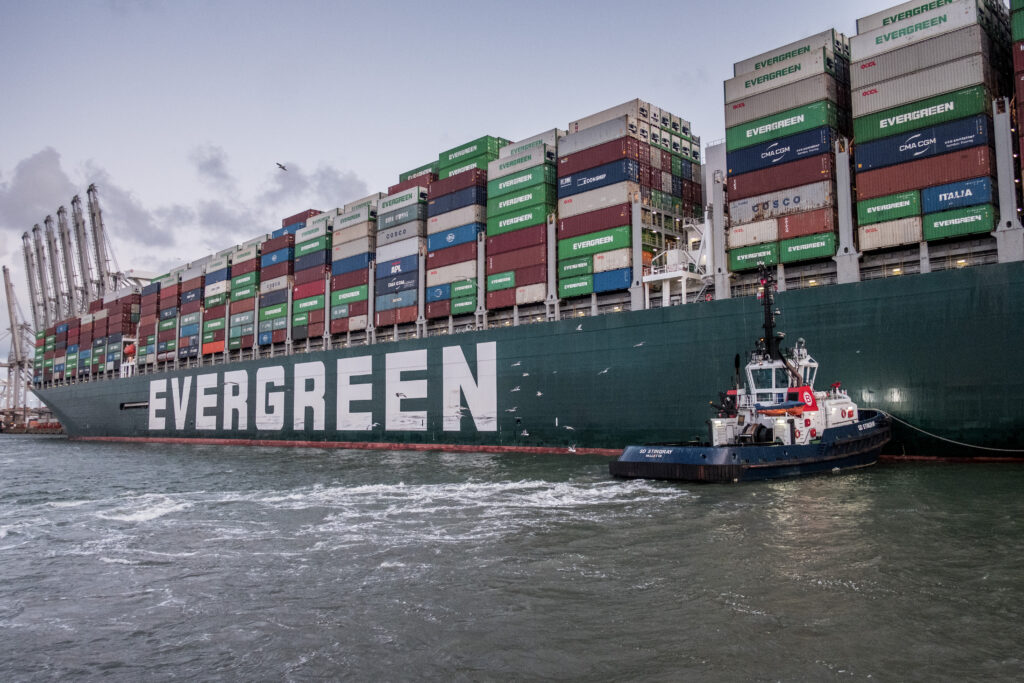
Shipping is the dominant method for transporting goods across the world, which means the functioning of the global economy depends on maritime security. While the six-day blockage of the Suez Canal by the container ship Ever Given in 2021 brought the world’s attention to the vulnerabilities of maritime supply chains, in general maritime security remains an underexamined topic among the wider US policymaking community. Considering the importance of maritime security to global security, as well as the rising number and types of threats, US policymakers must consider new ways to address this issue outside US territory.
The Ever Given incident exposed the vulnerabilities that choke points pose to the maritime industry. However, choke points are only one type of problem. Other risks include state and nonstate actors exploiting digital infrastructure to disrupt shipping flows. For example, by accessing Automatic Identification System (AIS) data, pro-Palestinian hacktivists have been able to target vessels linked to Israel. Recent Houthi attacks in the Red Sea have forced vessels to reroute around Africa, raising costs and delaying shipments. In another case, Russian groups have targeted European ports for supporting Ukraine.
Cyberattacks are another growing threat to the maritime industry. Targets include communications systems, port infrastructure, and logistics companies, sometimes causing physical consequences. These cyber-kinetic incidents — where digital incidents cause real-world disruption— include GPS jamming and spoofing, which can disrupt a vessel’s ability to identify its actual location. Even short-term disruptions in key waterways like the Black Sea or the Strait of Hormuz can leave ships blind, increasing the risk of collisions or accidents that impact global supply chains.
The complexity of maritime security makes this problem difficult to address, spanning both cyber and physical domains and involving overlapping jurisdictions. Effective policy requires coordination across governments, international organizations, private industry, and insurers. In addition, the technical knowledge needed to understand vulnerabilities in shipboard systems or satellite communications often places the issue outside the comfort zone of most policymakers. The result is that maritime security receives far less attention than it deserves despite its critical role in global stability.
Progress And Gaps In Current Policy Efforts
In June 2025, the House of Representatives passed three pieces of legislation addressing maritime security, which the Senate Committee on Commerce, Science, and Transportation is now reviewing. While movement in Congress on maritime security signals bipartisan willingness to address this issue, the proposed legislation inadequately addresses the variety and depth of threats to maritime security. The bills focus largely on domestic infrastructure and procurement, despite the most severe risks to maritime supply chains materializing in international waters and foreign ports.
The Secure Our Ports Act of 2025 (H.R.252) prohibits certain US maritime transportation facilities from contracting with enterprises partly or wholly owned by China, Iran, North Korea, or Russia. This action is intended to prevent state actors from using their access to port infrastructure to install intelligence gathering equipment or remote access tools that could disrupt or even shut down critical US ports. The Maritime Supply Chain Security Act (H.R.2390) attempts to incentivize replacement of Chinese port cranes — critical equipment used to transfer containers from ship to shore. An investigation by the House Homeland Security Committee and Select Committee on the Chinese Communist Party found that some of these Chinese cargo cranes included embedded technology that could allow the Chinese government to remotely commit espionage or disrupt the cranes’ functioning. Finally, the American Cargo for American Ships Act (H.R.2035) requires cargo owned either by the Department of Transportation (DOT) or recipients of DOT funding to be transported on US-flagged commercial vessels to reduce dependence on foreign vessels and support the domestic maritime industry.
Given the global character of this issue, any effective solution requires a multilateral approach.
Leveraging NATO’s Maritime Domain Awareness
Rather than confining the US approach to US ports and vessels, policymakers should increase engagement with multilateral partners to strengthen maritime supply chain security. Due to political tensions within the United Nations and the risk of interference from Russia or China, NATO provides the most viable vehicle for enhancing capabilities.
NATO’s Allied Maritime Command (MARCOM) already coordinates exercises, surveillance, and intelligence sharing among member states. Building on this, US policymakers should support NATO establishing a MARCOM center dedicated to monitoring AIS data, GPS interference, and cyber intrusions against shipping. To combat ongoing misuse of AIS, the center could employ artificial intelligence and satellite imagery to track vessels manipulating or refusing to enable AIS. By triangulating sources for maritime domain awareness, the NATO center would support improved intelligence coordination.
Additionally, US policymakers should advocate for more NATO maritime cyber exercises that integrate naval forces, port operators, shipping companies, and insurers. These drills would simulate cyberattacks and physical disruptions at key choke points, strengthening coordination between the public and private sectors.
Finally, learning from these exercises, the United States can lead efforts with allies to develop additional shared rapid response protocols for maritime incidents, ensuring that attacks on shipping lanes and port infrastructure are met with collective action. By demonstrating the importance of maritime security, US policymakers signal to allies the need to expand their own maritime capabilities in support of NATO, thus addressing imbalances in the alliance’s reliance on US forces.
Conclusion
Maritime supply chains form a crucial part of the global economy, yet their security remains an underdiscussed national security challenge. While piracy has declined, cyberattacks, state-sponsored sabotage, and climate-driven disruptions have made the maritime industry increasingly vulnerable. The bipartisan steps taken by Congress in 2025 are a start, but they fall short of addressing the international scope of the problem.
An effective and bipartisan solution prioritizes cooperation with NATO. This policy option recognizes that strengthening MARCOM’s capabilities would, in the short term, improve maritime domain awareness while laying the groundwork to diversify the alliance’s maritime capabilities and reduce reliance on US naval power. By integrating cyber and physical defenses, securing navigation systems, and strengthening coordination between allies and industry, the United States can lead in safeguarding the networks underpinning global commerce.
Protecting maritime supply chains is not simply an economic concern but rather a strategic imperative for stability in an era of geopolitical uncertainty.
Elisabeth Tamte is a recent graduate of the University of Oxford, where she completed an MPhil in international relations. She currently works for UNU-CRIS as a communications and policy intern. Tamte has a BA from the University of Virginia, where she majored in global security and justice, with minors in economics and foreign affairs.