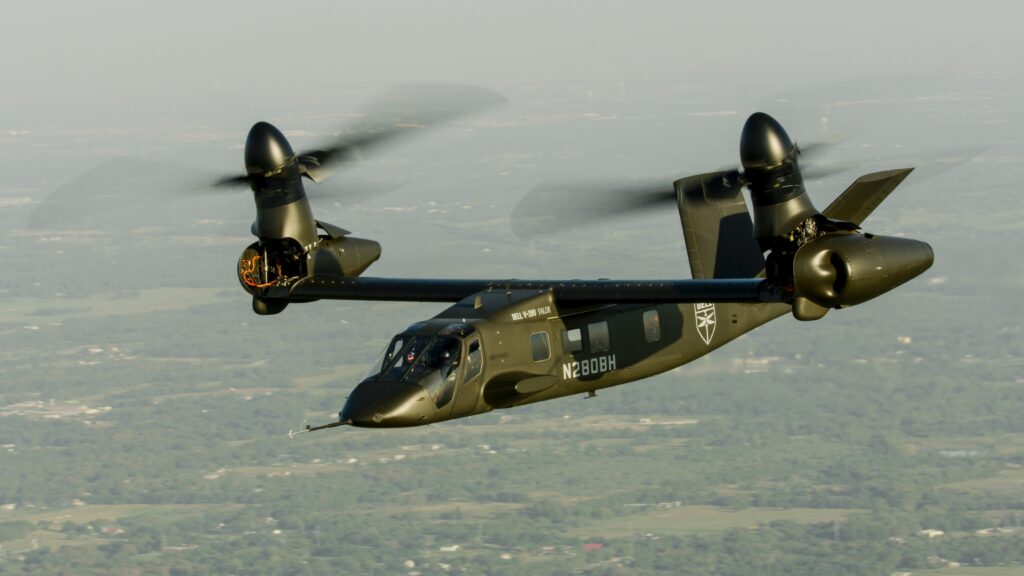
WASHINGTON — Earlier this year, Army Chief of Staff Gen. Randy George said he expected the Bell-Textron-made MV-75 tilt-rotor long-range assault helicopter will be delivered to formations for testing by the end of this year or the beginning of next. But two months later, the Army’s Program Executive Acquisition for Maneuver Air said today it’s “too early to tell” if that timeline is still viable.
A lot’s gonna have to do with funding as we go into a new year,” Maj. Gen. Clair Gill told Breaking Defense. “So there are a number of variables that I don’t want to commit to a day on the calendar right now, because we have what we call a success-oriented schedule, which means everything goes the way we want it to, and that, I don’t want to say it’s a utopian mindset, but it’s a very optimistic outlook for something that we don’t have a lot of history with.”
Gill, who is dual hatted as the Commanding General of the Army Aviation’s Center of Excellence, emphasized that the MV-75 is a complex, brand new system, and with that, he and other aviation leaders might have to make tough decisions on timing.
“Ultimately, we’ll have to make some risk decisions about when the performance of the system is not going to keep pace with the schedule. So we are absolutely prioritizing schedule right now, but not at the risk of safety,” he said.
Even if the first MV-75’s aren’t delivered to units for testing by the end of the year, Gill said the Army is still pursuing a tight timeline, which he said he believes Bell-Textron can achieve, though it is a “tall ask.”
The MV-75 was selected by the Army in 2022 to be the service’s pick for its Future Long Range Assault Aircraft (FLRAA) program of record — an aircraft that’s designed to fly “twice as far” and “twice as fast” as other assault helos, according to the Army.
Last spring George told lawmakers that the service was working with Bell-Textron to create an acceleration plan to move the delivery for the fully operational aircraft to formations up to 2028 from 2030, and another Army senior leader said the service was aiming to fly the first prototype in fiscal year 2027. Today Gill didn’t provide any updates on those goals.
In terms of the plan to integrate the aircraft with formations, Gill said today the Center of Excellence is standing up an operations development team (ODT) this summer of about 25 to 30 people that will be responsible for sorting out integration and lifetime sustainment.
“Their full purpose in life is to think through how we get this off the production line and into the hands of Army aviators, Army maintainers and formations, and start thinking about how we fight,” Gill said. “The Army’s been great about giving us extra people that we can think through what’s the best way to do this.”
He added that some of the ODT members will be “integrated” with Bell to help speed up the delivery to formations, and the ODT will serve as the “nucleus” for a potential future unit that will fly the MV-75s.
When the MV-75 is eventually delivered, the 101st Airborne Division will be the first to receive the helos, as former Vice Chief of the Army Gen. James Mingus previously said. After that, Gill said that he and other senior leaders are “thinking about” the potential to introduce the MV-75 into the National Guard as well.
“This is some of the analysis that the ODT will do that will tell us whether or not that’s a good idea,” Gill said. “First and foremost, we need to make sure we understand how to operate and fight this thing. But it does help us to think through, how would we integrate it into all the units and the different sort of types of units that we’re going to field it to.”