WASHINGTON — As world militaries race for cheaper air defenses, the US Army plans to ask that at least some of its next large drone fleet to carry high-energy lasers, an Army official told Breaking Defense.
“All [the unmanned systems] meant to have modular payloads configured to the specific operational environment, threat and mission,” the official said, speaking on the condition of anonymity. “Not every Group 4/5 UAS will have it. It will be a theater-specific, add-on payload.”
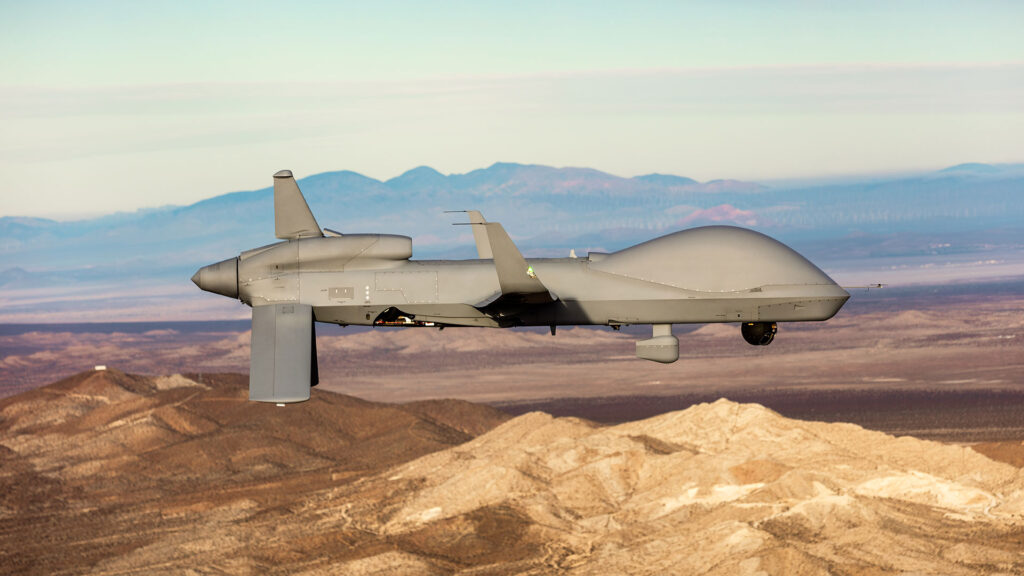
The Army is poised to officially launch a race for new Group 4 or 5 — read large and very large — unmanned aerial systems to replace its current fleet of General Atomics-made Gray Eagle drones. The official told Breaking Defense that at the tail end of October, the Army Requirements Oversights Council approved the Capability Development Document outlining the requirements and an acquisition plan for buying a new fleet of short takeoff and landing (STOL) or vertical take-off and landing (VTOL) drones.
The official didn’t say if the HEL capability was formally included in the requirements document but emphasized it will “absolutely” be a capability the service wants, suggesting it could play a role in the Trump administration’s sprawling air defense plan known as Golden Dome.
A request for information for the drone fleet is expected to be released in the near future, that official added, and interested companies will have a “quick response time” before a formal request for proposal is released and the service hosts an industry day.
The Army did not immediately respond to questions about the forthcoming plan, but it has been in the works for well over a year. Such a fleet — with each airframe weighing at least 1,320 pounds — is expected to help fill the gap created by the service’s decision to halt future buys of General Atomics’ Gray Eagle drone, in part over survivability concerns.
Military development of high-energy lasers have been in the works for decades — with some reported successes — but have often butted up against size, weight and power concerns especially on airborne platforms. Despite the challenges with an array of programs, the services have pushed on, with the Pentagon recently announcing that scaled directed energy is one of six tech priorities.

Why enterprise IT modernization matters now – and how to “delight by design”
Do more with less: streamline workflows, reduce duplication, invest upfront to save long-term.
That push and the Army’s plans to ask for a large drone able to fire a laser isn’t catching industry flatfooted. While it’s unclear which defense firms throw their hats in the ring to compete to see their larger drone offerings adopted by the Army, General Atomics, for example, could look to reclaim the contract with its STOL Mojave, or a version of the demonstrator.
“By the time we show it to the Army for an actual solicitation, our STOL solution will have been tested, tweaked, and tested again. We’re not offering a wink and a promise,” GA spokesperson C. Mark Brinkley wrote in a statement to Breaking Defense. When asked about integrating a HEL on such a drone, Brinkley said the company has been working on its own laser projects, and talking to industry and government teams about integrating other solutions onto GA aircraft.
“Imagine an unlimited magazine, able to knock down these flying trashcans,” he said. “That’s what we’re aiming for in the future.”
“You don’t have to burn holes through metal to defeat a lot of these systems,” Brinkley added. “We’re not trying to blow up the Death Star. You can blind the optics, start fires, melt plastic, disrupt targeting, overheat electronics. All of that is possible now.”
Smaller, laser-focused firms are also taking notice of the need. Aurelius Systems said it’s pitching its sub-10-kilowatt class laser called Archimedes that the startup says can be integrated onto a Gray Eagle.
“We’ve confirmed already… that the current form factor — weight and size — can be carried easily by an outer pylon of a Gray Eagle,” Aurelius’s head of growth, Dustin Hicks, told Breaking Defense on Monday. The weight of that form factor could become lighter if it uses power from the drone instead of from its own power supply, he added.
While both Hicks and Michael LaFramboise, the company’s CEO and co-founder, said they are eyeing such a mashup of tech, they noted that Aurelius does not have a formal agreement in place with GA or another stakeholder.
“But we’ve done enough specific technical validation, to know that we can actually integrate [it] onto that platform,” Hicks said. “We’re small enough and light enough that it could be carried on one of the weapons station pylons on the Gray Eagle.”
Aurelius is a new name in the defense startup space. In mid-October, the Army awarded the company with $62,000 from its FUZE initiative, new venture-capital-like acquisition model. As part of that deal, LaFramboise said the company demoed the Archimedes HEL from the ground, downing an unspecified number of small Group 1 and 2 drones.