
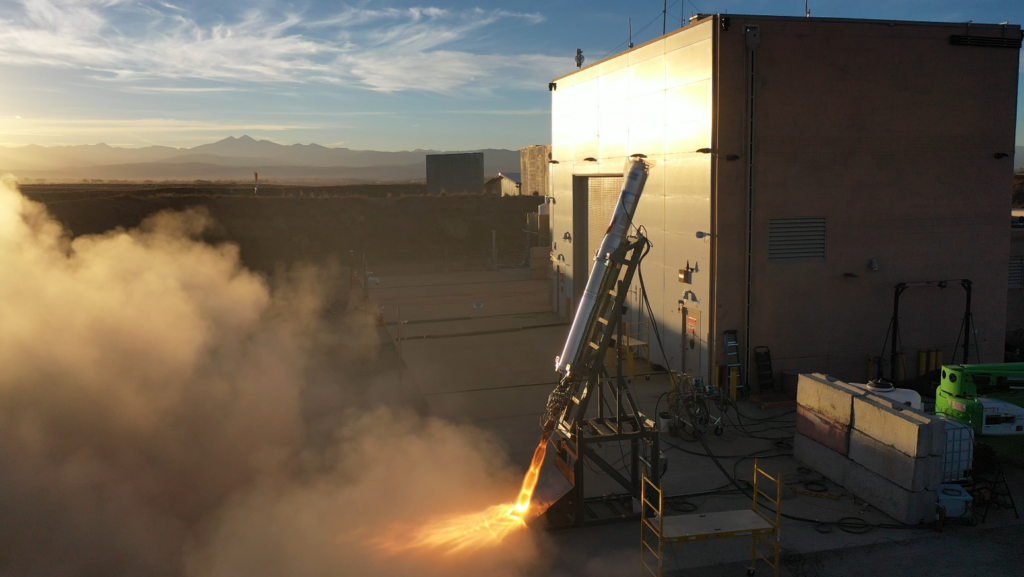
Hypersonics is an area where the US potentially lags behind Russia and China, and current propulsion methods such as solid-fuel rockets and air-breathing engines have limitations.
Ursa Major’s American-made storable liquid rocket engine technology offers advantages over traditional liquid and solid rocket propulsion, including: ability to start, stop, and throttle the engine for improved maneuverability and survivability; liquid propellants that can be handled more easily than cryogenic or toxic fuels and stored for years; the ability to operate endo- and exo-atmospherically; and a modular and affordable design using advanced 3D printing techniques. We discussed these capabilities and the company’s U.S. Air Force Angry Tortoise-Draper powered hypersonic program with Ursa Major CEO Dan Jablonsky.

Breaking Defense: What is the state of hypersonic propulsion today? What are the different types of propulsion methods?
Jablonsky: At a high level, we’re behind where we should be with peer and near-peer adversaries. Existing systems cost too much, and the US has had a lot of development programs along the way that have not panned out the way we’ve thought.
Solids are fantastic for many missions, and we make solids, as well. They’re very reliable. They have a simplistic design but are hard to build. Sometimes they’re very expensive at the larger form factors. They have a very high initial thrust, which can impede their ability to engage at the lower altitudes. They don’t have as much maneuverability as a liquid system because a liquid system can be throttleable.
Air breathing engines – scramjets and ramjets fall into that category – have had some delays and also have altitude limitations. They’ve been proven to be fairly expensive configurations. There is still development work going on there, but to my knowledge nothing’s been fielded in the fleet.
With liquid hypersonic propulsion, we’re category-leading, and we’ve now flown our Hadley engine several times at Mach 5 plus with Stratolaunch that also allows us vehicle recovery. That’s great for targets and test beds, though if it’s an offensive or defensive weapon you don’t actually recover that. For targets, liquid hypersonics enable a deep portfolio of reusable advance threat trajectories to inform wargames, exercises radar/sensors calibration and ultimately interception.
Because of the 3D printing techniques we’ve been using, it allows for very quick development cycles and also affordable missile mass for the types of capabilities we’re bringing online.
And building off that, we’re developing and fielding Draper, which is a storable, liquid engine, and provides tactical levels of responsiveness and performance.
Describe what you mean by a storable, liquid engine.
Typically, liquid engines have used cryogenic materials, or they’ve used what are called hypergolics. One advantage of cryogenics is you get higher energy density. One of the disadvantages is that you need launch-base-type operations and they’re not fielded tactically in anyone’s system right now.
A liquid engine combines the fuel and the oxidizer in the combustion chamber. You can start it, stop it, throttle it. Cryogenic liquids are usually generally a one-start-type configuration; they’re not the kind of thing soldiers, sailors, and marines handle in the fleet.
When we talk about a storable liquid configuration, we mean one that could be storable for up to or even longer than 10 years on a ship, an air base, in space, or on a forward-based operation – and have liquids that can be stored inside the system itself or are easily fueled into it. This was an Air Force objective after we started testing and even before we flew Hadley. They put us under contract to develop a tactical version of Hadley, and that’s what the Draper system is.
It acts like a solid in that you press a button, and it starts. It can be stored in the kinds of conditions a solid can be stored in, including in space. But it also provides the additional flexibility of a liquid system, which is throttling, starting, stopping, and a higher level of maneuverability even as you get to the higher rates of speed.
It’s also unlike an air breathing system in that you could fly it in the atmosphere at very high altitudes where some air breathers have trouble working because there’s not enough density of oxygen. You could also fly it out in space where none of the air breathers work.
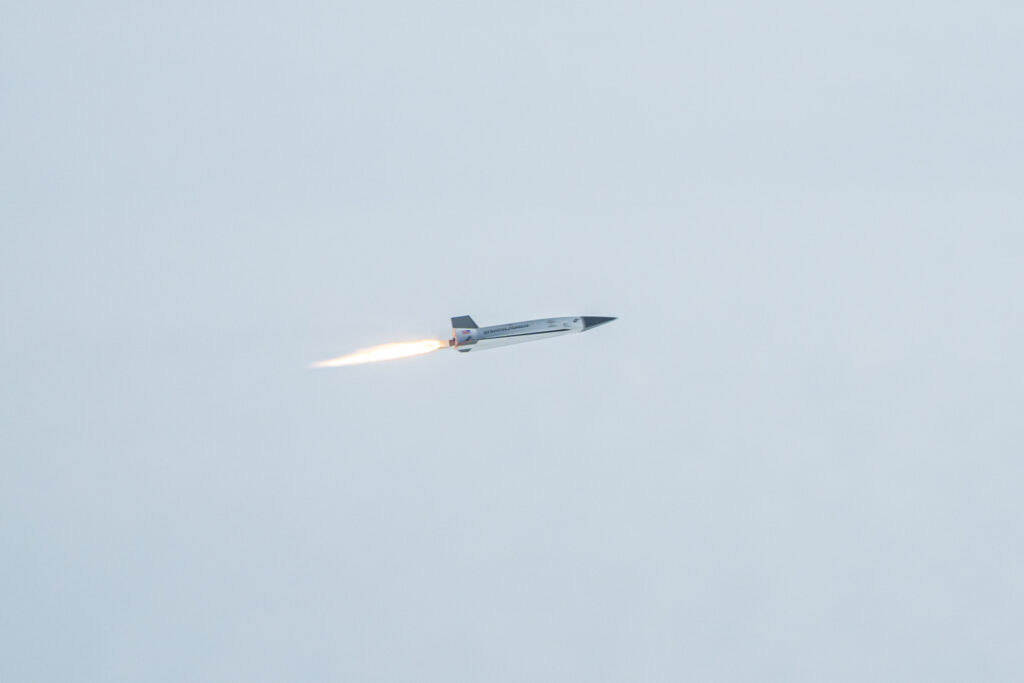
What can liquid engines and the Draper engine accomplish for the Air Force?
Two things. The first one is that with a liquid system like this and the density characteristics and maneuverability you can get, particularly if you use the liquid system as an upper stage, you can get long distances like a Tomahawk-type system, for example, but you could also get speeds that are unmatchable by current air-breathing systems and configurations.
Think instead of barely supersonic closer to the hypersonic range or above. The reason people are working hard on that is because the peer and near-peer adversaries have been developing those kinds of configurations, which means that they can punch faster and at longer distances than we can. We need to bring that type of capability into the US warfighting domain. That’s what we’re doing with the Draper system and the Angry Tortoise program. Draper systems provide the Air Force with the optimal balance of a low cost, high-speed weapons system.
The other advantage of the Draper system is that as we work on long-range space capabilities and Space Force’s objectives of rapid capabilities in space and space-based missile defense, this same modular liquid system also works in that environment with virtually no changes.
You mentioned earlier that you make extensive use of 3D printing for your liquid engines. Tell us about that.
When I say we’re category leading in areas like hypersonics, we’re also category leaders in additive manufacturing processes. We’re using very high temperature alloys for our products to be able to survive at operationally relevant environments and speeds.
A lot of times people think they had a 3D printer in high school or saw one at their kid’s demo science lab printing up little plastic toys. That’s not this. For example, we’re printing combustion chambers designed to handle 5,000 to 6,000 degrees Fahrenheit and turbo machinery with shafts that rotate in excess of 50,000 RPM, and we’ve proven we can fly with both of those. Our Draper engine is approximately 60% additively manufactured.
The biggest advantages of 3D printing in this environment – if you can be really good at it and we’re really good at it – is that it allows you to quicken development cycles and times because you don’t have to go through a forge, a casting process, and a follow-on machining process with one design. That means we can get to the test facilities in days and weeks with different configurations as we iterate into the final production stage of a unit. That’s a huge advantage to moving fast and being able to deliver the most capable solutions for the warfighter.