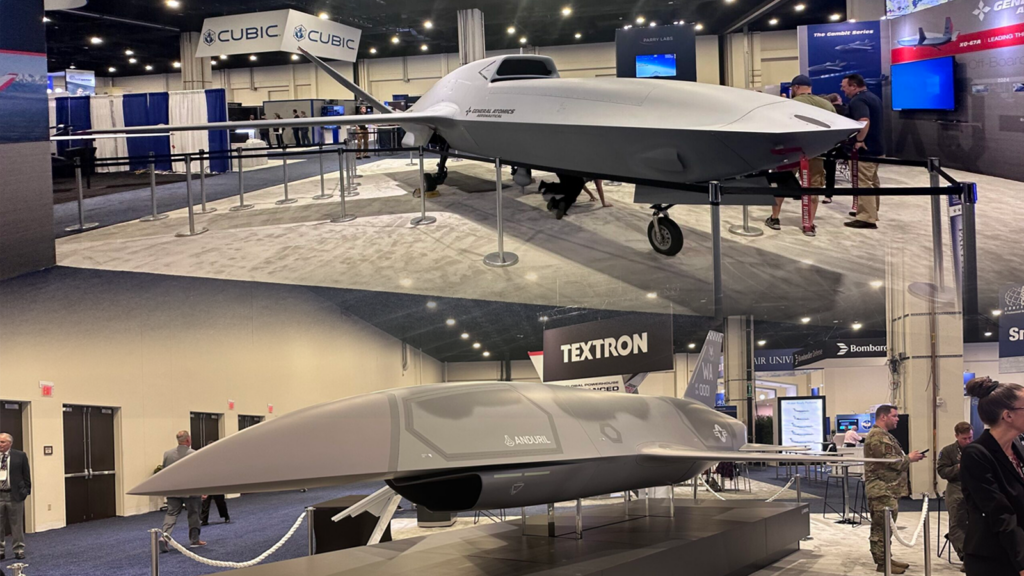
Amid a global race to augment military forces with unmanned systems, the Air Force this year notched first flights for prototype drone wingmen, a step lauded by officials as a key milestone for a top service priority.
But uncertainty remains for the future of the Collaborative Combat Aircraft program, and two critical questions are poised to be answered in the next year. The first: What will the Air Force decide to build? And second, what comes next?
Drawing from years of prior research in the technology, the Air Force unveiled the CCA program in 2023 and subsequently awarded defense tech startup Anduril and longtime dronemaker General Atomics deals to build prototypes. A parallel effort to develop the drones’ autonomy has continued largely in secret, where contracts have been issued to RTX and Shield AI.
[This article is one of many in a series in which Breaking Defense reporters look back on the most significant (and entertaining) news stories of 2025 and look forward to what 2026 may hold.]
Officials have said the first CCA will likely serve as missile trucks, lugging along extra munitions for fighters like the F-22 Raptor and F-35 Joint Strike Fighter. The unmanned wingmen are further meant to act as a force multiplier in the form of “affordable mass,” which would help offset a shrinking inventory of manned fighters. Other roles like electronic warfare or surveillance could also be on the table.
During the competition between Anduril and General Atomics, officials have said a production decision is on track for next year. The Air Force maintains that one or more vendors could be carried into production, including a dark horse candidate not currently on contract. On Dec. 22 the Air Force announced that Northrop Grumman’s Talon UAS received an official designation as YFQ-48A and was considered a “strong contender in the CCA program.”
It’s not clear how officials plan to move ahead with the parallel autonomy effort. Much testing and experimentation for how to employ the drones remains, but greenlighting production could pave the way for CCA to become operational by the end of the decade.
Nevertheless, there’s no guarantee these drones will enjoy a long-term franchise. Looking ahead, officials have expressed mixed opinions about future iterations of CCA, with one Air Force officer opining in April that future drones will come in on the “low end,” meaning cheaper, more attritable designs.
A recent set of contract awards leaves open a range of possibilities. For the CCA program’s second round, or “increment,” the Air Force awarded nine companies early design contracts that encompass a variety of concepts, from low-end to exquisite, Breaking Defense reported Dec. 19. The service will then winnow that pool down to a smaller set of designs to carry into prototyping, though it’s not clear whether different classes of drones could advance.
Industry investment hangs on what the service decides. And several firms already appear to have made informed bets, though most stress their offerings could compete for a variety of domestic and international needs. For example, Lockheed Martin and Shield AI have unveiled stealthy and more exquisite potential drone candidates. General Atomics has also separately said its LongShot drone under development with DARPA could play a role in Increment 2.
Airframers aren’t the only ones eager for an answer. Industry interest has surged in the realm of lower-end engines, which could power a range of weapons from munitions to CCA. Still, these companies are waiting to hear whether they can count on Air Force investment in lower-end systems that would require less powerful propulsion, a significant factor that could shape the size of the market.
Although much work lies ahead, the future does not appear that far off. In November, Lockheed announced an F-22 pilot successfully controlled a General Atomics drone from the cockpit using a tablet as an interface. Weeks later, the Royal Australian Air Force announced a successful trial where a “fighter-class target drone” was downed using an AIM-120 AMRAAM fired from a Boeing-made Ghost Bat drone.
“The future is here and the future is right now in Australia with Aussie-made, world-leading capabilities like the Ghost Bat,” said Pat Conroy, Australia’s Minister for Defence Industry.