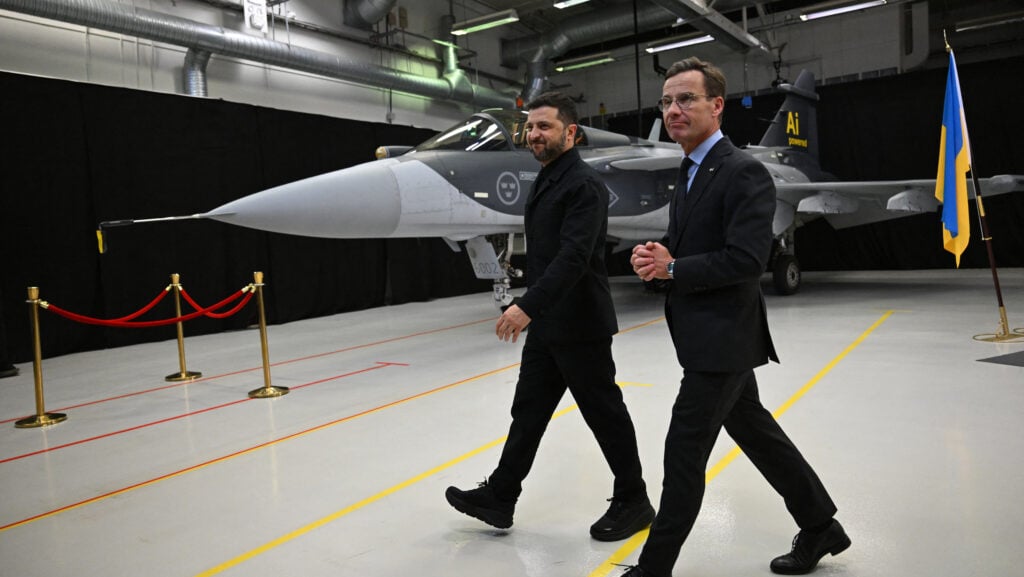
WASHINGTON — No matter what a potential deal to end the war in Ukraine ends up looking like, it is unlikely to alter the timeline for delivery of Saab Gripen-E fighters to Kyiv, Sweden’s defense minister told Breaking Defense last week.
But, Pål Jonson said, Stockholm continues to explore the option of sending older C and D models to Ukraine, which is eager to shore up its air capabilities as quickly as possible.
In October, Ukraine and Sweden reached a deal that could see Ukraine procure between 100 to 150 Gripen-E models. While that deal has yet to be signed formally, Swedish officials have said it will take about three years after the contract is inked to get to first deliveries of the E, which only entered Swedish service in October.
“I think if you’re talking about the Gripen Echo, that would be difficult” to speed things up from the stated three-year delivery timeline after Kyiv signs a contract, Jonson said during a visit to the Swedish embassy in Washington. Ultimately, the timeline is defined by “industrial capacity. … Industrial production is, I think, what’s going to be guiding that.”
However, Jonson said Sweden is “looking into” the potential of sending either Gripen-C or Gripen-D variants, which could lead to a “transition that could be done, possibly quicker than three years.”
While stressing that “no decision” has been made, Jonson said, “We’re in a close dialog with the Ukrainians in order to identify their needs, and we [are] here to take note of their experiences of the implementation of the F-16 and the Mirage and so forth.”
Asked if that could entail taking C and D variants out of service with Sweden and shipping them to Ukraine, with the Swedes backfilling with the more advanced E variant, Jonson said “that could be an option” but again said everything comes down to when the Ukrainians sign a contract for the Gripens, and what it looks like. (A month after news of the potential Gripen-E purchase, Ukrainian President Volodymyr Zelenskyy announced Ukraine also intended to buy up to 100 French Rafale fighters.)

Localizing tactical communications for sovereign, NATO-ready C3I
Beyond foreign sales, Rafael’s model enables tech transfer, local engineering, and is a template for NATO partners.
“We have to see if they decide, and we can reach an agreement on the Gripen Echo, then in that case, I think [a way into] the Gripen family could be the Charlie, Delta” jets, he said.
Ukraine has long lobbied for deliveries of Gripen C/D combat aircraft to push back against Moscow, but has yet to acquire the jets. That’s in part because NATO allies asked Sweden to hold back on sending them, so Kyiv could first focus on flying F-16 jets and in a bid to not overload pilots with a variety of different aircraft types.
On the whole, there has been a surge of interest in the Gripen globally in 2025. In addition to the Ukraine deal, Saab in August locked in a $550 million deal with Thailand to purchase four of the jets. Columbia in November signed a $3.6 billion deal for 17 E and F models. Meanwhile, there are ongoing talks with Peru, and Jonson recently visited Canada as part of a push to get Ottawa on board, as Canada reassess its F-35 plans.
Jonson said he did not have a sense of timeline for when Canada could make a decision, and declined to weigh in on when he expects a final contract with Peru to be signed.
A Next-Gen Fighter?
There are currently two sixth-gen fighter programs underway in Europe, one from a British-Italian-Japanese collaboration, and one from a Franco-German team.
The latter has an infamously rocky history, which has only become reportedly rockier in recent months, to the point where multiple reports have said the program, known as FCAS, is on the verge of collapse. If that happens, analysts previously told Breaking Defense that Paris could go it alone on the jet. So would that leave an opening for Sweden to team up with Berlin?
Jonson insisted that he has not had conversations with Germany over a sixth-gen fighter, but did note, “I can just say, on a general basis, we [are] always open for cooperation with all countries.”
His comments came just hours before it was reported by Reuters that Saab and Airbus, which counts the governments of France, Germany and Spain among its ownership, are teaming up to develop an unmanned aerial vehicle.
Said Jonson, “partnership is in our DNA. I always say when we engage into these matters that we’re not looking for clients, we’re looking for partners. Because for us to maintain this strong defense industrial base … it’s based on sharing cost, on further development and enhancement of it.”
Breaking Defense Video