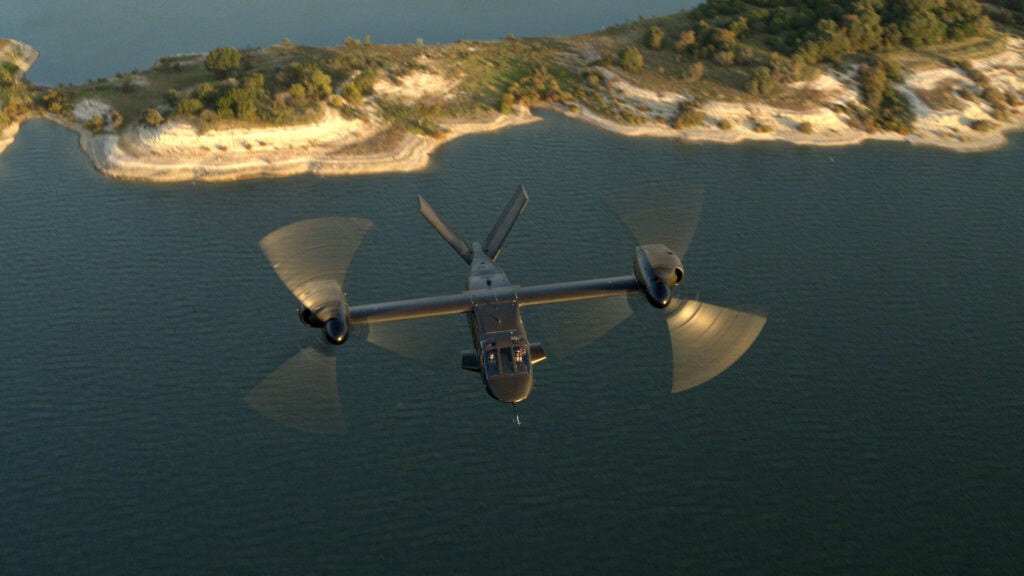
WASHINGTON — Army Chief of Staff Gen. Randy George hailed the accelerated timeline for getting the new MV-75 tilt-rotor long-range assault helicopter to soldiers, saying he expects the bird to join flying “formations” by the end of this year.
The MV-75 was selected by the Army in 2022 to be the service’s pick for its Future Long Range Assault Aircraft (FLRAA) program of record — an aircraft that’s designed to fly “twice as far” and “twice as fast” as other assault helos, according to the Army.
“We have a new tiltrotor aircraft, and it was supposed to be delivered in 2031, 2032 and we said, ‘No, we need it, you know, very quickly,'” George said Monday during a town hall event, a video of which was published online Tuesday. “At the end of this year, we will actually have those flying out in formations.”
A service spokesperson later clarified that aircraft would not become fully operational by the end of the year, but that the service expected to accept an airframe for testing by late 2026 or early 2027. The spokesperson did not offer a new target date for fielding the aircraft. Bell, which is producing the MV-75, referred Breaking Defense back to the Army for comment.
Last spring George told lawmakers that the service was working with Bell to create an acceleration plan to move the delivery timeline up to 2028, and another Army senior leader said the service was aiming to fly the first prototype in fiscal year 2027. But based on George’s comments Tuesday, the overall timeline for the helicopter could shrink even faster.
The Army’s Transformation Initiative boosted the FLRAA program to the top of the list of the service’s aviation priorities. It’s estimated to cost around $70 billion and is slated to potentially take funds away from other aviation programs.
For example, Breaking Defense previously reported that as part of the ATI, the Army is halting buys of General Atomics’ Gray Eagle drone, shelving AH-64D Apaches, and stopping the Future Tactical Uncrewed Aircraft System competition. It’s also considering ending General Electric’s development of the Improved Turbine Engine Program (ITEP) and maybe reducing the quantity of HADES aircraft to fund FLRAA.


America must adopt a Sixth Domain of warfare doctrine
The Sixth Domain is not defined by geography. It’s a new kind of conflict in which autonomy and networked systems allow thousand-dollar consumer electronics to destroy multi-million-dollar conventional weapons systems.