
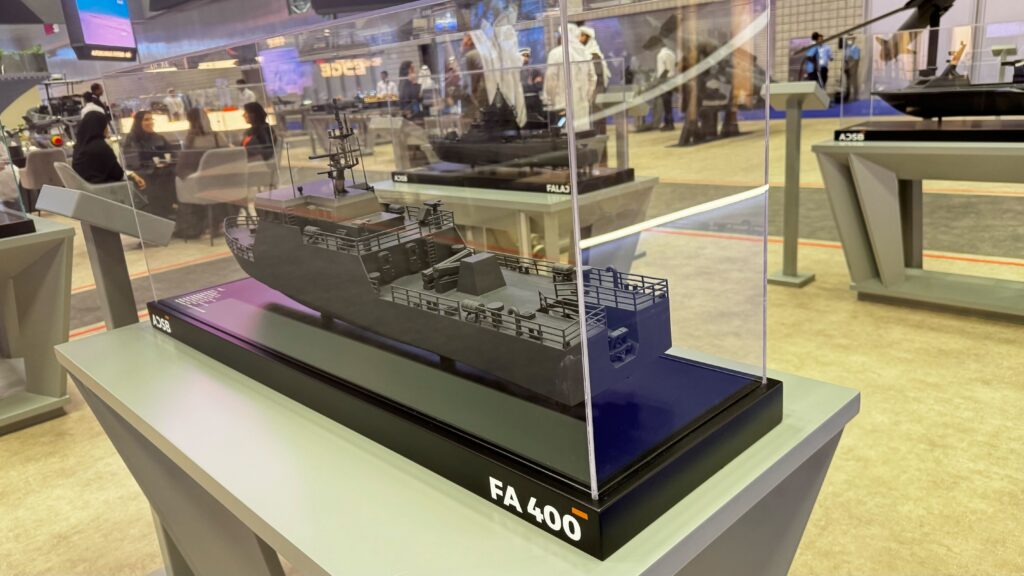
DIMDEX 2026 — Abu Dhabi Ship Building CEO David Massey said the company has big ambitions for the future, like increasing exports and speeding delivery times for the Falaj-3 offshore vessels for Kuwait and the BR71 MKII corvettes for Angola.
The company exhibited at the large stand belonging to Emirati defense conglomerate EDGE Group at this year’s DIMDEX naval exposition in Qatar, showing off models of its vessels from the FA-400 offshore patrol vessel to the 170 M detector unmanned surface vessel.
Massey sat down with Breaking Defense at the show to discuss the company — of which 49.8 percent is owned by EDGE — and its plans for developing future unmanned surface vessels, ramping up its exports and integrating new technology onto its platforms.
This interview has been edited for length and clarity.
BREAKING DEFENSE: ADSB have signed a number of large contracts recently, when do you expect to start deliveries of the Falaj-3 vessels to Kuwait?
DAVID MASSEY: We have gone from being six years ago primarily just a supplier the UAE Navy with occasional overseas contracts [like] Oman, Bahrain and Kuwait but nothing massive. But now ADSB has an order book, generated more than $4 billion of business in the last six years. We’ve got orders to build 16 large vessels, plus sophisticated OPVs [Offshore Patrol Vessels] and Corvettes.
We’ve got an order book for over 100 composite small boats, which is quite significant, and really does make us quite a player in this region, even on a global basis. ADSB is now supplying [customers] 6,000 kilometers (3,700 miles) west to Angola in West Africa and 6,000 kilometers east to Indonesia. So significantly better footprint than we had a few years ago.
The UAE leadership is doing its very best to expedite delivery [of Falaj-3] to Kuwait, even that involves the head of the UAE Navy being prepared to accept later delivery of some of their vessels in order to prioritize for Kuwait.
Are they of the same configuration?
Effectively, yes, integrated systems, and that there’s, of course, a reason for that as well, because if you’ve then got virtually identical platforms and combat systems, it makes for greater ease of MRO support and indeed, operational cooperation.
The Kuwait Navy very much wanted to have a virtually identical specifications to the UAE. It’s not exactly, it is virtually so, which makes it easier for us, because it means that we just keep churning, turning the handle. they have virtually identical specifications.
When is the expected delivery of the first vessel to Kuwait?
Mid-2027, so one year-and-a-half from now.
The original timeline of the project is for how many years?
The whole project was, I think, 60 months, which was very challenging timeline, but could be met because we didn’t have to go through all of the PDR [Preliminary Design Review] and CDR [Critical Design Review] requirements, because we’re delivering effectively the same vessel. We can just keep manufacturing. And the idea is that we build, that we deliver a vessel every six months to either the UAE or to Kuwait.
What are the updates about the BR71 MKII corvettes to Angola? When will delivery of the four vessels take place?
The first vessel will be launched on the fourth of March in Cherbourg [in France]. Both the number two and number three are currently ahead of schedule. We have already delivered the first seven composite patrol boats, and they are in service with the Angola navy. There will be further deliveries in the course of the next two or three weeks, depending on when we can get a ship to actually take them to Angola.
The contract is going very well. We are either ahead of schedule or on schedule for all of the milestones, and the [first] vessel will be delivered later this year from CMN shipyard. CMN is ADSB subcontractor on this one; we are prime. Second of [its] class is currently being built in ADSB.
What is ADSB’s building capacity?
It depends on the throughput of the assembly halls because currently we can build three vessels at any one time, effectively undercover in the assembly halls. And then it depends on the capacity of the dry berth, which is 10 slots, but we have to maintain some for Navy MRO [maintenance, repair and overhaul] work, and then access to the sink or lift.
So as I said, we can comfortably manage a throughput of one vessel every six months for anything that’s over 60 meters. If it’s under 50 meters and can be launched with our travel lift, it’s under 50 meters and weighs 400 tons or less, but we’ve got plenty of space. It’s just limited by manpower. We can build blocks anywhere, and we can launch anywhere.
[ADSB shipyard is] 330,000 square meters, big facility. We currently have 1,500 staff, which will go up by 500 this year.
What is ADSB’s plan to integrate new technologies into its platforms, specifically AI? Are you planning to ramp up unmanned surface vessels development?
Pretty much anyone can make 20-meter USV, the control system, the collision avoidance, the return to base. All of that has now become, effectively just off-the-shelf technology.
We built one [the 17-meter 170 M-Detector USV], originally the control system was IAI [Israel Aerospace Industries], now we working with TII which is an EDGE sister company. But anyone can do that.
The next development, which is an order of magnitude more sophisticated, is building a larger vessel which can stay at sea, not for a few hours or a day, but for a month. And clearly the future is having effectively one manned ship and a number of buddy vessels, which are either there just to provide effectively additional magazine capacity for vertical launch cells or distributed to be able to distribute force over a larger area, which minimizes risk.
I think a lot of navies have concluded now that large vessels are just big targets, and they would much rather have a large number of small vessels, but keeping a vessel at sea for a month also is way more difficult because all of the sensors, all the monitoring that’s currently done by the crew, all of it has to be done remotely if you’re going to operate.
So keeping a 30-, 40-, 50-, 60-meter vessel operating with all the data links is the next challenge, and everyone is going to do it for all of those reasons of threats reduction and manning problem.
We [ADSB] are all we are talking about it [with] TII, with other EDGE businesses, with other suppliers, and most firs-world navies have a program for doing this. We actually had some discussions with Serco about maybe partnering with them on that.
You will see over the course of the next few years, us being involved in developing that concept. [More specifically] within the next year or two, you will see, either at an edge level or an ADSB level, a significant ramp up in the development of larger unmanned vessels.
What are your export ambitions, and which markets is ADSB eyeing to penetrate?
We’re already doing quite well, 70 percent of our order book is for export to Angola, to Kuwait, we have some business in Indonesia. You will very shortly see another relatively large order in Africa [for] patrol boats, landing craft. ADSB has [export] ambitions in Asia, West and East Africa and Brazil.
More than 50 percent of ADSB’s order book will be for export for the foreseeable future. Our current order book, is about 14 billion dirhams, $3.8 billion.