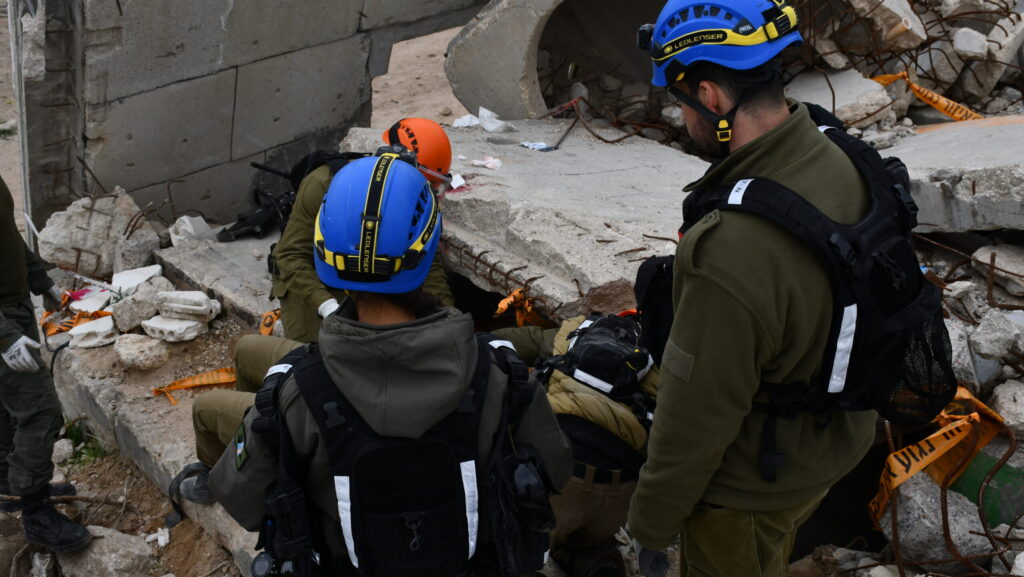
ZIKIM, Israel — Several Israeli soldiers stood over a large slab of concrete resting on a pile of rubble while another officer operated a mechanical lifting tool made by Holmatro, a Netherlands-based company that makes a range of hydraulic tools. If it looked like a scene from a search and rescue mission, that’s the idea.
The effort was part of a training exercise part of the Israel Defense Force’s Search and Rescue Brigade, which falls under the Home Front Command, to simulate a recovery effort in the wake of a missile impact or natural disaster.
Three days before Breaking Defense observed the training on Jan. 22, IDF Chief of Staff Lt. Gen. Eyal Zamir had visited the Home Front Command and said the IDF is preparing for the possibility of surprise war. Though he made no mention of Iran, it is a main threat that Israel continues to face, and one capable of inflicting heavy damage with ballistic missiles.
“In the face of multi-front threats against the State of Israel, the Home Front Command stands ready in defense — qualified, trained, and alert. The Command is prepared at all times to employ a wide range of capabilities to contend with an attack on the civilian home front and to save lives,” he said.
For this training, the 974th battalion and its reservists were in Zikim in mid-January. The drill was considered the first large-scale exercise of its kind near Zikim at a site specially designed to replicate destroyed buildings. Regularly used for training before Oct. 7, this area was attacked by Hamas and was near the frontline in fighting in northern Gaza during the two-year war.
Setting The Scene
The Army’s Digital Transformation
AI is reshaping the Army’s approach to cyber, electronic warfare and command and control. At TechNet Augusta 2026, leaders outlined how they’re turning emerging technology into capabilities for the battlefield.
When Breaking Defense visited the training site, there were hundreds of soldiers and other personnel acting as civilian liaisons, busy working on sites that looked like rubble and destroyed buildings. The concept was to give the soldiers a sense of a real-world scenario they might encounter, such as the dozens of impact sites made by Iranian ballistic missiles that Israel suffered in June 2025. The missiles damaged thousands of buildings and completely destroyed and collapsed numerous structures.
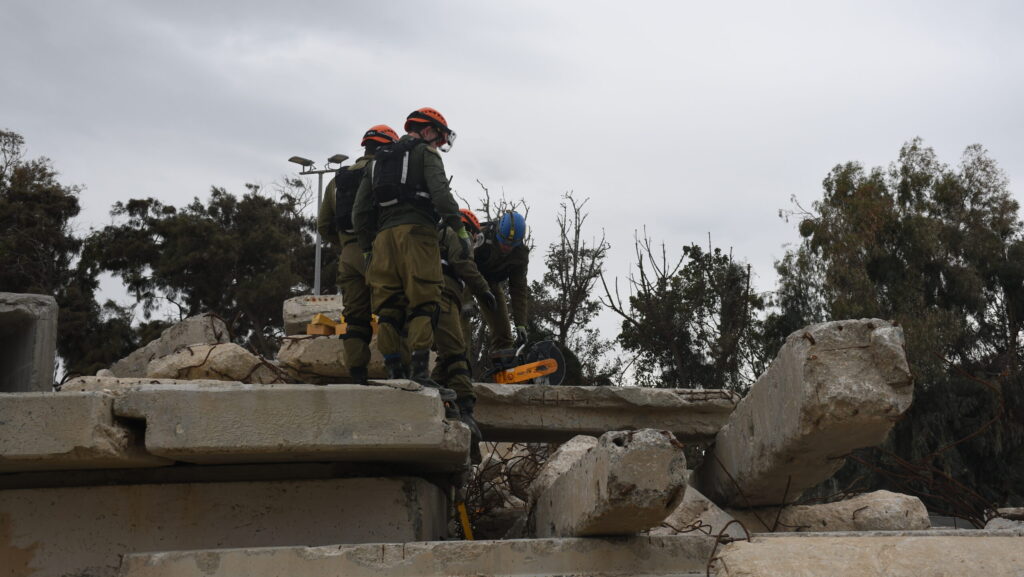
Col. S., who the IDF said could not be named for security reasons, told Breaking Defense that the IDF is ready to face different scenarios, including a new war. These comments came at a time when there have been increased tensions between Iran and Israel and threats that US President Donald Trump could order a new bombing campaign.
“This site simulates both a situation where rockets and missiles hit or an earthquake,” the IDF officer said. He noted that the site also simulated the search for bodies among the rubble. “All of our units were operating during the war and went to real actual sites and rescued people and now we are training for the next situation.”
The officer noted that the training is designed to be as realistic as possible. The use of new technology enables dummies that are placed in the rubble to make sounds, fake blood is placed on the scene, and machines that produce smoke are added to create a realistic environment.
To make this possible, the IDF has turned to a company called Extreme Simulations, whose personnel were present at the Zikim site. Oriel Herman, company CEO, said in a statement that it is the “official and exclusive medical simulation trainer of the IDF” and its teams have helped train over 200,000 soldiers since Oct. 7.
“A significant part of the training the company provided is in the field of disaster response: designing, building and operating large scale disaster response training for the IDF’s Home Front Command,” the statement noted. This includes specialized training in medical treatment in confined places as well as managing mass casualty incidents.
“Due to the increasing threat from Iran, the need for Extreme Simulations specialized training is in greater need and is used in a greater scale, specifically in the field of disaster response,” Herman added.
In parts of the multi-acre site, the IDF teams were practicing for different scenarios. In one area, a large plastic mat — the size of a twin-bed — was used to help bundle out a simulated wounded person. The plastic mat enabled soldiers to then drag it along the ground, like a bobsled, such that the plastic protected the victim and it was easy to pull along rather than be walked as a stretcher.
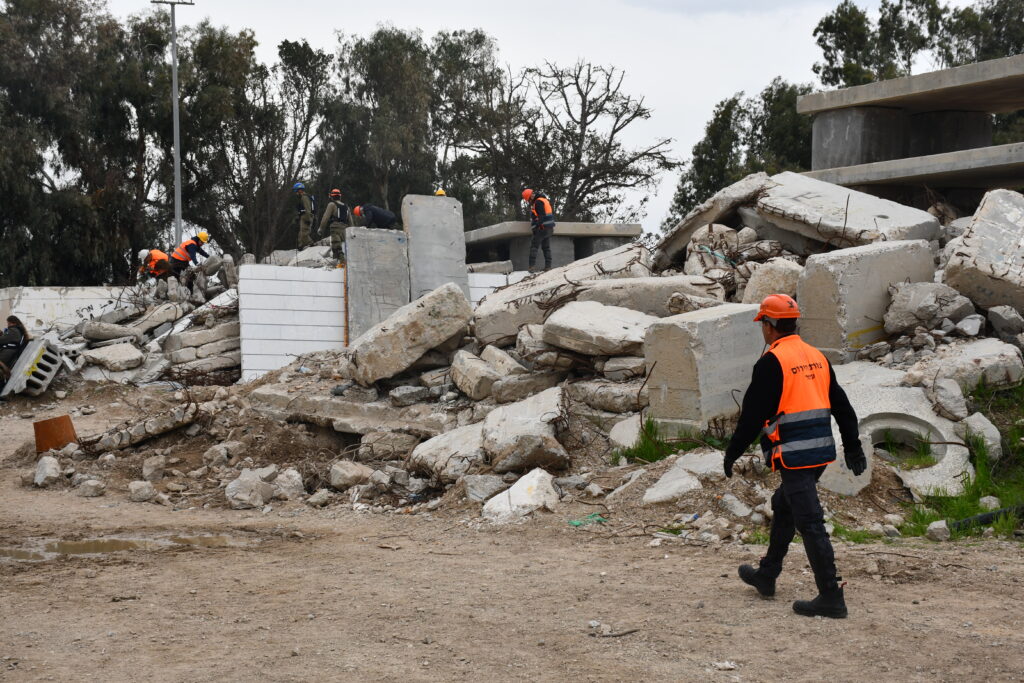
In another part, teams of men wearing colorful vests combing over piles of rubble represented the local authorities and civilian teams that work with the Home Front Command and Search and Rescue Brigade during such missions.
New Tech For Search And Rescue
Col. S noted that the past week was spent doing specialized unit training and is now bringing together the whole battalion for a final event. While these units use various types of jacks and other methods that have existed for years, there is also new technology being examined by the brigade. For instance, they are looking at how to effectively use drones to aid in search and rescue missions, the commander noted.
“We are also examining the use of AI because it is a tool to take data from a site and put it into an entity to distill the data and give you a product to work with to be able to find missing persons or rescue and engineers to accelerate the processing of information,” he said.
What that meant is building on the existing data sets that Home Front Command has already acquired by liaison work with communities throughout Israel. Israel’s IDF compiles a large amount of data and uses technology to respond to crises, putting information in the hands of units that are conducting search operations. Using AI could speed various processes or help provide a product that is needed to the unit.
In one training area, soldiers described how previously collected data can be used to help locate survivors. Cell phones can be traced, for example, and information about who lived in a building can be used to find where expected survivors might be.
The officer noted that Israel has a lot of experience now facing missile threats.
“We are preparing for something worse and we try to look and study not from the [previous] war we had but what will come. And I have much more confidence in our construction and regulations which have proven themselves,” he said.
Israel created new construction codes starting around the 1991 Gulf War, stating that buildings are supposed to have safe rooms and armored rooms. The safety of these shelters was tested in the Iran war and during the two years of war with Gaza, showing that, with the exception of a few direct hits, the safe rooms protected people.
“Even shelters from the 90s that took a hit saved lives,” the officer noted.
Zamir during his site visit stated, “The IDF is prepared to employ unprecedented offensive capabilities in their intensity against any attempt to harm the State of Israel. We are fully prepared defensively for every scenario.
“The integration of the Command’s capabilities and the close partnership with local authorities and emergency organizations, strengthens national resilience and ensures a response to every challenge,” he noted.
Breaking Defense Video