
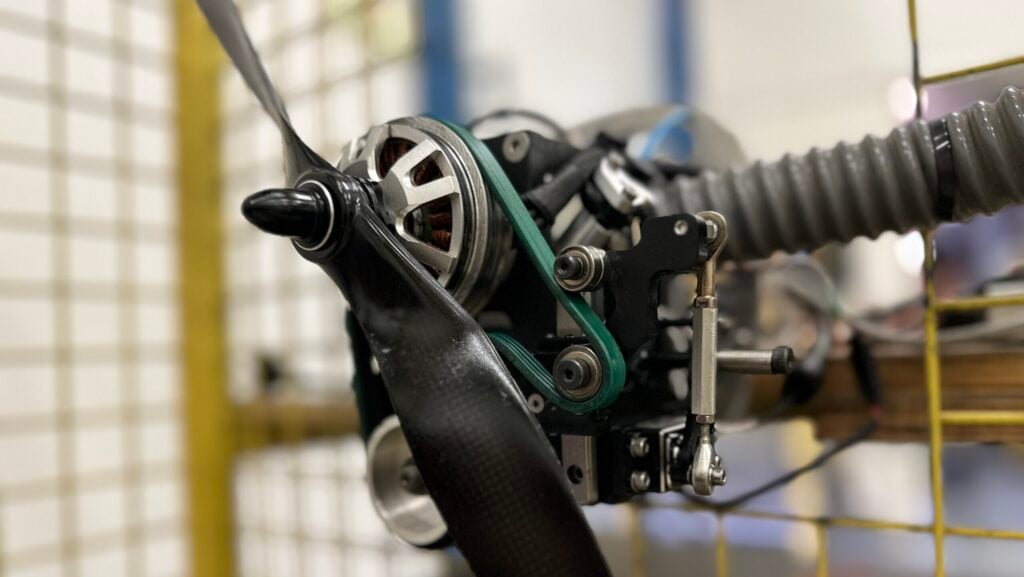
JERUSALEM — Israeli defense giant Elbit Systems has selected startup Lowental Hybrid to supply a new hybrid-electric engine small enough to fit in tactical drones, aiming for a breakthrough that could significantly extend the range of unmanned systems, Lowental Hybrid announced Wednesday.
“This achievement reflects how close cooperation between innovative startups and established defense leaders can accelerate meaningful progress in the UAV domain,” CEO of Lowental Hybrid Doron Fridman told Breaking Defense.
The company said in a statement that “the long-term agreement spanning a decade includes development, procurement, and services, with an initial scope of approximately $1.4 million, followed by substantial multi-year revenue from additional systems and support.
“Lowental Hybrid will provide dedicated engineering and integration support throughout the contract term, enabling Elbit Systems to integrate the hybrid propulsion technology across multiple UAV programs,” the statement continued.
Lowental Hybrid’s product for Elbit is called the Native Parallel Hybrid propulsion systems. The statement did not specify which type of Elbit UAV or loitering munition this might be for.
The new engine could offer a key innovation that until now has been limited to larger aircraft. Following discoveries of endurance limitations for all-electric platforms, users like the US Air Force have opted instead to pursue hybrid-electric approaches. Tactical drones face similar limitations, but are typically battery powered because hybrid-electric architectures have been difficult to scale down to be light and small enough to fit. The Native Parallel Hybrid engine aims to address that problem, offering a new propulsion solution that Fridman said could extend their flight duration by five times or more.
For example, Fridman compared an experimental UAV carrying batteries that weigh 6 kilograms and has a flight time of two hours to a UAV carrying batteries weighing 3 kg that could fly for 10 hours.


America must adopt a Sixth Domain of warfare doctrine
The Sixth Domain is not defined by geography. It’s a new kind of conflict in which autonomy and networked systems allow thousand-dollar consumer electronics to destroy multi-million-dollar conventional weapons systems.
“You can imagine what can be done in real UAVs, like Elbit is planning to do.”
Combining electric power with fuel has several advantages beyond extending the range and flight duration of smaller drones and loitering munitions. Fridman said that the UAVs can switch between the fuel engine, which may be louder, and an electric engine, that has a low acoustic signature. That means the UAV can be more stealthy when necessary.
He also discussed the types of integrations for using hybrid propulsion, stating, “It requires some engineering and integration but it’s relatively simple … taking some batteries out and replacing them with fuel tanks.”
The company’s statement said that “Elbit Systems sought to achieve significant flight duration improvements for tactical UAVs while retaining quiet, low-signature operation capabilities essential for ISR missions. The organization required a solution that would meet NATO standards for electric-stealth operation while maintaining military-grade reliability and reducing battery dependence.”
Another advantage is the fuel can be used to recharge the batteries during a long flight. Lowental Hybrid is one of several companies that have been innovating in the fuel space for smaller UAVs. For instance, in 2024 IAI discussed using a heavy fuel engine on smaller UAVs developed by Aerotor and Heven Drones unveiled a hydrogen-powered solution at IDEX in 2025.
The technology could also be applied to loitering munitions, Fridman noted. Loitering munitions are sometimes launched from tubes or rails or other methods, and units may prefer a quiet take-off, quickly accelerating from zero to 60 miles an hour without being noticed. Later, the munition can fly over a distance using a louder fuel engine.
Remaining in the air longer is a “game-changer,” Fridman said.
Fridman described the collaboration as an important milestone “enhancing endurance, reliability, and simplicity of use.” The company, founded in 2018, is also seeking other markets and customers in the US and Europe.
“We see a lot of interest in new propulsion,” said Fridman.