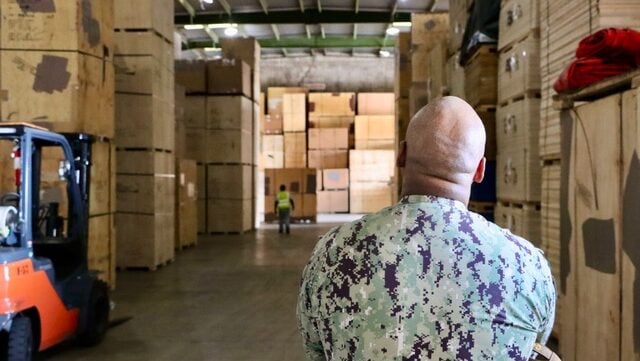
WASHINGTON — The Pentagon is turning its Permanent Change of Station (PCS) task force into a permanent, joint activity, a move that its first commanding general argues will pay dividends for America’s ability to wage war in the future.
And notably for industry, the transition to the new Personal Property Activity will require investments in new information technology systems as well, with an emphasis on commercially available software, Army Maj. Gen. Lance Curtis, the organization’s first commander, told Breaking Defense in a recent interview.
Defense Secretary Pete Hegseth signed out the change in a Jan. 21 memo, and announced it Jan. 23 with a video statement. He described the new agency as tasked with guaranteeing “high-quality, reliable, and efficient household goods and vehicle shipment services to the more than 300,000 warfighters, worldwide, who move somewhere every new year.”
Based at Scott Air Force Base in Illinois, the activity will report to directly to Hegseth, and will stand up officially on May 1. Before the formation of the task force, PCS was managed through US Transportation Command.
Ahead of the announcement, Curtis talked with Breaking Defense about why the new setup is vital for keeping troops focused on their missions rather than on relocating.
“The [Pentagon] moves approximately 300,000 service members [and] civilians every single year. . . . It’s a $3 billion program,” Curtis said. “Because of the magnitude, that it’s going to touch every service member somewhere over three years, really led us to the decision.
Katherine Kuzminski, the director of studies at the Center for a New American Security think tank, told Breaking Defense the decision “sends a good and strong signal to service members and their families that this is something being taken seriously.”


Meeting Zero Trust goals while maintaining information dominance
Balancing security and access to data are critical to providing users with trustworthy, reliable data for real-time decisions.
“With a task force, there isn’t necessarily a sense that this would be a long-term, accountable organization. Being permanent sets up an accountability structure,” she added. “It’s a good idea.”
Even before its elevation this week, the task force has been putting in work on making major changes to the PCS system.
The roughly 120 people office has been pulling together fragmented PCS data from across the services into a single view of the global flow of people and belongings. That’s managed by a joint operations center, along with a call center where service members can report issues — manned by active troops who understand the pain points of military moves, something Curtis said has been well received by the military community.
In the eight months the group has been active, Curtis said, it’s been “relentless, aggressive and decisive” in handling PCS problems. That includes communicating with leaders with skin in the game in order to avoid some of the infamous roadblocks that can come out of the Pentagon.
“We really felt we had to have good coordination within the building, on the Hill, with the service members and with industry,” he said. That included the services, which previously each had an office that managed the PCS process for their forces only — and which traditionally don’t love giving up responsibilities.
“We took three weeks in the Pentagon to meet with each one of the services. I met with service secretaries, chiefs of staff, undersecretaries and primary staff from each one of the services. I think the fact that we did face to face conversations, including with the Coast Guard, and took the time to answer their questions, helped the buy in,” he said.
Which comes back to the argument about why the PCS change matters for military capabilities.
“The services know this is something that takes bandwidth from them,” Curtis said. “Given the fact they’ve got multiple things going on at any given time I think they view this as fortuitous, having one organization that looks at this so they can get their time back to focus on warfighting.”
Kuzminski concurred, saying “I do think there are impacts on service members’ ability to get integrated into their new units and trained up to speed, knowing everything else is being taken care of.”
Now that it is a permanent agency, the office expects to add about 120 new people and have an operating budget of around $27 million, per a defense official. But other investments are likely ahead.
Investments In IT, Software
Underpinning the complex PCS process is a series of different software systems and an IT backbone. But officials said more investments are needed to achieve the future Curtis and his team envision.
Hegseth “wants a system that is very intuitive and supports the warfighter,” Curtis said. “Our current system is going to time out — it’s just aged. . . . That’s why we place so much emphasis on the modernization.”
The defense official said the activity anticipates the upgrades will cost in the “millions,” but they do not have a final number yet. (The memo standing up the activity notes that it will assign as “Senior Procurement Executive” to handle acquisition for the organization.)
Shortly before the task force was created, the Pentagon decided to cancel the Global Household Goods contract, an agreement with a potential price tag of $17.9 billion that put a single contractor in charge of the US military’s vast network of domestic and international moves, while creating new measures for people whose belongings are lost or damaged to hold movers accountable, among other goals. (The department had already sunk over $100 million into the effort when it was cancelled, per the Government Accountability Office.)
Included in that effort was a software system called MilMove, which lets troops and their families book and track shipments of their belongings from one home to the next. And while the contract may be dead, the task force hopes it can salvage MilMove to avoid building a new centralized system from scratch, said Col. Paul Licata, the PCS task force’s director of strategy and plans.
“What we are working through right now is taking that software investment that the department already paid for and using it as the software environment to replace the legacy defense personal property system,” Licata told Breaking Defense.
“We’re going to build out, over the next three years, all of the functional modules that exist in the old system into the system that we built to work with the Global Household Goods contract,” Licata said. “Service members were pretty happy with the user interface. It was a modern user interface. It was cloud-based. It had all the right pieces and parts. It just doesn’t have the right business back end, if you will.”
Ultimately, DoD may need to plug multiple commercial products into the MilMove software to meet its unique needs, and department officials are now hashing out a budget for the upgrades.
“Software is always a tricky thing within the government, so we’re taking that pretty carefully,” Licata said.