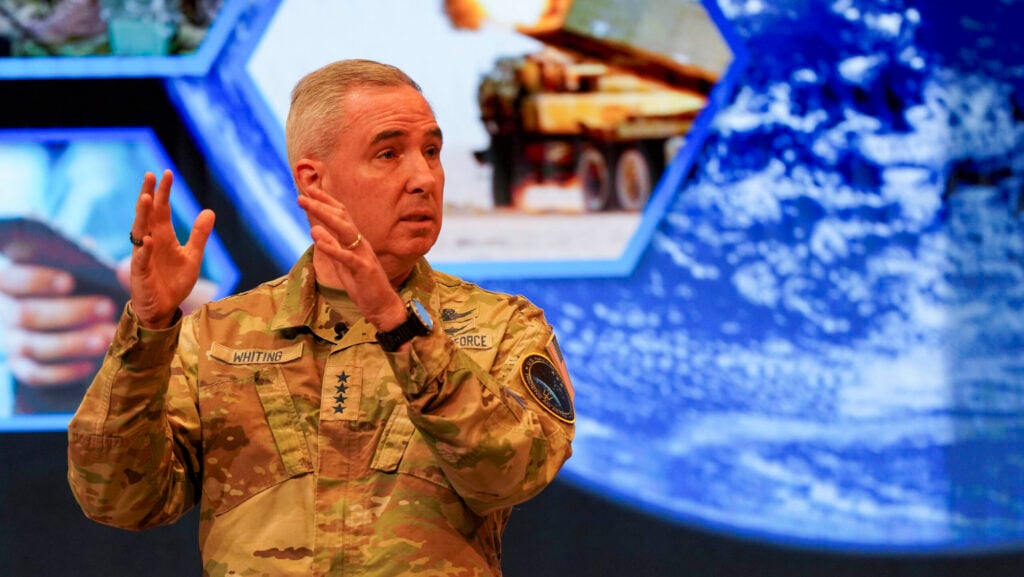
WASHINGTON — Gen. Stephen Whiting, commander of US Space Command (SPACECOM), today called for a foundational pivot to maneuver-based space operations to echo how the rest of the Joint Force fights — including increased investment in enabling technologies such as refueling, repair and on-orbit logistics, as well as new scaled-up exercises.
In a speech at the annual Space Mobility Conference in Orlando, Fla., he cited the core Marine Corps doctrine (MCDP 1) of “shattering enemy cohesion through rapid, focused, and unexpected actions” as a model for where space warfighting needs to go. He added that because size of SPACECOM’s area of operations is huge, making a maneuver warfare a reality requires “sustained” logistics based on-orbit.
And while the Space Force remains undecided about the military utility of maneuver-enabling technologies such as refueling, Whiting told reporters following his speech that SPACECOM firmly believes maneuver warfare in space is critical to success of both its own mission and overarching US military operations in the future.
“We see that operational demand [for maneuver-related capabilities] at US Space Command as we’re thinking about our requirements in space, thinking about the missions that we’ve been given to to deter conflict and to win,” he said. “Those investments, we think, just have to continue to grow, and the Space Force is going to need more resources to do that.”
Further, Whiting said he has seen forward movement in demonstrating the value of maneuver capabilities such as rendezvous and proximity operations, refueling and responsive launch, including to the Space Force.
For example, the “Victus series of launch activities that the Space Forces has demonstrated to show the rapid launch capability, the ability to put things on orbit quickly,” he said. “That’s a part of this story, because we want to be able to replenish capability.”
Further, Whiting said that he has “participated in exercises and tabletops that the Space Force has chartered that I think, are exploring these issues.”

Data overload threatens decisionmakers as autonomy expands
Reducing cognitive overload on warfighters while improving “time to trust” for autonomous systems is a matter of design.
He noted that as a combatant commander, he has the luxury “to demand capability without being beholden to a budget,” which is something that Space Force leaders do not enjoy.
“So, today’s speech was just about us looking forward to say, ‘Here’s what we see that we need. And we really got to start turning the ship toward those investments,'” Whiting said. “I think we’re making progress, and we’ll continue to work with the Space Force to
accelerate that progress.”
Whiting also used his Space Mobility speech today to introduce SPACECOM’s nascent “Apollo Maneuvers” exercise concept, based on the Army’s 1941 Louisiana Maneuvers in preparation for World War II. These exercises would involve Guardians undertaking large-scale satellite movements, responsive launch activities, and “spectrum maneuvering” operations.
“This is the seed of an idea that we still have to continue to develop, but we see individual elements of this being trained and tested and exercised, and we’re trying to think, ‘How would we pull that all together?'” he told reporters.
“We need to work with other stakeholders, like the Space Force, but we want to really think that through and then ask: ‘how would we holistically look at a maneuver and logistics type exercise for space’?”
Whiting said it will take “a few more months” to hone an internal SPACECOM concept for such an exercise campaign, but that in his best-case scenario the Apollo Maneuvers series could launch circa 2027 given the need to “fit into the exercise schedule, fit into the training schedule.
“But we think with the various elements that are out there, there’s probably some way we can pull that together and, that’s, again, a conversation we want to have with a broader set of stakeholders to find where on the calendar can we put that in and then align everybody to such an activity,” he added.
In the nearer term, Whiting said SPACECOM intends to initiate a set of four quarterly tabletop exercises at the classified level involving commercial providers.
“This first one is going to be focused on thinking through weapons of mass destruction in space, if that were to happen,” he said. “It’ll be focused, from our perspective, on all of the joint functions. And as I mentioned today, movement/maneuver and sustainment are two of those joint functions; but fires, intelligence, information, command and control, all of those seven joint functions, will be the kind of things that we’re thinking through.”