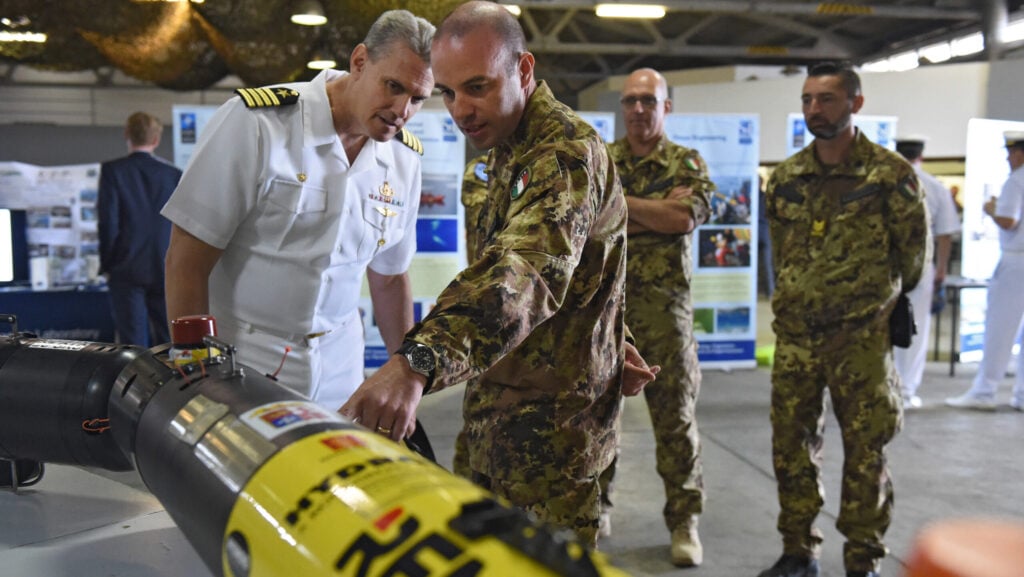
BELFAST ― Naval manufacturer Huntington Ingalls Industries (HII) has doubled the size of its Portchester, England, unmanned vehicles site as a way to increase support capacity for UK and European customers.
“This new facility will increase the square footage [at Portchester] by 6500 square feet and allow us to have a completely flexible REMUS 620 support facility, as well as supporting the integration of our Odyssey autonomy and the development of our new ROMULUS USV [unmanned surface vehicle] fleet for the UK and nearby continental Europe,” Nicholas Green, senior manager international business development at HII, told reporters during a media call on Monday.
Since 2001, the UK Ministry of Defence has procured REMUS 100, REMUS 300 and REMUS 600 unmanned underwater vehicles [UUVs] for mine countermeasure [MCM] missions.
Green added that the expanded premises will also enable HII to deliver REMUS 620 assembly and the opportunity to increase training capabilities to “our customers and allied navies, allowing us to have multiple training sessions at any one time.” He declined to comment on the level of investment HII had poured into the expansion. The 620 variant features a range of 275 nautical miles and a battery life of 110 hours, according to HII [PDF].
Additionally, the facility will also be used to support HII’s partnership, announced in September 2025, with UK firm Babcock, based on autonomous launch and recovery of REMUS UUVs through submarine torpedo tubes.
Duane Fotheringham, president of mission technologies unmanned systems at HII, said during the briefing that the company has delivered more than 750 REMUS UUVs to 30 users “around the world.” The systems can be operated either independently or as part of a team and are mainly designed for intelligence, surveillance, and reconnaissance (ISR), mine countermeasures, anti-submarine warfare, and electronic warfare missions, according to HII company literature.
Alluding to geopolitical affairs and tension more broadly, Fotheringham noted that as a result of “both the the US military and our allied militaries investing a lot more in defense,” spending increases are happening “across the board, and certainly this facility, this expansion in the UK, is in part to support those efforts.”
RELATED: NATO allies, besides Spain, set to make 5 percent GDP spending pledge
“MCM [Mine counter measures] operations [are at] the forefront of what REMUS is being used” for across Europe, said Green. He noted that countries from the REMUS user base including Estonia, Lithuania, Norway and Sweden will all be able to send their vehicles to the UK for repair and maintenance. A NATO REMUS users group meeting is also scheduled to take place in Portchester this week. The facility does not however host production of the UUV, which is manufactured at HII’s Pocasset, Mass., site.
“There is intent to do a level of production in the UK where possible and where we can, due to [the] licensing side of things, especially on the ancillary work, especially things like the launch and recovery systems for the [REMUS] 620 as well as basic level assembly of the 620 vehicles themselves,” said Green.
He said that HII is pursuing a “number” of additional UK business opportunities but could not go into detail about them, “due to competitive advantage.”