
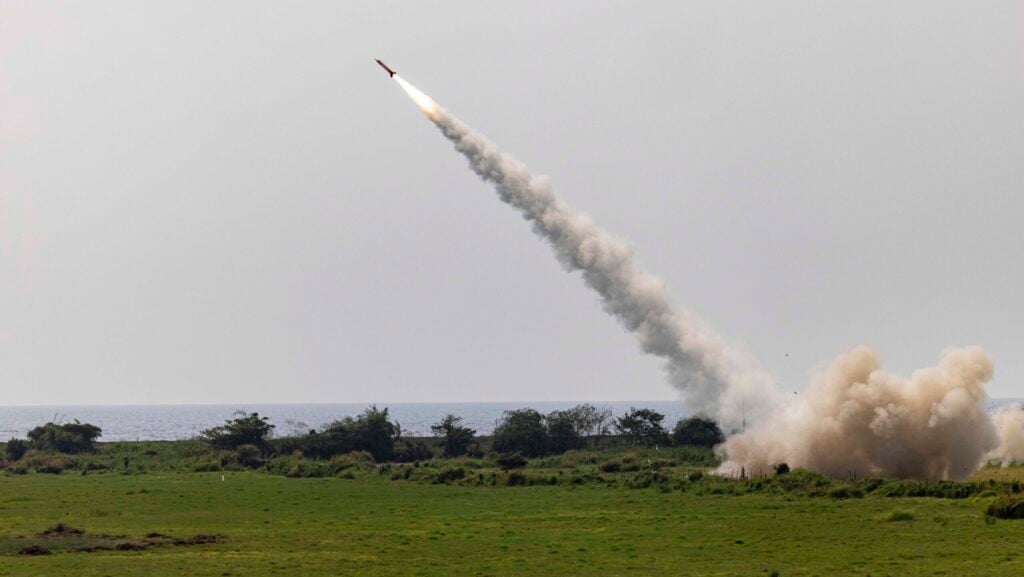
BELFAST ― RTX subsidiary Raytheon is investing over $1 billion to enhance its Patriot air and missile defense system supply chain as the company anticipates additional European orders in the face of Russia’s threat, according to a top company official in Europe.
An uptick in new Patriot business across the continent in 2025 was bookended with Spain’s $1.7 billion order for four fire units — a matter of weeks after Ukraine President Volodymyr Zelensky said on social media platform X that he wants to order 25 Patriot systems from the US. At the time, he also called for European “colleagues” to loan “their systems now and then take back ours once they arrive from the manufacturers.” Earlier this month, it was also reported that Kyiv has deployed two more Patriot systems to defend against Russian attacks.
Last week, Breaking Defense spoke remotely to Tom Laliberty, president of land and air defense Systems at Raytheon, to discuss prospects for more European Patriot orders, amid a rearmament frenzy in the region and an urgent need to bolster air defenses to counter Russian aggression. The conversation also drew on Patriot’s effectiveness in Ukraine in light of improvements to Russian electronic warfare capabilities, missing out on a Danish Patriot order and Raytheon’s perspective on the European Union’s drone wall.
This interview, conducted prior to President Donald Trump’s executive order regarding defense corporation stock buy-backs, has been edited lightly for length and clarity.
BREAKING DEFENSE: [On Patriot] is there anything you would like to begin [the conversation] with?
TOM LALIBERTY: One of the reasons we want to talk with you is [because] we continue to see significant demand for our Patriot air missile defense system in Europe, and the recent [demonstration] of that is Spain just announced that they’ve acquired additional Patriot fire units. And so, we’re really excited about that. Spain is an existing customer. This additional set of capabilities just shows their continued confidence in the system. They join a pretty large set of European and NATO partners who all have their confidence in Patriot.
If we look back slightly then at 2025, in terms of European orders, [they included] Germany, Netherlands and Romania and as mentioned Spain. So did that kind of tally up with what you were expecting? Was there disappointment after Denmark decided not to pick Patriot?

Europe’s military advantage depends on sovereign command of the ground truth
As NATO and European governments accelerate investment in space-based intelligence, decision advantage will depend on how quickly sovereign and commercial capabilities can be fused into a trusted operational picture.
As part of a kind of Team USA with our partners Northrop Grumman and Lockheed Martin, we thought we gave a very competitive proposal [to Denmark]. We have the confidence in Patriot as the best air missile defense system in the world, you know specifically why, Denmark, chose [MBDA’s SAMP/T] is really for them [the Danish government] to comment on. They did cite schedule [as a reason for not selecting Patriot]. We thought our schedule was very competitive, but they made their choice. But our achievements in 2025 are very much in line with our expectations.
There was a company plan to accelerate Patriot radar production by 25 precent before the end of 2025, did you meet that target?
We met that target [and we are] delivering early on orders that we have in our backlog. That’s enabled us to make some pretty good commitments to these countries going forward. The company is really stepping up in a big way in terms of making that happen.
So one of the things that we’ve been very proactive in doing is [meeting the challenge of] what I call the lumpiness of the way our orders come in, that’s not necessarily conducive to our supply chain. So, just kind of [making an extra effort to] smooth that out. We’ve invested more than a billion dollars in securing material ahead of orders, and that makes it a lot easier [to deliver on new orders]. So that enables [us to] keep our supply chain stable, keeps our factory stable, our workforce stable. And really helps us, advance that ability to shorten our lead times. The fact that we see the strong demand gives us the confidence to go ahead and put that funding at risk.
How much do you factor in Ukraine’s push for more Patriot systems when making these investment decisions?
When we look at that demand, obviously Ukraine is very much in that analysis. We continue to engage with the Ukrainian customer on additional Patriot systems. Those might come directly through [the] US government, or they might come via donations from European partners, and then [we could] potentially backfill those.
[It requires] government engagement from a variety of government stakeholders for any of those decisions to be made. And we of course stand in support of our Ukrainian customer, and the United States and the other governments that are very much doing all they can to support the Ukrainian cause.
There has been lots of commentary about how improved Russian EW [Electronic Warfare] has has become. In the early stages of the war, there was many successes for Patriot, particularly with intercepts of Kinzhal [missiles], but from your view, from feedback from the customer, is Patriot still as robust to threats, as it was say in early 2022?
What I would say about that is I don’t want to get into any specifics, but the [Russian] threat continues to evolve. Nothing ever stands still. Our ability to modify Patriot evolves as well.
We’ve been very proactive working, you know, through [the] US Army, with Ukraine, and making sure that we keep Patriot as up to date as humanly possible. The very fact that Ukraine has probably got Patriot at the very top of their list in terms of what they want for future procurements, I think, is a statement in itself in terms of their confidence of Patriots ability to defend Ukraine and our ability to keep Patriot updated as the threat continues to evolve.
Outside of Ukraine, air defenses are a huge priority in Europe, so how do you see demand for Patriot shaping up in 2026, especially as we see greater geopolitical tension emerging between the US, Greenland and Denmark?
I don’t want to talk about specific countries because I don’t want to get ahead of their procurement process, but we do have additional Patriot orders coming in 2026, in terms of both fire units and PAC-2 [Patriot Advanced Capability-2] GEM-T [Guidance Enhanced Missile-T] missiles. We’ve got significant backlog, both on that fire unit side and on the missile side. We have the 1,000-unit order through NSPA [NATO Support and Procurement Agency] for NATO partners. They’ve actually increased that additional [buy] to specifically service Germany. We’ve got all that backlog that we’re working off and we have additional missile buys coming as well.
Just specifically on Patriot, 21 European suppliers participate in our supply chain and that’s not just for Europe. That’s our supply chain. Supply in the United States, to the other 18 partners in the Patriot family. [There is] significant engagement with our European industrial partners to ensure that we keep a viable supply chain going. Maybe most notable in that would be our joint venture [also known as COMLOG] we have with MBDA Deutschland to produce the Patriot missile in Germany. So that 1,000 lot that I talked about, that’s being produced in Germany. So not just an export for the United States, it’s really coproduction in Europe.
Has production started yet?
MBDA Deutschland themselves host the COMLOG joint venture all up around the integration facility in the Schrobenhausen campus. We are breaking ground and building that facility, and we’ll be delivering missiles in 2028.
How do you perceive European future flagship defense programs — a closed shop or opportunities for joint ventures?
We’re very much encouraged by Europe’s growing investment in their defense industrial base. It grows supply. Aerospace and defense global supply chains are being enhanced because of the investment that Europe is making. Clearly, the overall goal for all of this is to strengthen deterrence against aggression. As a citizen of the world, I think we’re all encouraged by that, that Europe is investing in defense and doing its part to deter aggression.
We’ve got a long history of doing transatlantic [industrial] partnerships. We’ve got our NASAMS [National Advanced Surface-to-Air Missile System] partnership with KDA [Norway’s Kongsberg Defence & Aerospace] and [as] mentioned COMLOG with MBDA. We just announced a teaming agreement with [Germany’s] Diehl to coproduce Stinger. We’re still working through the appropriate government channels to make that a reality. So we’re very encouraged by that.
We could see in the coming months how the European Union wants to move ahead with its drone wall concept. Is Patriot something that could play into that? Would Europe be able to fund something of that nature?
I think what you find is there’s no real silver bullet for any of this. You need layered air defense and when you look at what Raytheon offers, we provide that full spectrum. I like to call it from mud to space. We have space based systems. We have upper tier systems that we participate in, Patriot is in the lower tier. We have things like NASAMS in that medium range, short range air defense level. We’ve got a system called LIDS [low, slow, small, unmanned aircraft Integrated Defeat System] that provides counter UAS capability. We’ve got MANPADS with Stinger lasers.
So that entire spectrum of air defense capability is really what’s required, because what the adversary is doing, as you probably see, you know firsthand in your reporting, is they try to overwhelm air defenses. If you have a system that’s specifically optimized towards ballistic missiles, then you’re going to get 1,000 drones. If you’re specifically focused on 1,000 drones, you’re going to get ballistic missiles or high-speed cruise missiles. So you really have to be prepared for all of it. And that’s what we’re trying to do, is to have that wide range of capabilities and then the appropriate level of integration between those capabilities to ensure that you have that continuum of coverage through that layering of air defenses.