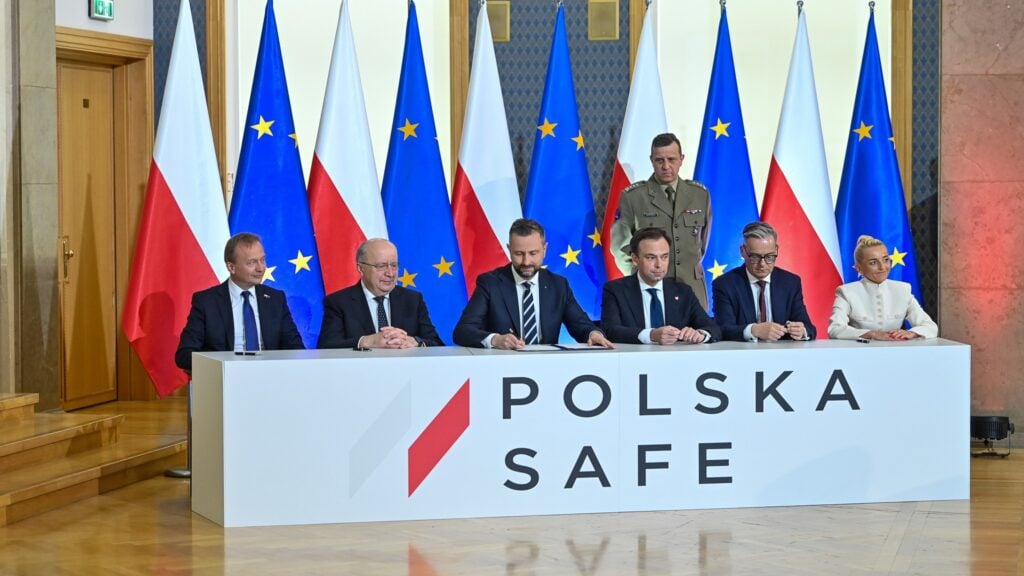
WARSAW — After a politically turbulent process, Poland has become the first country to sign the EU’s Security Action for Europe (SAFE) instrument agreements, clearing the way for Warsaw to begin receiving €43.7 billion ($51.6 billion) in defense funding by the end of the month.
The signing occurred Friday in the presence of a group of key leaders from both the EU and Poland, underlining the importance of the event, which Polish Prime Minister Donald Tusk described as a “special moment” that reflects a “turning point in the history of both Poland and the European Union.”
“We all hope to avoid open conflict, but we know the time and place we live in, so we want to ensure that the Polish army and the Polish defense industry will be able to meet any challenge,” Tusk added.
“It is still a huge task, but it will be simpler thanks to a change in policy, a change in strategy in the European Union … This is also the day when all of Europe, shows that it has learned a lesson from history and that it is ready, in accordance with the recommendations and in cooperation with the United States, to take on much greater responsibility for our security.”
Andrius Kubilius, European Commissioner for Defence and Space, said at the signing that “Poland is truly a leader in Europe, when it comes to defense of Poland, defense of the [NATO] eastern flank, and defense of all of Europe. … Today we need common defense [and] we need to produce much more defense equipment.”
Created May 29, 2025, SAFE is based on a pair of twined loans, where the European Union borrows capital on international markets and then re-lends it to member states. The higher credit ratings across the EU mean the costs of the loans suddenly become more affordable for smaller member states. The loans also come with a 45-year repayment horizon and a ten-year grace period on principal repayment — meaning that for the first decade, the state budget will only be required to pay interest.
In addition to Poland, other EU states taking part in SAFE loans are Romania (€16.7 billion), France and Hungary (€16.2 billion each), Italy (nearly €15 billion), Belgium (over €8.3 billion), Lithuania (€6.37 billion), Portugal (€5.84 billion), Latvia (€3.49 billion), Bulgaria (€3.26 billion), Estonia (€2.34 billion), Slovakia (€2.31 billion), Croatia (€1.7 billion), Cyprus (€1.18 billion), Finland and Spain (€1 billion each), Greece (€787 million) and Denmark (€46.8 million).


How integrated modeling and simulation accelerates Europe’s defensive edge
Lockheed Martin’s ACES platform delivers a shared virtual battlespace that strengthens readiness, interoperability, and faster decision-making through advanced, integrated modeling and simulation capabilities designed for evolving global threats.
Poland’s funds will finance over 120 defense-related projects, including new contracts and amendments to existing agreements, with 40 agreements expected to be signed before the month ends. Companies from the Polish Armaments Group (PGZ) will benefit the most from this program, with $4 billion invested in the San anti-drone system, $278 million for construction of the Ratownik rescue vessel, and $22 million for off-road ambulances.
Other Polish companies, such as the WB Group, will also benefit in expenditures on the production of ammunition, military equipment, anti-drone shields, and other new technologies. And the fact that there are so many other countries lined up to get SAFE funding also opens the opportunities for Polish firms to export to those nations.
Bypassing The Veto
Getting to the signing was no easy task, however. SAFE has been a target of political attacks from opposition parties, most notably from President Karol Nawrocki, who said the loan program “threatens Polish sovereignty.”
In March, Nawrocki vetoed the government bill implementing the SAFE program and submitted his own bill to the Sejm on the so-called “Polish SAFE 0%”, which would serve as an alternative to the EU SAFE program and provide Poland with approximately $51.5 billion for defense from the National Bank of Poland’s profits. According to Nawrocki, those funds would not incur interest and not constitute credit obligations until 2070, and avoid tying Poland’s security into political changes at the European Union.
Nawrocki hit a talking point that the SAFE loans would be repaid by Poles who are teenagers now, and claimed that the loans were “incompatible with Article 4 of the EU Treaty, which states that security is the responsibility of the Member States and not the European Union.”
But Tusk’s government decided to bypass the president’s veto by abandoning the Sejm-passed bill in favor of existing legal solutions. Warsaw adopted a special resolution called “Armed Poland” (Polska Zbrojna) authorizing the ministers of defense and finance to sign an agreement with the European Commission without the need to introduce new legislation.
Funds from the SAFE program will now be transferred directly to an existing Armed Forces Support Fund at BGK. But due to the president’s veto, SAFE funds can only be allocated to modernizing the Polish army. Projects involving the police, Border Guard, and State Protection Service — whose funding is controlled by Nawrocki — will be replaced by military investments. (The government says it is working on a new plan, without involving the EU, for funding those domestic security services.)
“I still don’t understand, how it was possible to block 180 billion złoty for Poland, for the Polish army, for Polish defense companies,” Tusk said at the signing. “I will never understand this. [But] we will find ways, just as we found a way, to finalize the SAFE project, we will also find ways to make European funds much more accessible to the border guard, the fire service, the police, and civil defense, because this is our great common task.”
Breaking Defense Video