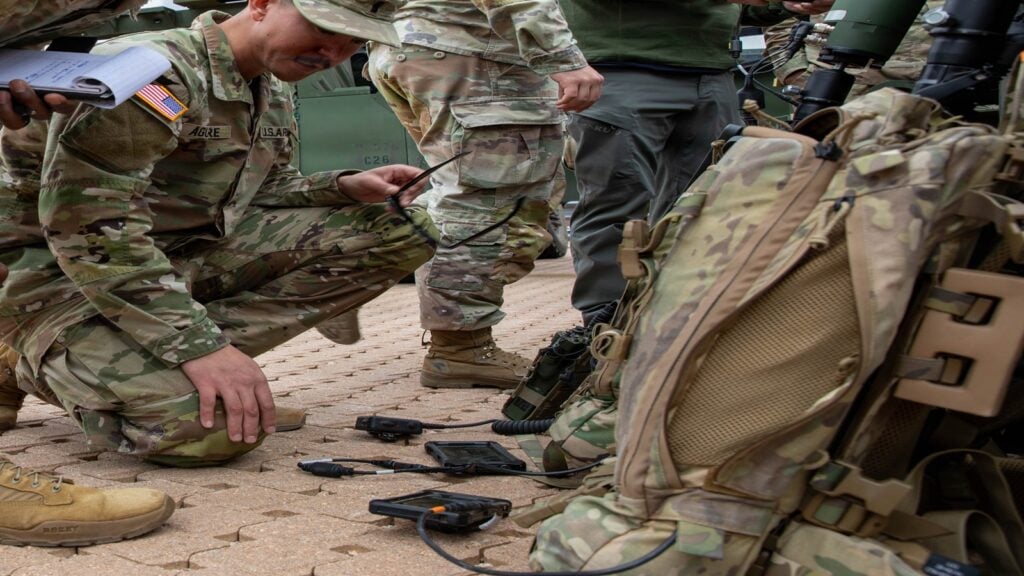
WASHINGTON — For the first time, the Joint Electromagnetic Spectrum Operations Center (JEC) hosted a tabletop event for senior leaders to examine what it means to operate within the electromagnetic spectrum environment.
“Aurora Pulse was designed for senior leaders. It allows us to get together and really discuss at that strategic level how we would operate in this particular environment, and then how do we need to adapt our tactics, techniques and procedures,” Maj. Gen. AnnMarie Anthony, director of the center, said in an interview with Breaking Defense.
The March exercise hosted a variety of organizations from all the services — to include the Coast Guard, the Joint Staff, members of the Intelligence Community as well as Northern Command, Cyber Command, Indo-Pacific Command and Strategic Command. It was the first such tabletop exercise put on by the JEC with senior leaders such as the J3s and J5s of the combatant commands, who are in charge of operations and plans. The exercise showed the leaders how to evaluate operating in the contested and congested electromagnetic spectrum.
Electromagnetic spectrum operations have often been an overlooked discipline in years past with US forces operating against a technologically inferior adversary for the last 20 years. Now, as more sophisticated nation state actors understand how reliant the US military is on the spectrum — for everything from communication, to precise munitions to the location of troops — bad actors are seeking to deny it, and proving adept at doing so.
Bringing in senior leaders to test tactics and capabilities, rather than lower level staff, highlights the significance and importance spectrum operations are playing and will play in future conflict.
“The reason that we did Aurora Pulse, and reason we feel it’s necessary, is because we really can’t assume, as warfighters, that the electromagnetic spectrum is going to be a permissive environment. And it is a critical warfighting maneuver space … it’s actively contested by our adversaries,” Anthony said.
The tabletop focused on an Arctic scenario because the spectrum operates differently there, allowing forces to also look at environmental challenges, Anthony said, with the Arctic providing the most demanding conditions to evaluate. Over the course of three days participants walked through complex scenarios that simulated operations in a degraded and congested electromagnetic spectrum environment exploring how potential adversaries could try to deny access and how environmental factors could disrupt systems.

Why Bigger Fences Aren’t Enough in the Age of Drones
Traditional thinking about how to protect facilities must adapt to new threats such as drones or downstream attacks.
“What this really allowed us to do is we were able to say, hey, given this scenario, given these objectives, this is how we would approach it. And then through the gameplay, see if we were successful,” Anthony said. “What Aurora Pulse allowed us to do, was really explore our tactics, techniques and procedures, operating through the electromagnetic spectrum, and see where we need to do any changes or tweaks to our TTPs today.”
Anthony said they identified certain areas where they need to improve communications, coordination and spectrum management, providing valuable insights to adapt tactics and technologies in order to maintain freedom of action.
While there are plans to host another such tabletop exercise, Anthony said they don’t have a date yet.
A future event will look to bring in more quantitative feedback and modeling and simulation to participants in order to bring more fidelity to the understanding of operations in the electromagnetic spectrum.