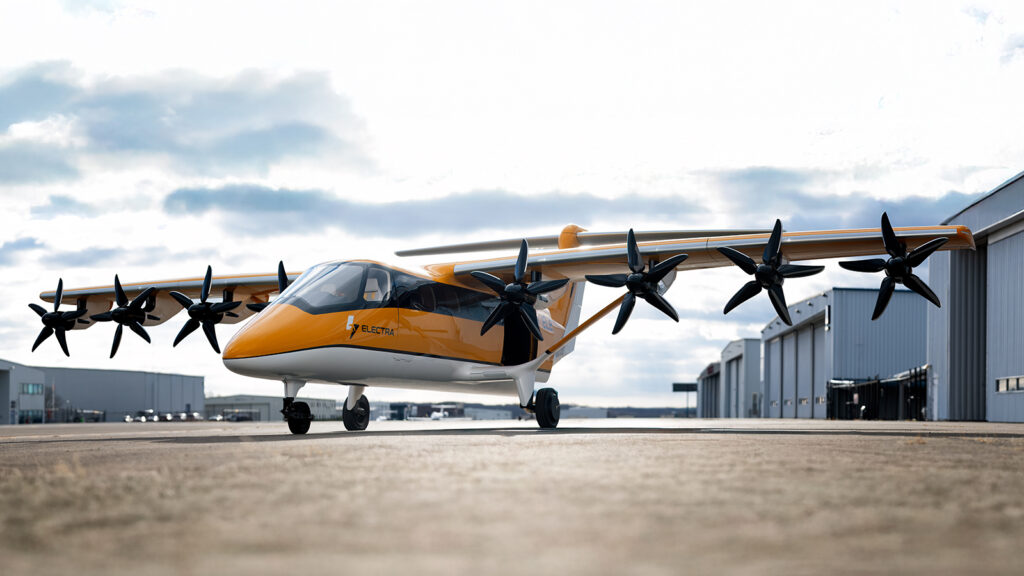
MANASSAS, Virg. — Sitting in a hangar in the exurbs of Washington, DC, at first glance electric aircraft startup Electra’s yellow and black hybrid-electric EL9 looks like many other aircraft parked at the regional airport here.
But a key difference quickly becomes apparent upon closer inspection, what the company calls the aircraft’s secret sauce for ultra-short takeoff and landing: Rather than a more traditional one- or two-prop propeller design, the EL9 sports eight electric rotors distributed along a fixed wing.
“Our goal is to fundamentally transform air travel,” Electra CEO Marc Allen told Breaking Defense during a December visit to the company’s facilities. “We want to create an airplane that gives you direct aviation,” Allen added, referring to nomenclature for point-to-point air transport.
That includes for the US military, a new customer Electra is courting with the EL9, also called the Ultra Short, and the recent establishment of a defense business unit.
According to the company, the EL9 will accommodate nine people, or a maximum of 3,000 pounds. For the Pentagon, that could mean moving small amounts of people and cargo in austere conditions, whether for regular resupply runs, standard transport, or special ops missions.
“The Pentagon has been very clear in its planning work that runway independence or runway agnosticism is a missing part of the puzzle,” Allen said. “If that’s true, then this is absolutely right in the center of the target.”
Company officials acknowledged that plenty of work for the EL9 still lies ahead. The aircraft in the company’s hangar is a full-scale model; a prototype is planned to fly either late 2027 or early 2028, according to Donn Yates, the head of Electra’s government programs. The firm hopes to certify the EL9 with the FAA by 2029, opening up the commercial market. (On the day of Breaking Defense’s visit, Electra announced it submitted its application to the regulatory body for EL9’s Part 23 type certification.)

If software and agentic AI are key to mission success, accelerate them to the front lines
A commercial prototype in a sandbox is different from deploying AI across classified networks.
Speaking aboard the EL9 model, Yates, a former Boeing executive, said the aircraft will cruise at a max speed of 175 knots (about 200 mph) and fly between 8,000 and 12,000 feet. The company says the aircraft also comes with 600 kilowatts of power, meaning it could act as a mobile power station for other systems, and sports fly-by-wire controls that could support autonomy.
Yates explained that the aircraft achieves its ultra-short operations with a concept known as blown lift, where motors blow air over the wings. The blown lift technique has been used by larger planes for decades, but a small aircraft like the EL9 would’ve previously required motors too heavy for the concept to work, Yates said. Thanks to new breakthroughs, distributed electric propulsion provides sufficient weight savings to make EL9’s blown lift viable. The batteries that drive the rotors are continuously charged by an onboard gas generator, which could also act as a redundant power source if a battery gives out.
Company figures said Electra’s new defense unit could tailor the EL9 to concepts like the Air Force’s Agile Combat Employment approach that disperses operations to blunt an enemy attack on fixed sites. The Air Force previously contracted with Electra as part of an $85 million strategic funding increase, under which the company has tested an earlier “Goldfinch” tech demonstrator alongside the service. The Army has additionally funded work with Electra to advance research in hybrid electric powertrains.
Using a map of the Indo-Pacific, Yates depicted the EL9 as a critical go-between platform for key military hubs, able to take off and land from small clearings, unprepared strips or potentially even ships. The aircraft would be complementary to larger airlift platforms like the C-17 and C-130, Yates said, offering an option to more cheaply transport small amounts of cargo that would otherwise require a large aircraft to move. The aircraft could also move people, able to operate at relatively quiet levels if a clandestine mission demands it.
“You need the Amazon Sprinter van of the sky,” Yates said.
Something like the EL9 was identified as a possible need by an Air Force program known as the Last Tactical Leg. According to Aviation Week, the Air Force in 2024 raised the possibility of issuing solicitations for the Last Tactical Leg effort in fiscal 2026, but it’s not clear whether the program is moving forward. The Air Force didn’t provide more information by press time.
“We’re building a platform we don’t have a requirement for yet. So what we’re doing is we’re going out and making a compelling argument,” Yates said.
Commercial customers, for their part, don’t seem to be as indecisive. The company is currently scouting manufacturing sites and says it has options for 2,200 aircraft in its backlog, a healthy start for a production profile if all goes according to plan.
“We’re going to be trying to build airplanes at rates nobody’s seen except for, you know, Boeing and Airbus narrowbody levels. Hundreds a year,” Allen said. The company hopes the aircraft will enter service around the turn of the decade, and gradually ramp up to the production rate Allen described over a few years.
Breaking Defense Video