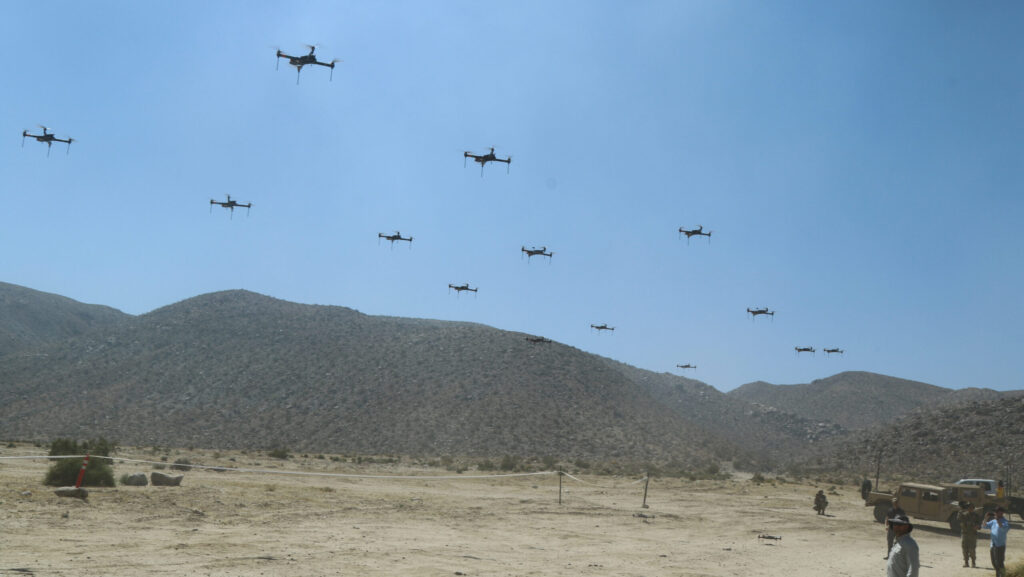
WASHINGTON — Army brigades are struggling to overcome electronic warfare and AI-generated disinformation in wargames at the National Training Center, a Rhode Island-sized swathe of the Mojave Desert where a full-time Opposing Force, the 11th Armored Cavalry Regiment, puts visiting units through the wringer with simulated bullets and real radio jamming.
Visiting units often lack the technical versatility and, even more important, the mental adaptability to keep fighting effectively with backup systems once their high-tech networks go down, current and former OPFOR officers told Breaking Defense in a series of interviews.
“We are definitely seeing, many times over, an over-reliance on technology,” said Capt. Jake Thomas, who heads the information warfare section of the OPFOR staff.
There is some good news, Thomas and his comrades said. Even with a wide array of electronic warfare gear, from backpack jammers to copies of high-powered Russian systems, the Opposing Force at the NTC can’t completely shut down visiting units’ communications, OPFOR officers and sergeants told Breaking Defense.
A new tactical satellite (TACSAT) upgrade being rolled out for battalion HQs and higher is particularly hard to jam, one captain said. Even lower-echelon units with less sophisticated tech can switch to a backup system when their primary communications network is jammed — or at least to a backup of the backup of the backup. (Army doctrine calls for four layers, known as PACE: Primary, Alternative, Contingency, and Emergency).
A big part of the problem is that the backup systems lack the bells and whistles troops are used to. Instead of a digital map with friendly and enemy forces marked in bright colors with positions updated in near-real time, for instance, soldiers might have to make do with staticky radio calls or low-bandwidth text chat. Stripped of their high-tech tools, commanders struggle to keep up with a fast-changing battlefield, decision cycles slow down, and subunits make uncoordinated maneuvers that let the OPFOR pick them off one at a time.
“Using their PACE plan … they are able to work around some of the jamming,” added Capt. Jonathan Maher, former deputy commander for Centaur Squadron, which controls most of OPFOR’s EW assets. “[But] those communications between the higher and lower echelons take longer … It ultimately creates a slower reaction that gives us a tactical advantage.”
Former Commander of Centaur Capt. Ethan Christensen added: “If we’re effective, generally success for us is them just committing combat power in a piecemeal fashion.”
The OPFOR finds plenty of ways to mess with visiting units’ communications — and with their heads. One favorite trick is to find the radio frequencies the visitors are using to control their drones and tune in to the feed: Inexperienced drone operators don’t know such eavesdropping is possible and leave vital information visible on their displays, including their own GPS coordinates, which allows the OPFOR to launch a (simulated) precision strike. On a more sophisticated and unsettling level, the OPFOR now uses generative AI to flood the training area with disinformation, including deepfake voices — trained from online videos of speeches, public ceremonies, and so on — of the visiting commanders giving fake orders.
“We’ve tested it successfully here,” said Col. Kevin Black, who commands the 11th Armored Cavalry Regiment, as the OPFOR is formally known. “Anything from AI-generated memes to AI-generated operational orders, AI-generated voice manipulation and spoofing.”
Training Shortfalls And Culture Gaps
Part of the problem is that combat arms officers — trained as tankers or infantry — are often unfamiliar with the complexities and, especially, vulnerabilities of the communications systems they rely on to hear reports and issue commands. On the flipside, signals soldiers may know their systems well but not how they fit into the overall battle plan.
“There is certainly that divide,” said Thomas, who started as an infantryman himself. “The role I am filling within the Regiment currently is essentially bridging that gap. [It’s] definitely a steep learning curve that can boggle my mind even now.”
Thomas has had plenty of time to climb that curve: He’s spent seven years with the OPFOR regiment, averaging eight to 10 simulated battles against visiting brigades each year. That constant practice is the biggest secret of the OPFOR’s success and would be impractical to replicate with every combat brigade across the Army. The OPFOR has also cobbled together a lot more jammers and drones than a typical brigade, although it’s got fewer armored fighting vehicles and other conventional assets.
But, Black told Breaking Defense, there are still lessons the larger Army can learn from the OPFOR about how to train. While the Regiment has the same digital maps and other “exquisite” command systems as the rest of the Army, “we’re not relying on that,” Black said. “We’re pushing [information] on multiple levels all the time, whether it’s through our primary or alternate, the contingency or the emergency network, and it doesn’t slow us down if, hey, all of a sudden [one’s] not working.”
The key is trusting his subordinates to use their initiative and take action on the spot, he said, without waiting for approval from above, detailed digital instructions, or their tech support getting the network back online. That requires combat arms officers to be keenly aware of how well their communications are or aren’t working and take charge of when to switch to backups, rather than delegate that decision to the techies.
“The number one thing is those junior leaders you’ve entrusted and empowered up front are probably the best I’ve ever seen at jumping through our PACE plan,” Black said proudly. “That troop commander is the one making those decisions, down front. … If we get jammed, if we lose our technical capabilities, our leaders can still execute.”