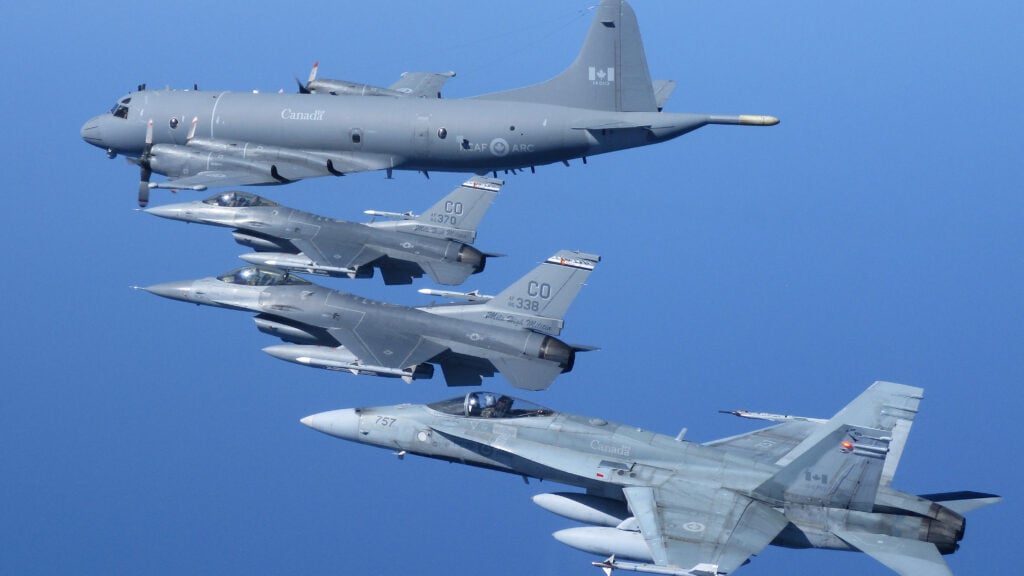
WASHINGTON —When President Donald Trump formally announced the creation of a “Golden Dome” missile defense shield, he made a notable claim: that Canada had already asked to take part in the effort.
“They want to hook in, and they want to see if they can be a part of it,” Trump said of America’s northern neighbor during the May 20 event. “It won’t be very difficult to do. They’ll pay their fair share.”
Of course, relations between Washington and Ottawa have been rocky for almost the entirety of Trump’s second term, given repeated statements from Trump that he wants Canada to become the 51st state.
And when it comes to Golden Dome, those tensions quickly manifested, with Trump saying Canada would have to pay $61 billion to take part. The issue popped up again just a few weeks ago, with Trump taking shots at Ottawa for, he said, opposing using Greenland as part of Golden Dome.
Despite all that, Canada remains interested in taking part, at least in theory, Canada’s Prime Minister Mark Carney told an audience in Montreal on Tuesday.
“The project is under development and, if it serves Canada’s interests — and I think there are certainly many scenarios where that would be the case — we will be willing participants,” Carney said, according to translated comments.
That raises the question: if Canada is to take part in Golden Dome, what would its role be? And perhaps more dramatically, if the US were to not involve Canada in Golden Dome, could its existing missile defense architecture, anchored around cooperation through NORAD, survive?
“Those [Golden Dome] conversations are ongoing, and we will only participate if it is right for both parties,” a spokesperson with Canada’s Department of National Defence/Canadian Armed Forces told Breaking Defense last week. The US Department of Defense, for its part, did not respond to questions about how it is currently factoring Canada into ongoing Golden Dome planning nor the status of talks between the two neighbors and more.

Not just selling into the kingdom, but building partnership with Saudi Arabia’s defense industry
Partnerships with outside industry are a cornerstone of the kingdom’s ambitious growth strategy.
Longstanding Partnership
At the core for missile defense between the two countries is the North American Aerospace Defense Command (NORAD), created in 1958 between Washington and Ottawa.
Its mission: detecting and tracking ballistic missiles, and potentially intercepting cruise missiles, that are targeted at either nation’s homeland. The organization is headed up by a US four-star general that is dual-hatted at the NORTHCOM commander, while a Canadian three-star general acts as the deputy.
So how does that work? Hypothetically, if North Korea launches a ballistic missile towards North America, the US four-star would first don their NORAD commander hat, utilizing those responsibilities and authorities to track and warn of the incoming threat.
“NORAD has to make an assessment in minutes. Is the missile a threat to North America? Is it a threat to the President’s location, the Prime Minister?” Glen VanHerck, who retired as a four-star US general and head of US Northern Command and NORAD in 2024, told Breaking Defense. “If it is a threat to North America, and if it’s going to be engaged, then I would have to change hats and put on my NORTHCOM hat and engage the threat with my… NORTHCOM authorities.”
“To make matters more challenging, while prosecuting a maritime threat via NORTHCOM authorities, if the threat launches a cruise missile, NORAD authorities and assets will be utilized to prosecute and engage the threat under today’s construct,” VanHerk added.
However, NORAD’s future, as its role in Golden Dome, is somewhat murky. While it seems logical that Golden Dome would fall under NORAD, no such public declaration has been made, and details of Golden Dome remain closely guarded. In addition, Pentagon officials are weighing a consolation of the combatant commands that could lead to combining NORTHCOM and Southern Command. It also remains to be seen if the NORAD commander will be peeled off or not.
How Canada Fits Into Golden Dome
That said, VanHerck pointed to a number of benefits and avenues for collaboration.
“The biggest thing they offer is terrain… [and] a larger footprint forward to place, sensors, radars and effectors” VanHerck said of what Canada can offer.
“There’s a reason President Trump sees Greenland as a strategic location, and I would say the same can be said for Canada and Alaska,” he added. “The shortest route to North America is over the poles and up through the Arctic, and that doesn’t matter whether you’re coming from Russia or China or North Korea. It’s all the same way.”
Ottawa has already started investing in a range of capabilities that could potentially contribute to the Golden Dome by expanding tracking and targeting capabilities.
“Golden Dome is much more than space-based interceptors and ballistic missile threats. It’s cruise missiles. It’s hypersonics which come from maritime platforms parked off the coast,” VanHerck added. “And so there are ways that Canada can be very helpful with Golden Dome, and more broadly, just continental defense for North America.”
Front and center is its plans to invest $28.3 billion USD to help modernize NORAD over the next two decades. That plan includes multiple Arctic Over-the-Horizon Radar (A-OTHR) sites in Ontario, planned to come online in 2029 to help with early warning radar coverage and threat tracking.
Beyond the A-OTHRs, VanHerck pointed towards the 16 Boeing P-8A Poseidon aircraft Ottawa is planning to buy to replace its aging CP-140 Aurora fleet, as well as the potential to buy new submarines for enhanced maritime awareness.
Tom Karako, a missile defense expert with the Center for Strategic and International Studies, added two more weapons to that list of possible contributions to Golden Dome – the acquisition of Lockheed Martin’s F-35 Lightning II fighter jets for tracking and targeting threats, and the Canadian Surface Combatant (CSC) program with SPY-7 Radars.
There could also be future Canadian defense investments folded into Golden Dome, said Eric Sauve, a consultant for the Canadian Department of National Defence, though he cited internal concerns about Washington simply tasking Ottawa with purchasing US tech.
“If it’s going to be a joint partnership Canada should provide part of the technology as well, not just just be told at the end, ‘Here’s the percentage of the Golden Dome you are going to finance, and it’s going to be 99 percent US industry,’” Sauve said.
While speaking to Face the Nation recently, Canada’s US Ambassador Kirsten Hillman said the country is “deeply committed to arctic defense” with current systems and future capabilities like A-OTHRs.
“Much as we do across all sorts of defense systems, where we’re interoperable, we work together,” Hillman said while speaking more broadly about a possible collaboration on Golden Dome. “We make our investments that make sense for Canada in defending our territory and defending our sovereignty, but we work with the Americans and other allies to maximize the benefits of those.”
Said the Canadian defense spokesperson, “In this rapidly evolving strategic environment, Canada recognizes that Integrated Air and Missile Defence (IAMD) is critical to deter and defend against the full spectrum of air and missile weapons.
“Canada is reinforcing its IAMD posture through a range of investments to enable a more integrated defence against air and missile threats by helping us to identify threats earlier, respond to them faster, and strengthen our contribution to collective security,” they added.
Those investments are likely to continue whether Canada takes a formal role in Golden Dome or not, according to Karako, as NORAD remains a useful construct for both sides.
Sauve, the Canadian consultant, agreed, saying that even if Ottawa was a hard no on Golden Dome participation — something he doesn’t anticipate — NORAD would survive.
“The relationship between Canada-US and NORAD is very, very strong, we’re fully integrated,” he said. “I think [Golden Dome] is kind of treated as an aside thing, not part of a NORAD commitment.”
“But, there is a lot of trust that has gone down the gutter between Canada and the US,” Sauve added. “When you mentioned the 51st state threats of invasion, talking about our prime minister as a governor of a state, it had a massive effect on the trust issue between our two countries… Can we trust the US again? We feel like we’ve been betrayed.”