WASHINGTON — A recent Air Force industry survey is seeking to “benchmark” the progress of a Northrop Grumman radar-killing missile, but the Air Force “[a]t this time” is not considering canceling the project or replacing Northrop as its prime contractor, according to a service spokesperson.
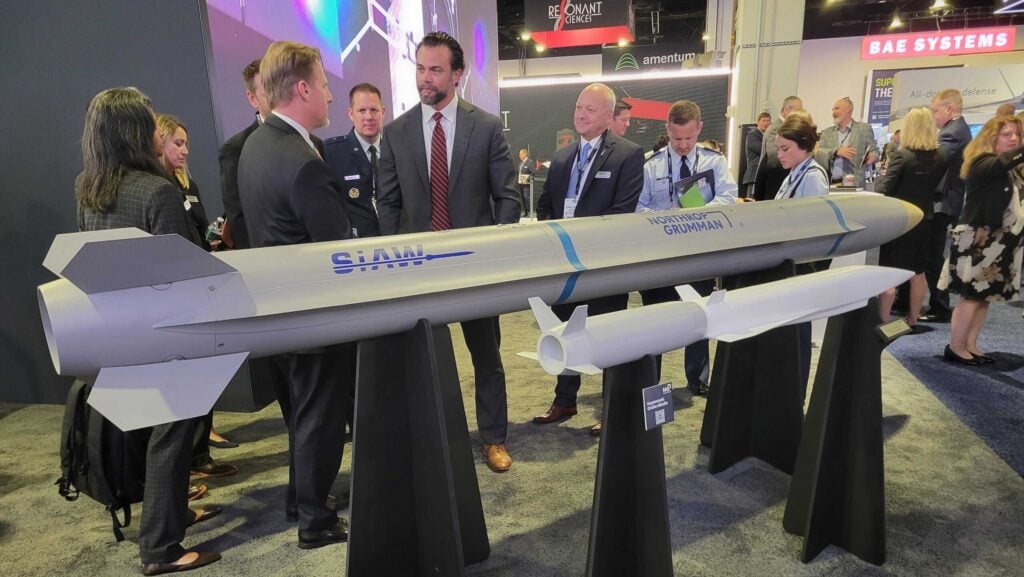
The request for information, posted on March 4, asked vendors about the potential to supply a munition with “similar or improved capabilities compared to” the Stand-in Attack Weapon (SiAW), an air-to-ground missile envisioned to strike mobile targets and a wide range of threats like radars, missile launchers, GPS jammers and other features of integrated air defense systems.
Northrop was chosen to build the SiAW in 2023, and while the Air Force spokesperson did not comment directly on any programmatic woes, they made clear that the recent request could help assess whether the Northrop effort is on track.
“The RFI is the mechanism to gather the most up-to-date information directly from industry about options to build-up munitions capacity and potentially deliver the capability on faster timelines. Given the very high importance of the requirement, the USAF wants the most up-to-date information from industry to benchmark the progress of Northrop Grumman’s SiAW program,” the spokesperson said.
Northrop said in a statement to Breaking Defense that the SiAW “is a critical strike capability for our warfighters, and Northrop Grumman is committed to the program’s success.”
Northrop had planned to deliver SiAW this year, but it’s not clear that timeline is still intact. In responses to Breaking Defense, the Air Force spokesperson did not comment directly on when initial operational capability is expected but disclosed production of the weapon has not begun.
“The USAF will consider a decision on production when development is complete,” the spokesperson said.


Support for Patriot air-and-missile defense is a case study for the industrial base
Manufacturing scale, global sustainment, and next-gen tech are becoming inseparable.
The spokesperson added that the Air Force does not “[c]urrently” plan to “field more than one missile with SiAW’s capabilities,” but that responses to the March 4 survey “may change that position if industry has solid options for delivering munitions faster and cheaper.” Some of the Air Force’s comments on the SiAW program were previously reported by Defense Daily.
L3Harris and Lockheed Martin participated in earlier stages of the SiAW program, but both companies previously told Breaking Defense they elected against further bids. L3Harris, for its part, attributed its reluctance to a fixed-price contract. Northrop was the last program participant left standing, and was awarded a $705 million deal.
The March 4 survey set a deadline of March 19 for replies. Lockheed said in a statement that the company “values its partnership with the U.S. Air Force and welcomes opportunities to apply our strike missile expertise to enhance warfighter capabilities. We continuously evaluate emerging Department of War requests with that in mind.”
An L3Harris spokeswoman said the company would not comment directly on RFI responses, but added that “L3Harris provides a range of propulsion and defense tech solutions to support various defense programs. Our investments in innovative technology, new facilities, modernized manufacturing processes and supply chain resilience are enabling us to deliver these solutions more quickly and affordably.”
It’s not clear what other companies may have responded.
The SiAW is expected to be carried by fighters like the F-35 but could also be integrated with other platforms like the in-development B-21 Raider stealth bomber. The Air Force is buying the Navy’s AARGM-ER, also manufactured by Northrop Grumman, as a stopgap until the SiAW — or its equivalent capability — comes online.
Breaking Defense Video