JERUSALEM — As Israel fights a two-front war with Iran and Hezbollah, the Israel Defense Forces are working to implement lessons learned from the Oct. 7, 2023 Hamas attack. One lesson at the forefront is the need to be better prepared, and that starts with securing the country’s borders.
As part of this stance, the IDF stood up the 96th Division working out of the Jordan Valley, a 200-mile-long geographic formation that serves as the border between Israel and Jordan. The division began operating in June 2025, coinciding with the 12-day Israel-Iran conflict.
“The IDF decided to put a division here for the sake of the people. … We keep the civilians safe,” an Israeli military official told Breaking Defense in late February during a trip to the Jordan Valley.
The role envisioned for the 96th Division is multi-layered. First, it is supposed to provide an additional organizational level through which the brigade and battalions along the valley can be coordinated.
“The concept of the division is that you can communicate to those above you in command and transfer info and also to be in touch with the field,” the IDF official, who could not be named due to security reasons, said.
By putting a division on the border, it acts as a higher-level command to communicate issues from the battalions and brigade to IDF Central Command. Currently, there is a brigade in the valley that includes a coed patrol battalion called the Lions of the Jordan Valley, which was stood up in 2014. The new division will oversee these units and coordinate their response to emerging threats.
In addition, the division has battalions of reservists around Israel who serve as local rapid reaction forces in case of an Oct. 7-type of incident. The members of these response units keep their rifles and equipment at home so they can move quickly to their regional battalions to respond to attacks.
In June 2025, the IDF held the 96th Division’s first exercise where troops “practiced emergency scenarios and rapid response to sudden incidents, while enhancing the division’s combat readiness.”
That November IDF Chief of Staff Lt. Gen. Eyal Zamir, visited IDF Central Command for an exercise and met with members of the 96th Division. At the time, he explained that the division was preparing for situations the IDF “must never reach,” in line with the IDF’s post-Oct. 7 strategy to secure borders.
Zamir spelled out that posture, saying, “we must act and neutralize threats before they reach our doorstep,” noting that “we will reinforce our troops wherever necessary in order to continue countering terrorism and prevent the next threat from arising.”
He reiterated the message in December when he described the IDF’s efforts for expanding its military through the force buildup initiative. Force buildup for the IDF has included creating and re-establishing new units in the IDF, like the 96th, and investing heavily in the ground forces.
“These are significant steps in shaping the IDF’s defensive capabilities for the coming years,” he said.
Rebuilding Defenses
One of the first missions of the new 96th division has been to bolster Israel’s defenses along the Jordan River, which snakes through farmland that fans out on both sides north of the Dead Sea.
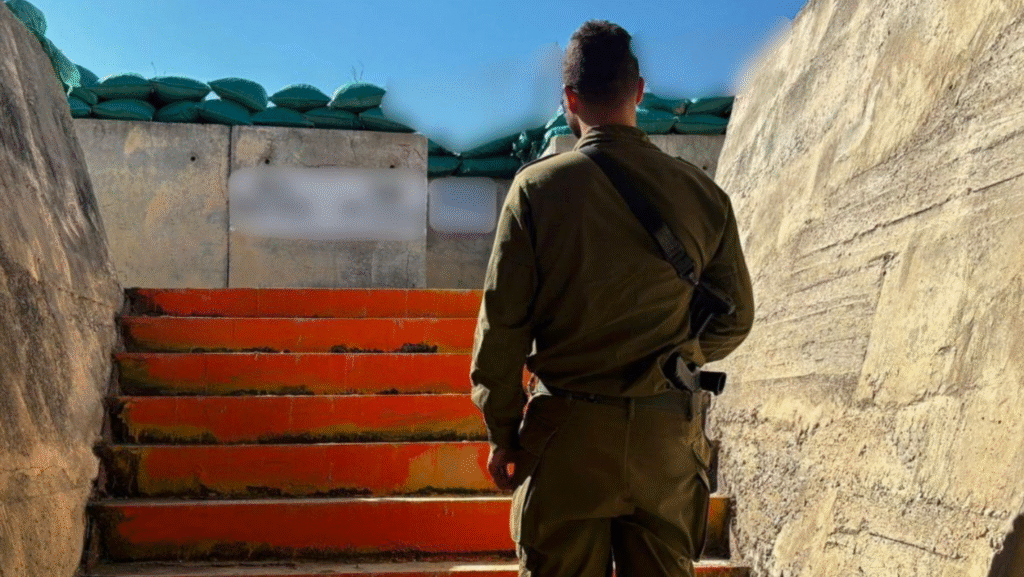
In this area, the IDF built a number of forts in the 1970s that were part of a static defense line the IDF had built in the Golan Heights and Suez Canal areas. The forts were mostly designed in the same manner, with a kind of redoubt of sandbagged positions and bunkers underground. While left abandoned for many years in the Jordan Valley, the IDF is now working to return dozens of these sites to use.
“We refurbished these 1970s-era outposts. … Some of them were filled with garbage or mud when we arrived and what we did is we began to clean them out and turn them into bases,” the IDF official said.
The refurbishment is part of a larger series of investments to secure the border, using fencing and other means.
Part of the Jordan Valley includes areas controlled by Israel prior to 1967 near the Sea of Galilee and the region of Beit She’an. It also includes the Arava Valley south of the Dead Sea. However, the central Jordan Valley is part of the West Bank and viewed as part of the Occupied Palestinian Territories.
There are several Jewish settlements in the valley and several Palestinian villages, along with the Palestinian city of Jericho. The Division is responsible for most of this entire area, straddling Israel’s Route 90, which runs from Eilat north up the entire length of the valley.
Driving down from the hills of the West Bank to the Jordan Valley, one doesn’t get the sense of a large military presence. The presence of hitchhikers, for instance, implies the roads and civilians are safe. In general, this is a rural area with a low population, but the length of the border means there are challenges, such as smuggling via drone.
Jordan and Israel have been at peace since 1994, however, there have been increasing numbers of security incidents along the border in recent years.
For instance, in September 2024 and September 2025, there were two terrorist attacks at the Allenby Bridge border crossing. There have also been numerous incidents of drones being used to smuggle weapons. In December 2025, the IDF intercepted a drone used for smuggling coming from Jordan with 40 weapons. In another incident in February 2026, a drone with 12 pistols was intercepted.
Most recently, during the current conflict with Iran, sirens went off in the northern Jordan Valley on March 6, warning of a drone threat. Iran and Iranian-backed militias have also targeted the Kingdom of Jordan, where US forces are located.
Adding the 96th Division to the Jordan Valley is a natural expansion considering that the IDF has division-level commands on all of its other borders. For instance, the Gaza Division is on the Gaza border, and the 80th Division defends the Egyptian border and Eilat. In the north, the IDF has the 210th Division on the Golan, and in early 2024, the IDF formed a new Mountain Brigade to bolster that division. Along the Lebanese border is the 91st Division.
“I think we learn from the past and what we saw then on Oct. 7 and how to protect,” the official said.
Breaking Defense Video