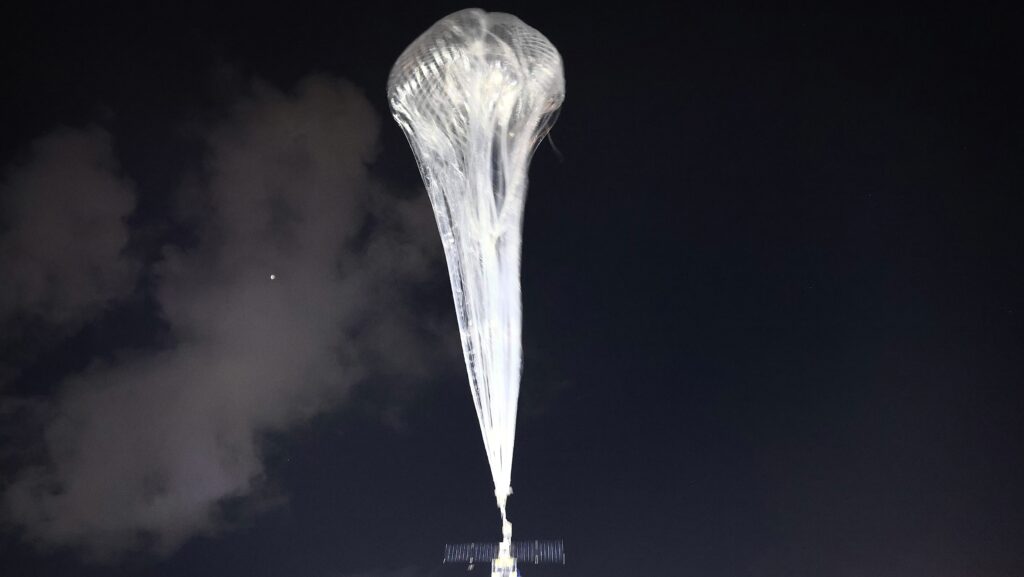
WASHINGTON — The Army’s intelligence hub and the Joint Staff’s J-7 are set to test a new prototype system, dubbed Project Wallabee, comprising a sensor with autonomous target recognition (ATR) capabilities on top of a stratospheric high-altitude balloon in the coming days, a senior Army official told Breaking Defense Tuesday.
The exercise, in which the Army’s G-2 is partnering with the J-7’s Warfighter Laboratory Incentive Fund program, is the first time the military is testing manufacturer Urban Sky’s high-altitude balloon with Applied Intuition’s ATR software that controls and processes data from the small sensor. Andrew Evans, the director for the new Strategy & Transformation Office inside the G-2, said it’s been notoriously difficult to find sensors small enough to thrive on high-altitude platforms given the precarious nature of the stratosphere — which starts at about 60,000 ft. above the Earth’s surface and has harsh physical limitations caused by extreme weather and thinning air.
“We discovered along the way that the maturity of sensors to operate in the stratosphere was simply not there,” Evans said. “We think mostly because the systems that fly or operate at those altitudes are very light, typically because they’re contending with low air density, and so they don’t carry heavy payloads.”
He explained that the payloads that the Army has been investing in up until this point have been much heavier and require much more power, causing them to be ineffective in the stratosphere. As a result, he said the force needs something lighter and that can operate in the “vast temperature swings” in that part of the atmosphere.
“Wallabee is simply that. It’s pairing some advancements that are happening with stratospheric balloons with advancements happening in miniaturizing sensors that can operate the stratosphere,” Evans said.
Further, Evans explained that the Army and the J-7 want to bolster capabilities in the stratosphere because the end goal is to combine ground, airborne, stratosphere and space-based sensors to create a “multi-layered, robust sensing ecosystem.”
“What we seek as intel professionals is to create as many sensors from as many different altitudes and sensing domains of ground, air and space as possible because we believe that creates some important dilemmas for adversaries,” Evans said. “If you only do things from the ground or only from space, you’re giving your adversaries a lot of opportunities to counter your capabilities because they can then focus on countering exactly what you’re doing.”

Island surge: the Army’s Next Generation Command and Control in action
Lightning Surge exercises are turning soldier feedback on NGC2 into operational software changes in days, not years.
Specifically, he said, the multi-layered approach allows the force to provide early entry forces with the tools they need to find without relying on uncontested communications or exquisite space-based sensing systems.
The results from testing Wallabee will help inform future experimentations, Evans said, adding that it will be a “complementary” exercise to a large balloon swarm exercise that is slated for later this year. Originally, the swarm exercise was to take place in the Indo-Pacific theater, however, Evans told Breaking Defense at the annual AAAA conference earlier this year that it would be taking place some place else, but did not share where.
Nonetheless, Evans said he’s hopeful that Wallabee will provide important lessons on such capabilities, especially as the Army and greater Defense Department focus on experimenting before heavily investing in a product or program.
“It allows you to learn early, especially if you’re going to learn some things that are things you don’t want to repeat; it allows you to learn that before you make enormous investments, and then learn that lesson after it’s too late,” Evans said.
“We’re not yet ready to declare, you know, mission success here. What we are ready to declare is that we know we need to do this. We must do this. It’s a domain we must exploit,” he added.
UPDATED 6/4/2026 at 1:42 ET to clarify that Applied Intuition makes the ATR software for the sensor used in Project Wallabee.