
FT. STORY, Va. — The Pentagon’s Golden Dome project is slated to cost upwards of $185 billion, with $17 billion alone planned for fiscal year 2027. And with all that money comes attention — and a mandate to sell the ambitious idea to the taxpaying public, the program’s head acknowledged today.
“We need to show the public that we are making progress, that this isn’t just a paper exercise,” Golden Dome program manager Gen. Michael Guetlein told a small group of reporters at Joint Expeditionary Base (JEB) Little Creek-Fort Story.
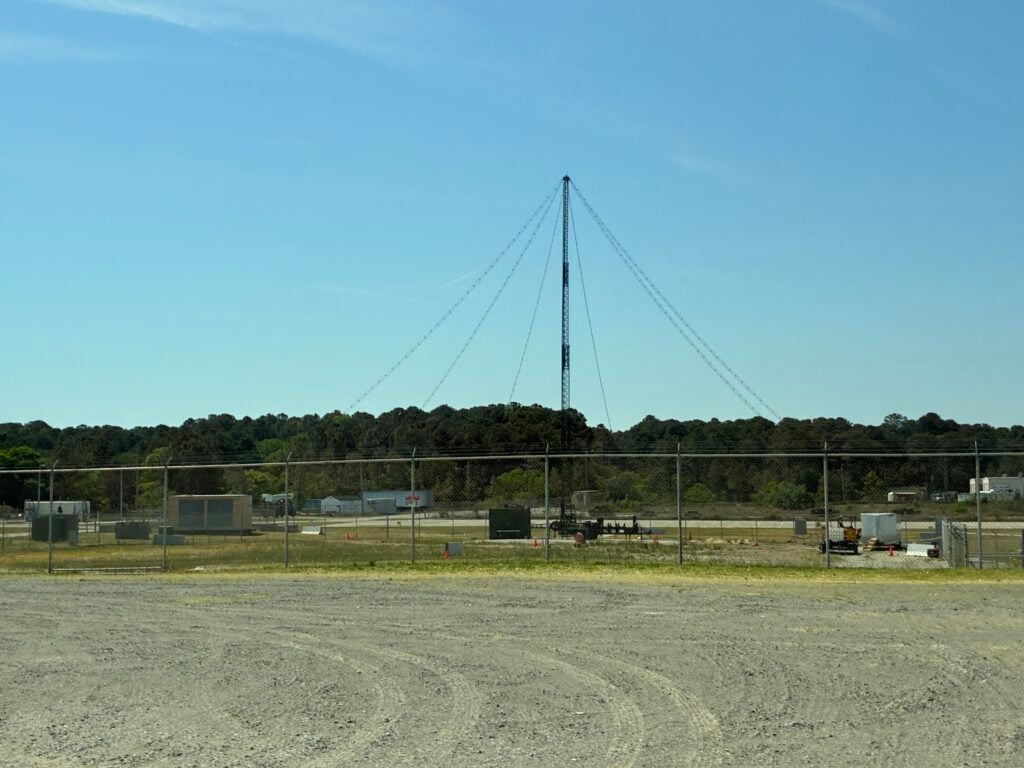
Exhibit A in the Guetlein’s argument: the Army’s advanced Long-Range Persistent Surveillance (ALPS), a system that has been used abroad but is now ensconced right next to the Ft. Story baseball field. It, along with other unidentified systems here, make up what officials said are the first publicly acknowledged elements of the missile defense shield.
“The testing of the Army’s advanced Long-Range persistent Surveillance radar right here in Norfolk is tangible proof of our progress,” Guetlein said in his speech. “The ALPS system, built by PAE fires, is significant in that it can detect threats without ever sending out a signal, which allows soldier to quietly see without being seen.”
“The most important message I can give to you today is that Golden Dome is real, and it is no longer theoretical,” he said. “Contracts are being awarded, sites are being scouted, and we are hitting our milestones on schedule and on budget.”
Adding emphasis to Guetlein’s message was the presence of Undersecretary of Defense for Research and Engineering Emil Michael and the program’s military deputy, Lt. Gen. Brian Gibson. Also in attendance was NORAD Deputy Director of Operations Maj. Gen. Mark Piper and Lt. Gen. Frank Lozano, the Army’s Portfolio Acquisition Executive for Fires.
Speaking to reporters after the speech, Guetlein called ALPS the “first down payment in changing the equation of homeland defense,” but also indicated that there are other, less open, technologies being installed in the region as part of Golden Dome.


Why enterprise IT modernization matters now – and how to “delight by design”
Do more with less: streamline workflows, reduce duplication, invest upfront to save long-term.
Guetlein said that his office is in active discussions with industry, including the creation last week of an “Ecosystem Hub,” which he described as an “one-stop entry point for Golden Dome for industry, academia, our allies and our other government agencies.” That hub includes data on supply chain security and resiliency.
“It also includes a thing that we call Apex Arc,” Guetlein said. “Apex Arc is a data lake that we expose all of our data to government, industry, academia. [It] includes an AI sandbox and a data exploitation sandbox, to allow them to come in and see what they can do with our data, and if they can provide operational value, we can immediately pave them path to an operational system.”
Making The Case For Billions Of Dollars
First announced by President Donald Trump in January 2025 as “Iron Dome for America,” and later refined into its present name in May of that year, Golden Dome has emerged as the defining defense project for the Trump administration. The appointment of Guetlein as a “direct reporting portfolio manager” to lead the program solidified the focus on the effort.
The money certainly seems to be lined up behind getting Golden Dome off the ground, with a $185 billion estimated price tag for the life of the program.
For fiscal 2027, Golden Dome is slated for $17.5 billion. But only $398 million of that is in the base budget with the rest to be found in reconciliation funding — a potentially risky move, given a key lawmaker is already talking about stripping defense funding out of the first go at reconciliation and trying again down the road. The bulk of the reconciliation request, $14.2 billion, is spread across the services and agencies to cover research and development efforts.
With all that spending, however, comes increased scrutiny, both in Congress and from the public. Both Guetlein and Gibson were open that they feel the need to justify that spending and explain to American citizens what Golden Dome means to them.
Asked if the American public has bought into the program, Guetlein said, “No.”
“Because we have been protecting the secrets, to protect the nation’s investment, to make sure that we don’t tip our hand to our adversaries and they get ahead of us … the American public has not had the opportunity to hear what’s actually going on, and there’s been a lot of confusion,” he added.
Gibson said, “Really, it’s about achieving big things, and we’ll be judged, we should be judged, on how will we do that.”
“We’re very early on this process, although sometimes that in and of itself, doesn’t matter, right, because the nation has invested a lot of money, a lot of capital,” he said.
Gibson described the message from today’s event as three-fold.

First, confidence in the existing capabilities, such as the Patriot battery stationed behind Guetlein as he talked. Second, to raise awareness about the potential threats to the homeland and explain to the public why this matters. And third, to harken back to history — the fact that the country used to have missile defenses stations around the nation.
“To start having the open dialogue that, we’re moving out,” Gibson said. “This is not on a timeline that we can afford to spend decades achieving.”
Tom Karako, a missile defense expert with the Center for Security and International Studies, described Thursday’s event as a “confirmation that stuff’s getting done.
“One of the most important things [Guetlein] said today is that contracts are indeed being let,” Karako said of the speech. “There was a time not so very long ago when they weren’t talking and they weren’t writing contracts. … I see this as a public affirmation, public affirmation that, no kidding, they are moving out.”
However, Gibson emphasized that there is always going to be a natural tension between being able to fill in the public and needing to keep things behind the curtain.
“They’re going to be [Golden Dome locations], all over the place. Some seen, some not seen. Some said publicly, some not said publicly. And that’s intentional,” he said. “That’s intentional because we don’t want to put ourselves at a disadvantage with others who are intent on overcoming what we intend to do.
“That’s what this is. [Norfolk] is a good representative location of things for you to imagine and think about.”
Ashley Roque in Washington contributed to this report.