

Risk in cognitive operations is not additive. It is multiplicative. A missile strike has a defined blast radius, effects are immediate, observable, and bounded. Cognitive operations have none of these characteristics. Messages spread through networks in ways no one fully controls. Attribution may be ambiguous or deliberately obscured. Cognitive effects may unfold over weeks, months, or years. Second and third-order consequences ripple well beyond the immediate objective. Understanding, or a lack of cognitive effects understanding, is not a reason to hesitate, it is a reason to build a consistent and replicable risk assessment into the design of every operation from the start.
The Cognitive Targeting Nomination Packet (CTNP), addressed in an earlier article, treats risk as a design input, not a compliance step. Risk assessment begins at intake and continues through execution. The result is not slower operations, it is operations that are approved faster because commanders receive complete, risk-scored packets with documented rationale, in a predictable format, rather than incomplete drafts that require iterative revision.
The Eight-Factor Risk Framework’s theoretical foundation is Social Judgment Theory (Sherif and Hovland), which describes the three zones every audience holds simultaneously. The latitude of acceptance contains positions the audience finds reasonable, this is the low-risk zone where persuasion is possible. The latitude of non-commitment contains positions the audience neither accepts nor rejects, the prime battlespace, with high malleability and manageable risk. The latitude of rejection contains positions the audience finds unacceptable, messages here do not persuade; they trigger backlash, boomerang effects, and active resistance. Most influence failures occur not because the message is wrong, but because it starts in the latitude of rejection, too far ahead of the audience. Ego involvement, when issues touch identity, honor, ideology, or survival, narrows the latitude of acceptance and expands the latitude of rejection, compounding risk exponentially.
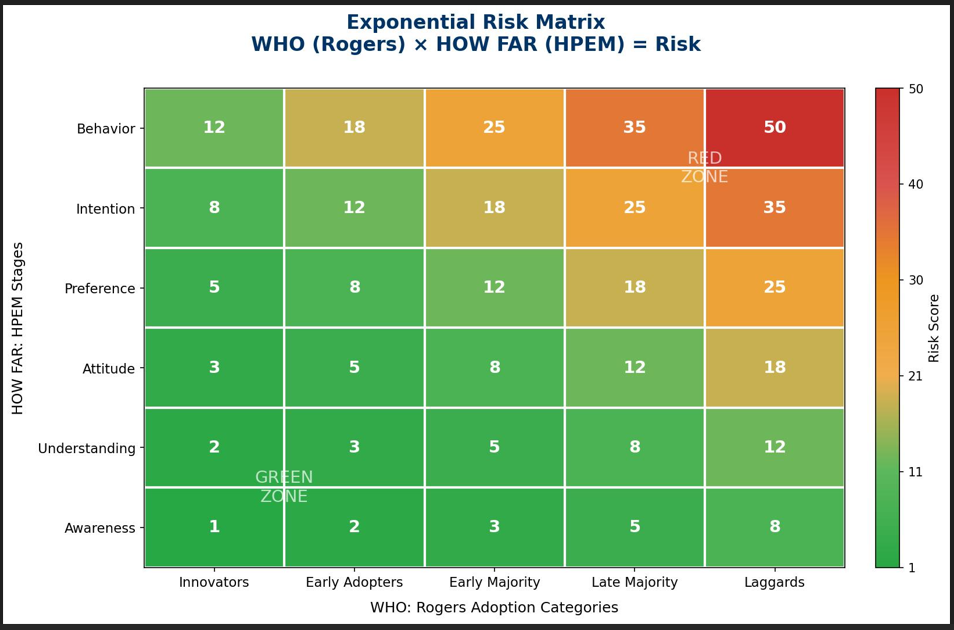
The Exponential Risk Matrix captures how risk compounds across four dimensions simultaneously. The WHO dimension (Diffusion Risk) reflects that moving from Innovators toward Laggards increases visibility and backlash potential. The HOW FAR dimension (Behavioral Distance) reflects a person or population’s Hierarchy of Psychological Effects Model (HPEM) position; best practice involves shifting HPEM one step per cycle. The TOLERANCE dimension (Social Judgment) reflects where the message lands relative to the audience’s latitude of acceptance; messages that fall inside the latitude of rejection do not persuade, they harden opposition. The CAPABILITY dimension reflects that some audiences cannot do what is being asked, even if they agree — a constraint that should never be overlooked in influence planning.
The Eight-Factor Risk Framework evaluates each domain independently, because aggregating risks into a single score obscures the analysis commanders need. Risk to Mission asks whether the operation will achieve its intended cognitive effect. Risk to Force addresses physical, legal, or psychological harm to personnel. Risk to Partners addresses damage to host nation, allied, or interagency relationships, partnerships are strategic assets that take years to build and moments to destroy. Risk to Strategy asks whether the operation will undermine higher-level diplomatic, economic, or military objectives, tactical success that produces strategic failure is still failure. Risk to Reputation addresses credibility loss and attribution blowback. Risk to Target Audience addresses unintended harm to the population the operation seeks to influence, operations that harm the populations they claim to serve are both morally unacceptable and strategically counterproductive. Risk of Inaction addresses the strategic cost of delay, hesitation, or non-execution. The adversary does not pause while approval cycles run. Vacuums fill, narratives harden, and windows close; inaction is never neutral, it is a decision with consequences. Risk of Success, the most frequently overlooked domain, addresses unintended escalation resulting from the successful achievement of objectives. Planning must account for success scenarios, not just failure scenarios.
High risk in any domain does not invalidate an operation, it reshapes it. High partner risk narrows the target audience. High reputation risk drives more conservative messaging. High force risk precludes channels requiring physical presence. High strategy risk may require delay until diplomatic windows close. Risk is not a tax on effectiveness; it is a boundary condition that defines the solution space.
Risk acceptance is tiered explicitly: low risk is acknowledged and monitored; moderate risk requires a mitigation plan and supervisor concurrence; high risk requires commander review and documented rationale; extreme risk requires redesign, delay, termination, or the commander’s personal coordination with all friendly parties. Implicit risk acceptance, where no one formally owns the decision, makes accountability impossible when blowback occurs.
The Eight-Factor Risk Framework does not slow operations down. It structures the conversation commanders need to say yes. By presenting risk in consistent, pre-scored terms across every engagement, planners build command familiarity and trust over time, which compresses approval cycles, reduces back-and-forth, and increases the rate at which operations are approved and executed. Risk assessment is not a gate; it is the common language between planners and commanders.