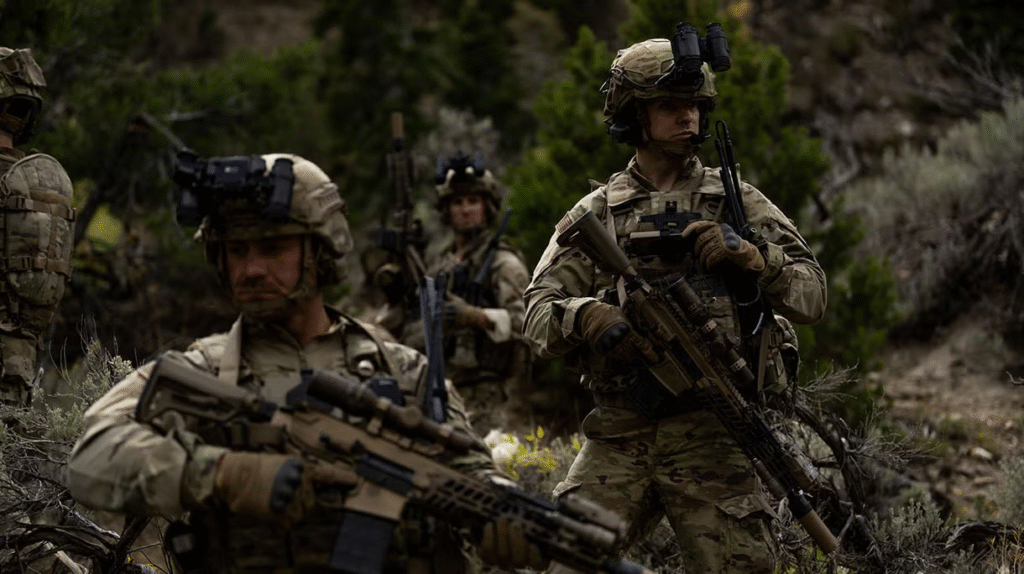
WASHINGTON — With small drones inflicting massive losses on both sides in Ukraine, defense electronics maker L3Harris is reprogramming its widely used Falcon IV handheld radios to generate a personal protective electronic-warfare “bubble” for the soldiers carrying them, company executives said.
Branded as Wraith Shield, the capability doesn’t require any new hardware, the company said, just a software upgrade to the existing Wraith communications waveform, which is compatible with over 100,000 Falcon IV radios in service worldwide.
“At the cost of a software upgrade … single-digit thousands of dollars … you can add this capability to a radio they’re already carrying,” Chris Aebli, the company’s president for Mission Critical Communications, told reporters this morning. “[It’s] their own protection bubble for counter-UAS.”
“It’s ready to be delivered,” he said, although international sales are still awaiting export approval from the US government. While no formal order has been made to date, Aebli acknowledged, “there’s a tremendous amount of interest, both internationally and domestically, [and] there’s a handful of customers that are ready to buy it … shortly.”
The US Army in particular may transfer electronic warfare funds to one of its radio program offices to buy the software, he suggested: “They might execute the acquisition as a radio upgrade, at least initially.”
RELATED: Picogrid wins $9M Air Force contract for counter-drone software written by AI
In essence, L3Harris and partner DataShapes AI, which trained the AI algorithms involved, are exploiting the digital smarts already built into modern “software-defined” radios (SDRs), whose versatility blurs the traditional lines between military walkie-talkies, civilian cell phones, and specialized electronic warfare gear.


Winning the information war is as much about ideas and perception as it is about data
"Being able to tell the commander you don't need to do something is actually a pretty powerful message, as well."
To run the Wraith waveform — developed in 2022-2023 with extensive input from Ukraine, the company said — the Falcon radio already has to scan the airwaves for signals, figure out which ones are friendly radios also using Wraith, form a local ad hoc network, and transmit signals back.
Wraith Shield adds the capability to identify which signals an enemy is using to control their drones, share that data over the local network, and coordinate all the radios on the local net to broadcast (in essence) white noise on the same channel, scrambling the control signal. Depending on the individual drone’s programming, a lost control link might cause some drones to circle aimlessly overhead, others to automatically return to base, and still others to outright crash.
L3Harris says the current version of Wraith Shield can coordinate simultaneous jamming from 40 Falcon radios at once, roughly enough to equip an infantry platoon, but L3Harris engineers are aiming to amp that number to 100 radios at once in a future update. Wraith Shield can also share data on the drone threats it’s detected with command posts or more powerful counter-drone systems.
Wraith Shield isn’t a silver bullet against all types of unmanned threats, Aebli and other executives emphasized, and it works best as one element in a larger, layered defense. But it adds a new layer of protection that individual soldiers currently lack.
Breaking Defense Video