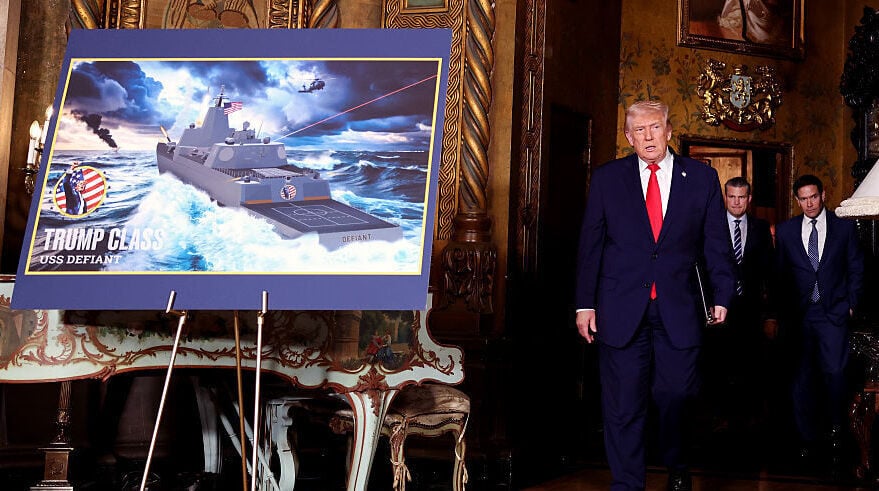
WASHINGTON — The House Armed Services Committee doesn’t want the Navy to sign off on a construction contract for the Trump-class battleship until the service provides Congress more details about the ship’s design, according to the chairman’s mark of the National Defense Authorization Act (NDAA) released today.
The draft legislation includes a section that would prohibit the Navy from inking a contract or other agreement that “includes a scope of work for the construction” of the lead ship until after the Secretary of the Navy proves to lawmakers that the weapons systems the service plans to include on the vessel are “at a sufficiently mature technology readiness level.”
The House language does not spell out which technologies must be proven out, but there are hints from the initial announcement of the ship by President Donald Trump in December. At the time, Trump said the vessel would include hypersonic weapons, electronic rail guns and high-powered, laser-based weaponry.
The Navy’s new shipbuilding plan released this month shows that the service wants to purchase 15 battleships in the next 30 years, and that the first vessel is on track for delivery in 2036.
Multiple lawmakers have questioned the value of the battleship, frequently citing the projected cost associated with the vessel when voicing their concerns. The Navy is requesting approximately $1 billion in advance procurement and roughly $837 million in research and development funds for the battleship in fiscal year 2027, and is planning to request roughly $17 billion in procurement funding for the first ship in FY28, budget documents released in April show.
“That’s just an amount of money that really defies logic in terms of the fact that we just do not have anything close to design,” Rep. Joe Courtney, D-Conn., said during a House Armed Services Seapower and Projection Forces subcommittee hearing last week.
Sen. Chris Coons, D-Del., expressed similar sentiments at that hearing, saying: “As I understand it, you don’t have a design, you don’t know what’s going to be on it, you’re counting on multiple unproven technologies, and you don’t know how you’re going to build it.”
Still, Navy officials have maintained the battleship is necessary because the service needs a ship with a larger hull size to accommodate more capability than destroyers. Chief of Naval Operations Adm. Daryl Caudle told lawmakers on the House Appropriations Committee earlier this month that the nuclear-powered ship is important for the fleet to provide “significant payload volume for all future fights.”
“The fact it’s nuclear is going to give it the sustainment it needs,” Caudle said. “In particular, in the Pacific — an ocean is three times the size of the Atlantic — I need those types of legs and endurance to serve as a capital ship that comes with that firepower to be able to deliver that combat payload.”
The draft NDAA legislation released today also includes an additional $500 million to foot the bill for a second Arleigh Burke-class destroyer, after the Navy asked for one in its budget request last month. While lawmakers have labeled destroyers the “backbone” of the fleet and questioned why the Navy only requested one, Acting Secretary of the Navy Hung Cao has said that the Navy did so to allow the industrial base to “catch up.”
Breaking Defense Video