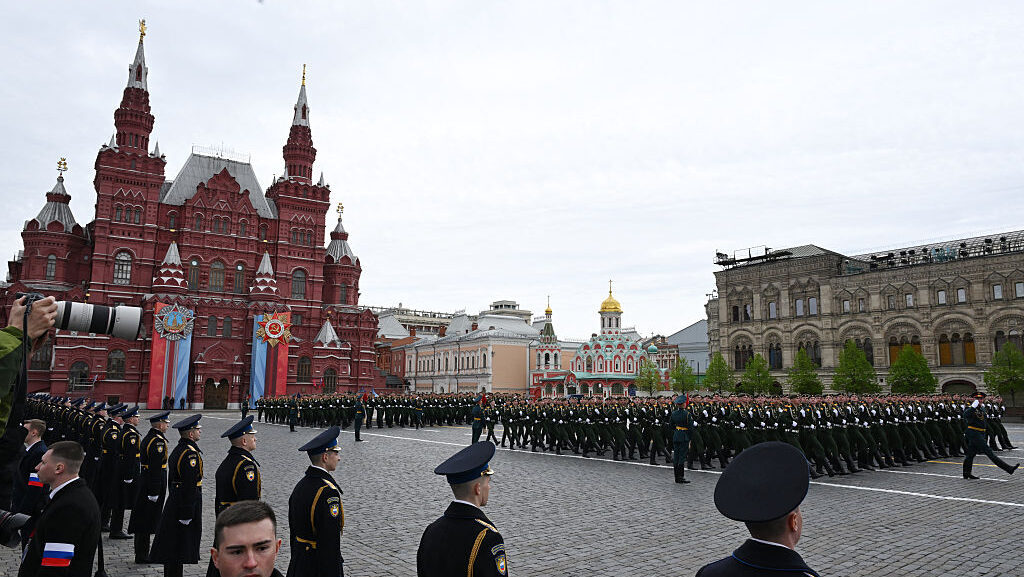
BELFAST and MILAN — Russia’s Victory Day parade in Red Square over the weekend came and went without the usual accompaniment of high-end weapon systems and power projection that has long symbolized the annual event, as Moscow decided to scale back on both hardware and military personnel amid fears of a Ukrainian attack.
While normally defense analysts use the parade to gauge Russian military and technical prowess, several told Breaking Defense that this year the lack of gear showed something else: Moscow’s implicit acknowledgement that Ukrainian capabilities remains a serious threat, more than four years since Russia’s invasion. One described it also as potentially a watershed moment in President Vladimir Putin’s declining grip on power, behind only the short-lived coup by Yevgeny Prigozhin, the former leader of the Wagner Group.
The parade on Saturday was “quite extraordinary” and showed “real vulnerability” on the part of Russia, said Timothy Ash, associate fellow in the Russia and Eurasia programme at Chatham House, a UK-based think-tank.
“I think what we saw on Red Square is, in a way … the real nervousness now in Moscow about the sustainability of all this” in terms of the war with Ukraine and Russia’s spiralling economy, Ash told Breaking Defense on Monday. “They’re in this war they can’t get out of, the Ukrainians have held the frontlines and are pushing them back through using technology. They have this deep strike capability.”
Alexander Baunov, editor-in-chief at the Carnegie Russia Eurasia Center, went further, writing online before the event, “A military parade is intended as a demonstration of strength and bravery, but if it is held furtively, without rehearsals, and with the internet jammed (to reduce the chances of a Ukrainian attack drone being able to navigate to the site), it demonstrates nothing but fear and weakness.”
Similarly, Natia Seskuria, associate fellow for international security at the Royal United Services Institute, a UK security and defense think tank, noted that the decision to hold the “subdued” parade “signals a degree of vulnerability rather than strength, because even last year, Russia demonstrated a range of new tanks and drones in front of invited world leaders.”
A trio of main battle tanks on display last year, the T-72B3M, T-80BVM, and T-90M, have all been upgraded following operations in Ukraine, according to Janes. The outlet further reported that only a single “truly” new land vehicle was paraded last May: a 4×4 ZA-SpN Titan, Mine Resistant Ambush Protected (MRAP) platform.
Putin told journalists that military equipment was not displayed this year due to “security reasons” and because “the armed forces must focus their attention on the final defeat” of Ukraine, according to state-sponsored news agency TASS.
The Victory Day parade went ahead after Donald Trump announced a three-day ceasefire between Moscow and Kyiv, covering the “suspension of all kinetic activity.” (Ukraine did not attack the parade, but Ukrainian President Volodymyr Zelenskyy said Russia continued to fight along the front lines of the conflict, prompting condemnation from European Union foreign policy chief Kaja Kallas.)


How integrated modeling and simulation accelerates Europe’s defensive edge
Lockheed Martin’s ACES platform delivers a shared virtual battlespace that strengthens readiness, interoperability, and faster decision-making through advanced, integrated modeling and simulation capabilities designed for evolving global threats.
The ceasefire did not appear to mollify Moscow’s security concerns regarding Ukraine’s ability to strike into Russian territory. The embattled nation had developed “an array of dedicated, long-range one-way attack” drones, “able to penetrate deep into Russian territory and hit high value targets and critical infrastructure at a sustained pace,” according to Federico Borsari, non-resident fellow at the Center for European Policy Analysis think tank. “Strike packages have become more successful, as more drones are able to reach their target. Russia appears unable to protect its energy infrastructure and many of its military installations.”
Ukraine famously launched an ambitious, multi-faceted drone attack on Russian air assets during Operation Spider’s Web in June 2025, and just days before the parade Russian officials said the country intercepted dozens of drones as they flew toward Moscow.
In determining why Ukraine appeared to pose much more of a credible threat to Putin this year, Ash pointed to the Trump administration’s role in the killing of Iran’s former Supreme Leader Ayatollah Ali Khamenei in a joint US-Israeli strike in February, and Kyiv’s pivot away from Washington on Russian long-range strike policy.
“The shackles, in a way, are off the Ukrainians, because before the war in Iran, the Ukrainians were kind of holding off a bit because the Americans and the Europeans had told them, ‘Please don’t do anything that impacts global markets,’” he said.
Kyiv is less interested in toeing the line on the issue because the US is “going against our [Ukrainian] interests,” following Washington’s decision to go to war against Tehran, he stressed.
“Previously, the Americans have told them [Ukraine], ‘Don’t hit Red Square, don’t hit the Kremlin now.’ Maybe you could argue that because the Americans themselves hit leadership in Iran, Putin is worried.”
Putin “is a guy who takes no risk in terms of his own security. [He] doesn’t really go on the front lines … and maybe … the Americans could no longer assure his security,” Ash suggested.
The BBC reported that despite the absence of military equipment on display on the day, screens around Red Square projected images of multiple rocket launchers, fighter jets, tanks, and submarines.
For Seskuria, the non-inclusion of defense equipment matters because it takes away from a central focus of the Victory Day celebrations, which have typically provided “powerful optics” and reinforced “Russia’s image as the heir to Soviet victory in World War II.”
She stressed that “removing this important element weakens the propaganda value of the event, particularly for domestic audiences, as it reduces one of the most visible symbols of Russian power and military prestige.”
The analysts also agreed that domestic discontent linked to Russia’s struggle to win the war against Ukraine is mounting on Putin.
“Although announcing another wave of mobilisation would help address manpower shortages, such a move remains politically sensitive for Putin given the domestic backlash triggered by the first partial mobilisation in 2022,” said Seskuria, adding that the Kremlin is therefore likely to “avoid another large-scale draft for as long as possible.”
Ash said, “Everything you hear in Russia now is people complaining about the economy, and then the frustrations are definitely building” inside the country. “There’s the huge human toll in terms of casualties [from the war] … the Putin administration is probably under more pressure at the moment than any time since the Prigozhin affair.”
Rounding off the consensus, Baunov stated, “Russian society seems to have come full circle, from the worst fears at the start of the ‘special military operation’ through the euphoria of survival into a new cycle of doubt and fear. Even Putin’s official approval rating has noticeably declined.”
It remains to be seen what the next May 9 parade will bring, or if there will even be one at all.