TAMPA, Fla. — The heads of US Special Operations Command and US Southern Command this week hit on a common need that each said they need to be ready for modern combat threats: more leeway to use test ranges that simulate contested environments.
“We have to develop ranges and places where we can test and evaluate, rehearse those highly choreographed maneuvers and projections in these new, contested environments. That’s not easy to do,” SOCOM Commander Adm. Frank Bradley told an audience of special operators and industry at SOF Week here on Tuesday.
“We’ve got all kinds of regulations here in the United States — and frankly, every nation does — to be able to control their electromagnetic spectrums and the interference that occurs,” Bradley added.
The next day SOUTHCOM Commander Gen. Frank Donovan echoed the worry, saying the his command doesn’t “have training ranges right now that allow us to use these systems to any level of their capability.”
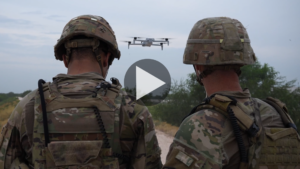
“I mean, it’s remarkable that […] I think of a certain base, I know that there’s a civilian road in between, and anytime we want to fly, like a drone, like across the civilian road to the training area, we have to shut traffic down. We got to get special approval. We’re just struggling with that, especially when we want to train in that [communications] denied environment,” he said at an event put on by Defense One on the sidelines of SOFWEEK.
Bradley said the Federal Aviation Administration regulations are one constraint.
“The FAA [Federal Aviation Administration] here in the United States controls the altitudes at which drones can fly, even over our military bases and ranges, and so we have to find places where these kind of more sophisticated projections of force can be rehearsed and can be tested and tried,” he said.
Tension between the military and the FAA are hardly new, and the Pentagon has said it is working with its federal agency partner to extend US bases more leeway, at least when it comes to base defense.
But with the evolving nature of warfare and the contested environment that comes as a result, Bradley said more “exquisite” ranges are needed for training. Right now, he said, neither the funding nor the policy is in place, especially considering SOCOM’s budget has “flat lined” since 2019.
“These more exquisite ranges are expensive, and … they’re going to take new authorities and do policy adjustments to allow them to give us what we need to be able to operate this into a truly integrated force,” Bradley said.
Breaking Defense Video