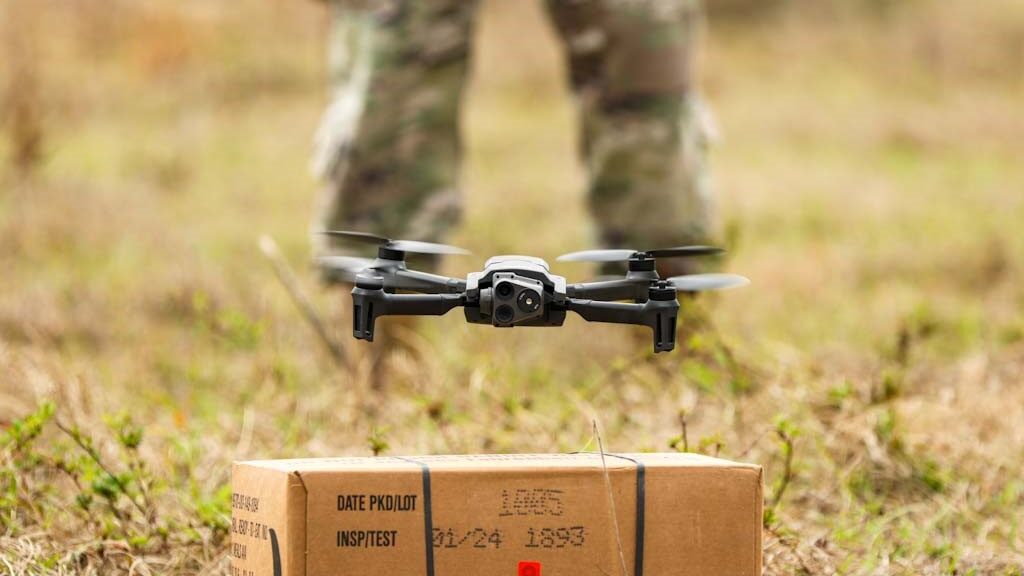
WASHINGTON — The Army-led Joint Interagency Task Force (JIATF) 401 announced additional authorities for counter-drone activities in the homeland, giving service chiefs and base commanders more flexibility to take on the growing menace.
“Drones are a defining threat for our time, [t]echnology is evolving fast and our policies and c-UAS strategy here at home must adapt to meet this reality,” JIATF-401 Director Brig. Gen. Matt Ross said in a statement published Monday.
The new guidance, which was signed by Defense Secretary Pete Hegseth last month, allows commanders to expand the range at which they are allowed to take down a threat, deems unauthorized surveillance of a designated facility a threat and gives service secretaries the power to designate what facilities should have special protections.
Prior to the new guidance, commanders were only allowed to engage with a drone threat if it was within the “fence line” of a Department of Defense installation. The new guidance says that’s no longer the limitation, though it does not say exactly how far out the new rule of engagement goes. An Army spokesperson told Breaking Defense that “installation commanders are expected to coordinate on any action they may take outside established fence lines.”
The Pentagon also deemed that unauthorized surveillance of a “designated facility” now “explicitly constitutes a threat,” meaning that commanders have the authority to shoot down a drone that is surveilling the area without permission.
“Countering drones does not start and stop at the fence line,” Ross said in the statement. “With this new guidance installation commanders are empowered to address threats as they develop, and the guidance makes clear that unauthorized drone flights are a surveillance threat even before they breach an installation perimeter.”
Further, the new guidance changes the rules for what is considered a “covered facility or asset,” which are installations in the US that relate to DoD missions such as to missile defense, nuclear deterrence, special operations activities, testing facilities, combat support and more. Under current policy, known as 130i, the Defense Department is only allowed to engage with drones if they pose a threat to such installations. The new guidance says service chiefs will be empowered to determine which facilities are “covered” and therefore afforded additional protection.


Engineering decision advantage for the warfighter
Multi-orbit mission capabilities are accelerating decision making across domains.
“This updated framework provides commanders with the expanded authority and flexibility needed to dominate the airspace above their installations,” the Army spokesperson said.
On the sidelines of the annual Apex Conference today, Ross told Breaking Defense that new guidance builds on the Safer Skies Act, which was enacted in the 2026 National Defense Authorization Act and expanded the nine criteria for what constitutes a covered asset.
“What we’ve done is clarified the guidance to the services for what those criteria are to establish if something is covered under 130i. It gives great latitude to the service secretaries,” Ross said. “Subsequently, when I say installation X is covered under 130i, now that installation commander has to figure out what their plan is to defend it, and then they coordinate with the FAA [Federal Aviation Administration], and they say, ‘Hey, I plan to use a combination of active and passive sensing. I want to use this electromagnetic defeat mechanism. I’m going to make sure that doesn’t interfere with any airports around here.”‘
Though the task force already works closely with other agencies across the government, the new guidance also included a portion on “enhanced interagency cooperation” which further authorizes the sharing of drone track and sensor data among interagency partners such as the Department of Homeland Security and the Department of Justice.
As Breaking Defense has previously reported, the military has collectively reported hundreds of drone flights over Pentagon installations on American soil in the past few years.
US Northern Command head Gen. Gregory Guillot told reporters last fall that the department sees about one or two incursions per day on DoD installations. A spokesperson later said that there were 230 drone incursions reported over military installations between September 2023 and September 2024, which jumped by 82 percent to approximately 420 sightings reported over roughly the same period the following year.
As for the new c-UAS authorities, the Army spokesperson said, “JIATF-401 partners and supports coordinating efforts across all agencies and departments.”
“While we cannot comment on specific operations, the creation of this task force underscores the Department’s commitment to continuously adapting amid a rapidly evolving operational landscape, ensuring the United States Armed Forces remains the most lethal fighting force in the world,” they said.