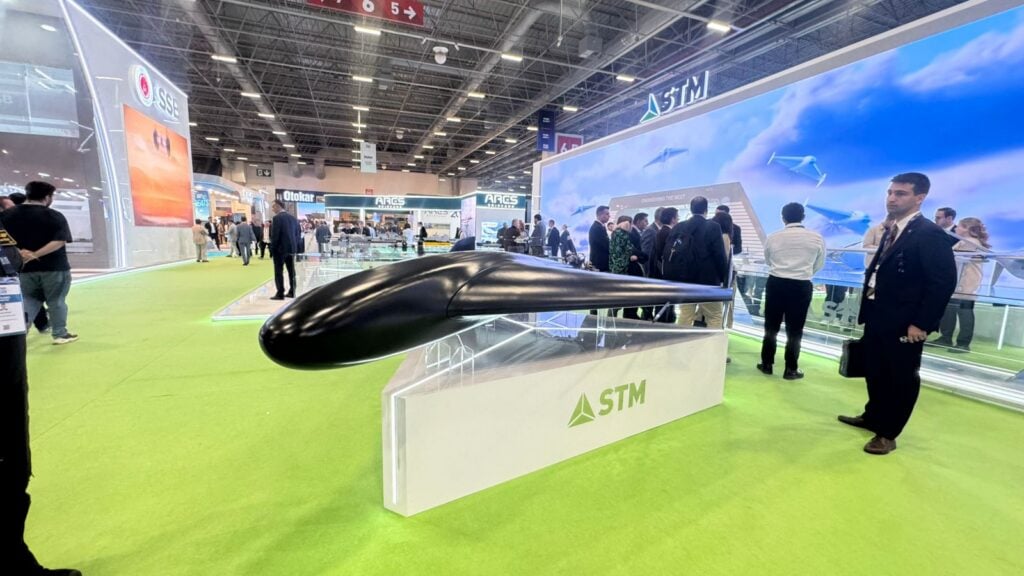
BEIRUT — The SAHA defense exposition in Istanbul had no shortage of new drones on display, and local defense contractor STM was no exception, unveiling four unmanned aerial vehicles (UAVs) and one unmanned underwater vehicle for the first time.
The Turkish company unveiled a one-way attack UAV dubbed Kuzgun — a fixed-wing loitering munition with a range of more than 1,000 km (621.4 miles). The drone is equipped with a high-explosive fragmentation warhead and a speed of 180 km per hour, according to the company. The drone has similar design features to Iran’s Shahed 136.
“Using it [in] a swarm is also already in the agenda,” STM General Manager Ozgur Guleryuz told Breaking Defense, adding that the platform is currently undergoing tests. Kuzgun has “no contract at the moment, but there’s huge interest in it,” he noted.
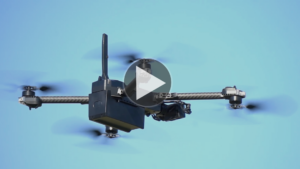
Also on display from STM was the TOGAN-M Mini Reconnaissance and Surveillance UAV System. The company noted it has a weight of just 2.5 kg (5.5 pounds) and has a foldable design. The UAV is dedicated to intelligence, surveillance and reconnaissance (ISR) missions, per STM.
The Turkish engineering firm also unveiled its largest family of autonomous unmanned underwater systems, dubbed Tengiz, which is equipped with heavy torpedo launch capability and can carry “smart” loitering munitions.
The 11.2-meter-long (36.7-foot-long) system can operate 400 meters underwater with a speed of 8 knots and can perform both ISR and combat missions, including anti-submarine warfare and electronic warfare, the company stated. Further, STM is continuously updating its platforms and technologies, Guleryuz said.
“We are already using artificial intelligence, image processing, machine learning and things like that. But we are also going more deep and deep in those areas,” Guleryuz said.

Europe’s military advantage depends on sovereign command of the ground truth
As NATO and European governments accelerate investment in space-based intelligence, decision advantage will depend on how quickly sovereign and commercial capabilities can be fused into a trusted operational picture.
He added that STM is an “engineering company. We are the biggest shipbuilder company of Turkey, but we don’t have a shipyard of our own. And like similarly on the UAV side, also our production facilities are really small because we are using subcontractors to build the business for us. We just integrate them and then ship them to the customers, and we are really open to any kind of technology transfer in that sense.”
Guleryuz explained that STM is looking to support localization in other Middle Eastern and Gulf countries.
“We have already signed some MOUs [Memoranda of Understanding] in that region, but we are a governmental company in Turkey, and one of the missions that was given to STM in Turkish defense sector up to now was to increase local contribution in the products,” he said.
He highlighted the different models of possible cooperation with Gulf states. “We are really willing to produce some things locally. If a technology is developed in a Gulf country, we can try to develop drones indigenous for them, using their technology if they need our support, or we can even produce them there directly. Or we can produce these drones that has been designed by STM in those countries. Also, we are really open to the kind of collaboration.”
Breaking Defense Video