DETROIT — As unmanned surface vessels (USVs) continue to take priority for the Navy, service officials and experts are discussing how these systems could ease operational and sustainment pressures of the Navy’s aging fleet.
“The surface fleet is stretched pretty thin,” Cmdr. Jon Noda, USV department head for Surface Development Squadron One, said on a panel at the joint Xponential/MDEX conference here. USVs give commanders “alternate options” for servicing mission sets.
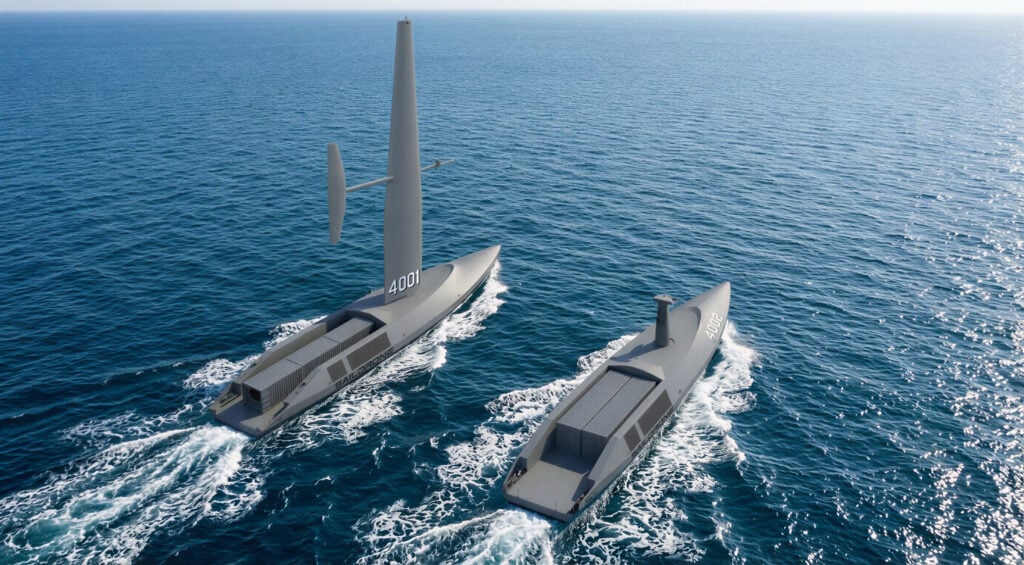
USVs are being considered as potential substitutes for some missions performed by ships like guided-missile destroyers (DDGs) cruisers or amphibious ships, especially when the job does not require a large, manpower-intensive combatant, panelists said at the joint Xponential/MDEX conference in Detroit. For example, a single Arleigh Burke-class destroyer and its roughly 300 sailors, paired with a couple of medium USVs carrying towed arrays, could execute missions that might otherwise require 2 or 3 DDGs.
They are not wholesale replacements for destroyers, cruisers, or amphibious ships, however. Their value, as described by the USV panel at Xponential, is in taking on narrower, high-demand missions that have traditionally consumed large manned platforms because the Navy had few other options. Anti-submarine warfare, intelligence, surveillance, and reconnaissance, mine countermeasures, and some air and missile defense missions can all require persistent presence in dangerous or distant places.
Sending a destroyer and hundreds of sailors for a single-purpose mission may work tactically, but it is an inefficient use of a scarce multi-mission warship.
“Operations and sustainment costs for the Navy tend to be the thing that limits the size and shape of the fleet,” said Bryan Clark of the Hudson Institute. Even if more money is available to buy ships, he said, the Navy still has to recruit, train, maintain, fuel, and deploy those forces over decades. USVs offer a way around those labor-intensive cost centers.
That is why the concept of “tailored forces” is so important, Clark explained. Rather than defaulting to a standard manned force package for every problem, the Navy can assemble mission-specific formations using the right mix of manned and unmanned systems. Clark described those forces as a way to “take on challenging missions in geographies where we can exploit a forward deployed uncrewed force.”
Capt. Jerry Daly, the Navy’s deputy assistant secretary for Robotics and Autonomous Systems, sharpened the point with a simple comparison: using a large combatant for some of these jobs can be like “sending a tractor trailer to deliver your one Amazon box.”
The payload bay is what makes the replacement logic work. Panelists described the medium USV as a “truck,” meaning the vessel becomes operationally relevant only when it carries something commanders need: sonar and other sensors, communications, decoys, missiles, loitering munitions, or other mission packages.
For allies, the same logic applies due to geography. Capt. Atsushi Yanagita, director of Future Warfare and Logistics Studies Office at the Japan Maritime Self-Defense Force Command and Staff College, noted that Japan must contend with a vast operating area that includes the Southwest Islands, the East China Sea, and the Western Pacific. Japan, he said, needs more persistent surveillance and rapid response across that wide maritime domain, and USVs can fill that role as part of a distributed architecture with satellites, drones, manned ships, and allied systems so that data can be shared.
“The real value is not only [what] the USV can do by itself, but [what] information it can provide, and how quickly it can support the fleet and support alliance partners,” said Yanagita.
Breaking Defense Video