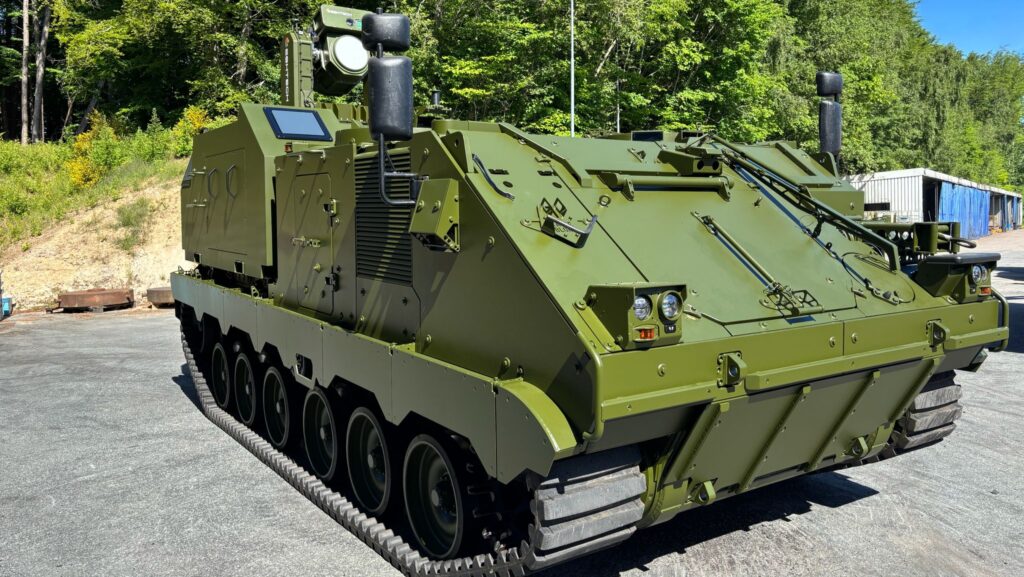
JERUSALEM — Esh-Tech, a new Israeli defense startup, plans to unveil its DroneLight laser defense system, aimed at countering unmanned aerial vehicles, at this year’s Eurosatory exposition, the company’s CEO told Breaking Defense.
“We are dealing with lasers. From day one, we tried to find a solution to counter UAVs, primarily small drones. We understood this would be the next threat,” Erex Riahi, the CEO of Esh-Tech, told Breaking Defense. “We saw that soft-kill RF [radio frequency] solutions were constantly evolving, and with the rise of fiber optics we understood we needed hard-kill capabilities, so we bet on hard-kill to destroy drones.”
As drones continue to dominate the modern battlefield, countries like Israel, involved in a multi-front war, are looking for counter-drone solutions.
DroneLight, the company noted in a statement, combines “high effectivity with very low energy consumption and a cost structure that is dramatically lower than traditional laser systems.”
The technology is based on a pulsed laser that uses only 4kw of energy.
“It’s a game changer. It’s smaller, uses only 4kWh, can be connected to a vehicle, and is three to four times less expensive than current laser or microwave systems,” Riahi said. (In comparison, Israeli Rafael Advanced Defense Systems’ LiteBeam is a laser that uses 10kw.)
“We developed our own lasers using our own technology. Most other lasers are continuous-wave systems that burn the target, meaning you need 10-15 seconds on target,” Riahi said, explaining that pulsed lasers use a higher concentration of energy over a short period of time.
“It’s like shooting, making holes in the target like a bullet, but with light. Nothing goes to the ground, there are no munitions limitations. We do five pulses per second and create multiple holes in a drone, which allows us to kill it efficiently,” he said. According to Riahi, DroneLite can be used on both plastic materials and metal.
Regarding potential issues with weather, Riahi said Esh-Tech “found a way to identify windows in the atmosphere where conditions are better as they change.”
Identifying these optimal conditions, in a 0.01-second time window, can improve range by 50 to 100 percent, according to Riahi, which can affect laser effectiveness.
“Even in good conditions, especially in the middle of the day, one kilometer range can drop significantly because of atmospheric effects,” he said.
The goal of the DroneLite, Riahi said, is to “move with forces and protect critical infrastructure, creating a kind of dome rather than relying on huge, power-hungry systems weighing tons.”
The laser system was previously tested on an undisclosed vehicle in Israel last year, Riahi said, where DroneLite destroyed 20 drones. The first operational system is set to be ready in October of this year, he said.
Before that, DroneLite will be on display at the Eurosatory exposition taking place in Paris this month.
Riahi said he predicts Esh-Tech will be able to scale up its production to hundreds of systems a year next year, but will start with just dozens of systems in early 2027.
He hopes to find customers in the US and Europe. “Our plan is to sell hundreds and work closely with customers to provide a complete solution.”
Riahi said the Esh-Tech is cooperating with the Israel Ministry of Defense’s Directorate of Defence Research and Development (MAFAT) to potentially provide its system for Israel’s defense needs.
“Everyone understands the priorities and what needs to be done. The heart of the system is to provide solutions, and all industries, including us, are making maximum efforts to solve this challenge,” he said.
To him, finding an effective counter-drone solution is personal: “I have children in combat units, and it is important to find a solution to this threat.”
Breaking Defense Video