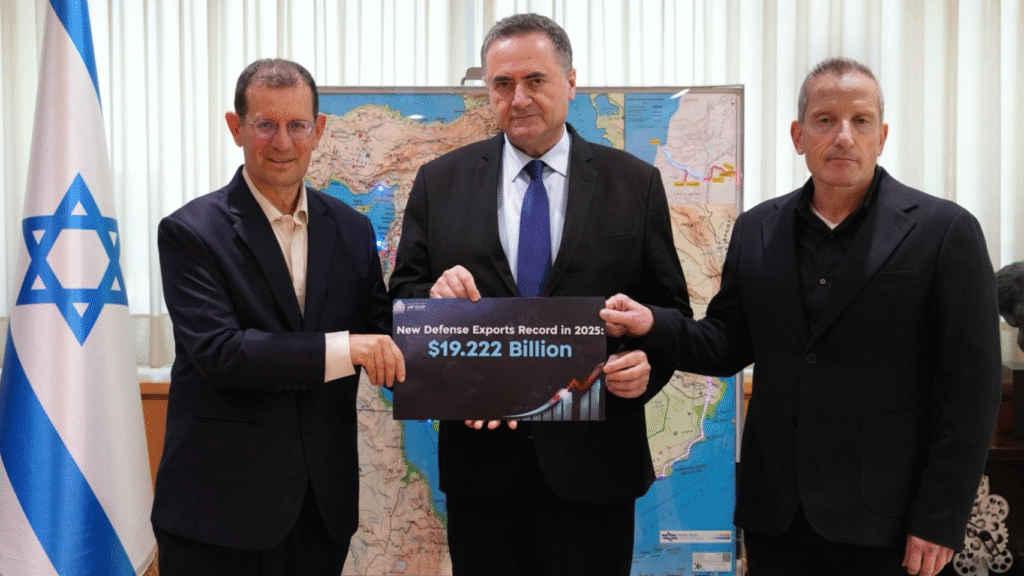
JERUSALEM — Israel’s defense exports increased in 2025 for the third year in a row to reach a record $19.2 billion, the Israeli Ministry of Defense announced today.
This announcement comes as Israel has approved its largest-ever defense budget, and Israeli defense giants have announced record backlogs of orders.
Israel’s Defense Minister Israel Katz said in the statement that the new export figures show “there is a clear and unmistakable thread connecting the IDF’s battlefield achievements across all fronts, the extraordinary capabilities of Israel’s defense industries, and the success of Israeli defense exports around the world.”
Over half the export deals — 53 percent — were what Israel calls “mega-deals,” valued at over $100 million each.
“[M]issile, rocket, and air defense systems continued to lead in 2025, accounting for over a quarter (29%) of total deal volume,” according to the ministry. In contrast, missile, rocket and air defense systems made up 48 percent of deals in 2024 and 36 percent in 2023.
The ministry said that deals for observation and optronics systems rose to 22 percent in 2025, up from 6 percent the previous year. Meanwhile, drones, previously a major export for Israel, made up just 4 percent of the country’s exports — a slight increase from 1 percent in 2024.
Radar and electronic warfare systems made up 11 percent exports in 2025, similar to the prior year’s 10 percent. Among other categories the ministry noted were “manned aircraft and avionics (11%), C4I and communication systems (7%), weapon stations and launchers (6%), drones and UAVs (4%), satellites and space systems (3%), vehicles and APCs (2%), intelligence, information and cyber systems (2%), maritime systems and platforms (2%), and ammunition and armaments (1%).”
As to where Israel was exporting its systems, in 2025 36 percent went to Europe and 32 percent went to Asia and the Pacific region, the numbers show. This is a stark difference from 2024 where Europe accounted for more than half of the exports at 54 percent. Meanwhile, 15 percent went to the Middle East and 13 percent went to North America.
The MoD noted that Israel’s defense industries have been operating “round-the-clock production for the IDF while simultaneously fulfilling contracts for foreign clients.”
Israel has been fighting a multi-front war since the Hamas attack on the country on Oct. 7, 2023, and more recently has been fighting alongside the US in Operation Epic Fury. The conflicts have seen the first use of several systems, including the Arrow 3 and Barak naval system, and also the deployment of new systems such as laser air defenses.
Part of the success in 2025’s government sales, according to the ministry, can be credited to the ministry’s strategy and reforms, like “the opening of new markets, the expansion of strategic partnerships with a range of countries, and significant easing of export licensing policies.”
Israel’s Ministry of Defense Director General Amir Baram agreed, crediting the jump in exports to Israel’s unique defense industry ecosystem.
“It is also the result of a deep reform carried out by the Ministry over the past year to reduce regulation and open new markets, which led to landmark deals. Today, our force buildup budget relies heavily on these partnerships, yet we cannot stop there,” Baram said in today’s statement.
He further mentioned the record numbers could be due to the country’s investment in research and development as well as in expanding munitions production.
“This is the essential step for ensuring independence in critical munitions and interceptors, maintaining technological superiority, and generating Israel’s next surprises,” he added.
Katz said that the exports show confidence in Israel’s defense establishment.
“These achievements are built on the IDF’s capabilities and those of our broader security forces – in Gaza, Lebanon, Iran, and Yemen,” adding that the exports were a “mirror” of Israel’s “strength, ingenuity, and the ability to think differently.”
The head of the ministry’s International Defense Cooperation Directorate (SIBAT), Yair Kulas, pointed to the global increase in demand for defense systems and how this has resulted in more global interest in Israel’s defense industry. “SIBAT and the Israel Ministry of Defense are leading a consistent and deliberate effort to expand Israel’s defense cooperation with countries around the world, to make the capabilities of the industry and the IDF accessible globally,” Kulas said.
As with the other Israeli officials, he pointed to Israel’s development of effective systems and the combination of the defense industry’s work in supplying the IDF and also expanding global exports.
Government-to-government deals have been a key factor in the defense export increase as well, with 2025 seeing a record $10 billion.
“The historic record in government-to-government (GTG) deals — approximately $10 billion — is not only an economic figure; it reflects the deepening of strategic partnerships and the growing international trust that the Ministry has built with defense ministries around the world,” Kulas said in today’s statement.
Breaking Defense Video