PARIS — Advanced Acoustic Concepts, a US defense subsidiary of the global defense giant Thales Group, has secured a $53.9 million contract with the US Navy to deliver at least two remote mine hunting (RMH) modules aimed at bolstering sailor safety when tracking mines.
“The ability to counter undersea mine threats remains fundamental to maritime security and naval mission success,” Rob Geckle, CEO of Thales North America, said in a statement Monday. “By advancing the Navy’s [mine countermeasures] capabilities, this program will help strengthen fleet readiness and support mission success in an increasingly dynamic operating environment.”
The contract comes as mine countermeasure operations have taken the spotlight amid operations in the Middle East like Operation Epic Fury, where US Central Command kicked off mine clearing missions in the Strait of Hormuz in April. President Donald Trump said in August mines in the waterway were cleared.
The contract also covers engineering support for the modules, and has the possibility to climb to $196.2 million for subsequent modules. The first two modules are slated for delivery by October 2029, with potential follow-on modules delivered through 2039 and beyond.
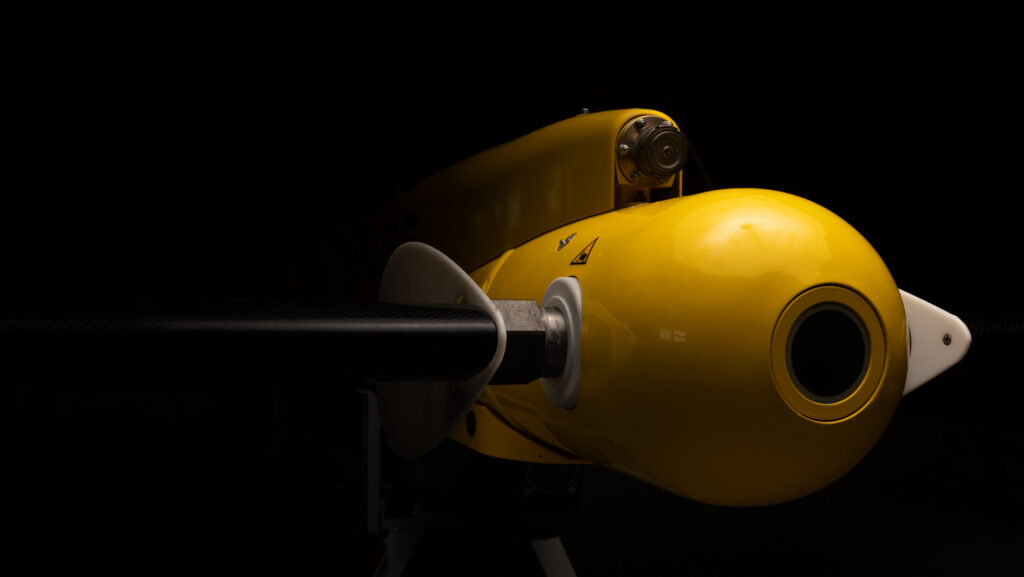
The RMH features Thales’ SAMDIS 600 sonar that can provide high-resolution imaging of potential mines, along with an AI software so sailors can analyze the data quickly and accurately, according to Thales. The SAMDIS 600 sonar was recently tested with an unmanned underwater vehicle from HII for a mine countermeasures exercise.
Tony Lengerich, vice president of naval programs with Thales Defense & Security, Inc., told Breaking Defense that Thales’ SAMDIS 600 sonar features a three-beam system that allows a “highly improved probability of certainty” during one sweep through a minefield.
“You get three looks at an object instead of just one look,” Lengerich said. “Those three pictures, if you will, really increase the certainty that you’re looking at a mine, not a Volkswagen somebody tossed in the ocean somewhere. So, speed of detection, speed of certainty, is now what we’re improving.”
Relatedly, Thales and HII announced today they recently teamed up to deploy Thales’ SAMDIS 600 sonar on HII’s Remus 620 UUV, which is capable of conducting long-range, multi-day operations.
Together, they used Thales’ Expeditionary Portable Operation Center command and control system to function as the “operational hub,” along with HII’s command and control software known as Odyssey to facilitate mission planning and management to scout potential mine threats, the firms said in a joint news release today.
“They can program that thing to go through the minefield surface, send back the data, and continue to keep searching,” Lengerich said.
Additionally, the exercise also employed HII’s automated launch and recovery system called Sea Launcher to deploy and retrieve the REMUS vehicle underwater. The launcher system can be paired with either manned or unmanned systems, further removing sailors from the minefield, according to HII.
“Keeping the sailor out of the field is a critical part of that,” Nicholas Green, senior manager of international business development with HII, told Breaking Defense. “But another part is actually getting the equipment in and out of the water. That’s always been a difficult part of what we do. And the Sea Launcher is the latest iteration of what we are offering for launch and recovery of our medium sized UUV.”
After analyzing the data collected from the sonar and UUV, the teams deployed Thales’ Advanced Acoustic Concepts’ ANGLER underwater effector to neutralize detected mines.
Breaking Defense Video