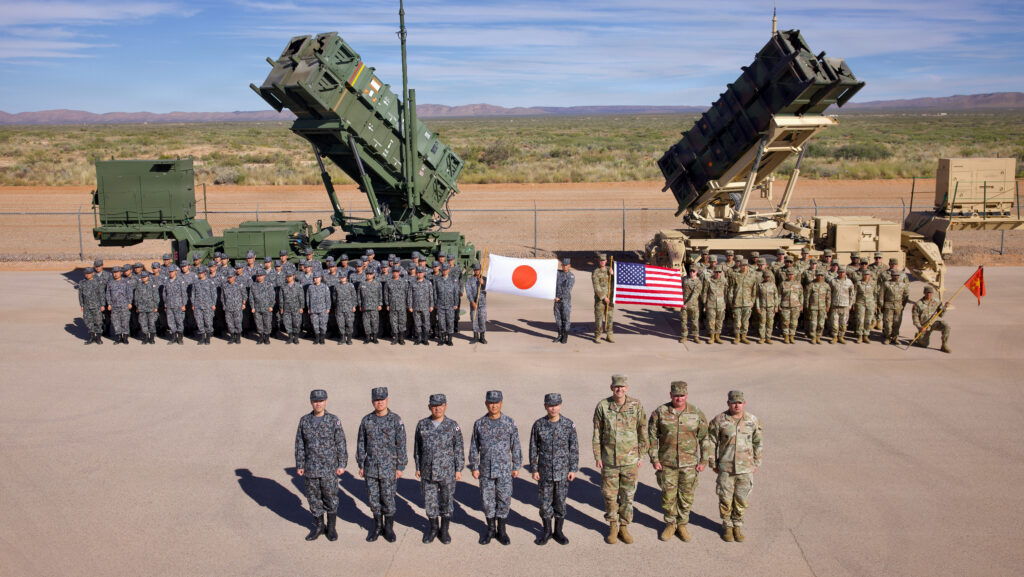
There is no more important bilateral air and missile defense cooperative relationship than that between the United States and Japan. In the 1980s, Japan became the first non-NATO adopter of the Patriot air defense system, now used by 18 nations. Cooperation also includes Aegis ships, space sensors, PAC-3 production, SM-3 IIA for ballistic missile defense, AMRAAM air-to-air missiles and co-development of the Glide Phase Interceptor for hypersonic defense.
In the coming months, Japan will develop the FY2027 budget and three new documents: the National Security Strategy, National Defense Strategy and Defense Buildup Plan (DBP). Prime Minister Takaichi Sanae has said that these documents “will determine our country’s fate.”
Takaichi is likely right. These documents could incorporate decisions that will shape the character of the missile defense relationship for years to come — and not necessarily for the better.
Defense Minister Shinjirō Koizumi has highlighted the centrality of countering air and missile threats to what JMOD calls the “new ways of defense.” The United States is fortunate to have its Japanese ally move with such urgency. Japan’s defense expenditures rose to $58 billion this year. Their overhaul of defense export restrictions and the 2025 sale of PAC-3 interceptors likewise represent impressive steps forward.
America will need Japan’s further help to both improve air and missile defense capability and increase joint production. These cooperative efforts will continue to evolve, especially given the demand for increased production following the considerable depletion of interceptors during Operation Epic Fury. The demand for greater capacity, including SM-3 IIA, can be met partly by increased production in Japan. Other means of supplemental production will likely be necessary, either with facilities operated by Japanese industry, or by subcontracting American solid rocket motor companies as suppliers.
Despite these many promising developments, there is a problem: a potential split on Patriot modernization.
At the core of Japan’s missile defense modernization effort is improved sensor coverage, including the new 360-degree Lower Tier Air and Missile Defense Sensor (LTAMDS) radar, which will support the Patriot system operated by the Aerospace Self Defense Force (ASDF). If you cannot see a threat, you cannot kill it. Defeating air-launched ballistic missiles, hypersonic gliders, drones and cruise missiles requires 360-degree detection and tracking.
Written in 2022, Japan’s DBP included LTAMDS acquisition as the next step to modernizing its Patriot force. Four years have now transpired, however, without any progress acquiring that radar. Threats from maneuvering aerial threats like drones and cruise missiles have since become ubiquitous. DBP modernization plans for Patriot now stand in jeopardy.
The reason for Japan’s impasse has to do with a complicated set of dynamics about how radars relate to command and control (C2) systems.
The US Army built LTAMDS specifically to be operated by its Integrated Battle Command System (IBCS). For the United States and at least some other Patriot operators, IBCS will replace Patriot’s existing C2 hub, the Information Coordination Central (ICC). LTAMDS was not designed to plug into the legacy Patriot ICC operated by Japan, sixteen other countries worldwide and, for many years yet, most of the US Patriot force. While LTAMDS can be made compatible with the legacy Patriot ICC, it takes work to do so. US and Japanese defense industry have studied a path to that option, within what is known as a Smart ICC, a system Japan is already developing to integrate their domestic systems with the Patriot ICC, such as Chu-SAM.
When the DBP was crafted, Japan’s Air Staff Office understood that LTAMDS could be incorporated into Japan’s Patriot force through Smart ICC. This explains why neither Japan’s DBP, nor their National Defense Strategy, nor any budget mentioned IBCS.
Shortly after the 2022 DBP was put forth, however, the US adopted a somewhat different posture toward allied Patriot modernization, more heavily favoring capability and heightened integration.
The Smart ICC path will not be formally endorsed by the US Army, since it is not part of the US Army’s own program of record. The prospective Foreign Military Sale (FMS) of LTAMDS is now tied to IBCS, an all-or-nothing linkage, but JMOD has not yet embraced IBCS.
Tokyo now faces three possible paths forward: 1) acquire both IBCS and LTAMDS, 2) acquire LTAMDS and integrate it into the existing Patriot ICC; or 3) acquire neither.
The first option, acquiring IBCS and LTAMDS, offers significant operational advantages. IBCS allows multiple sensors and shooters to operate as a unified network, deconflicting fires, sharing tracks and improving battlespace awareness. Those capabilities contribute to better magazine conservation, which is critical to surviving mass raid attacks. By connecting certain Patriot elements with others operated by the ASDF, IBCS would supplement, not replace, the Japan Aerospace Defense Ground Environment (JADGE) network, into which many other service elements are integrated.
From the perspective of the United States government, Japan getting both IBCS and LTAMDS is the most optimal option. All things being equal, it is best for US-Japan interoperability to have common C2. For context, Poland is procuring both systems, and Denmark has been approved for IBCS.
At least as understood by JMOD officials, however, this could also be the most expensive option. While it could surely be done, parallel questions remain about schedule and cost for integrating Japan’s other indigenous systems into IBCS.
A second path, acquiring LTAMDS without IBCS and making it compatible via Smart ICC, is presumably what Japan was considering four years ago. Given Japan’s current comfort level and familiarity with ICC, this path might seem less disruptive for training and operational transition. If the FMS path is unlikely, this could happen by means of a Direct Commercial Sale (DCS). The DBP’s planned acquisition of LTAMDS could proceed while deferring the question of IBCS to another day.
Smart ICC-LTAMDS integration would also require significant developmental investment. Other members of the Patriot family could split the cost of nonrecurring engineering and integration. Due to its divergence from the US approach, such a cooperative effort would not advance under the multinational cost pooling for Patriot upgrades, but some parallel arrangement could emerge.
After Operation Epic Fury, other Patriot operators looking to modernize their radar coverage could include Saudi Arabia, UAE and Kuwait. While the optimal outcome remains for all members of the ever-growing Patriot family to share a common C2, it is unlikely that this will happen.
A third path is for Japan to pursue neither LTAMDS nor IBCS. This could happen by quietly removing LTAMDS from the FY2027 DBP and without any public statement about IBCS.
This result would be both the easiest and worst outcome, leaving the new DBP without any clear path forward on 360-degree radar coverage for Patriot. Developing and building a new indigenous radar program from scratch would take years, incur considerable development expense and remain uncertain of success. It would weaken interoperability instead of strengthening it.
Removing LTAMDS from the modernization plan would represent a devastating setback to the ASDF’s Patriot force without any clear path forward. Cancellation would undercut sensor coverage against advanced aerial and maneuvering threats when Japan is in need of expanding it, especially to the east and southeast.
The scale of that setback would be measured in both lost capability and schedule, not unlike the scuttling of plans for Aegis Ashore sites begun in 2017 before being cancelled in 2020. Whatever one’s views of the Aegis Ashore plan for Japan, there is no doubt that the episode involved a considerable loss of time.
Recent conflicts in Ukraine and the Middle East confirm that missiles have become weapons of choice. In the face of growing air and missile threats in the Pacific, 360-degree radar coverage and advanced command and control will be critical to US and Japanese defense objectives.
To be clear, the onus here is not only on Japan. The United States government has a responsibility, too. Over the last several years, the Pentagon’s preferences and reasons for Japan to acquire IBCS and LTAMDS have been clearly and often communicated, as have the risks of degrading sensor coverage in the face of structured aerial attacks.
The specter of air defense suppression is profound. Iran has demonstrated the ability to target US missile defense radars and C2 nodes in the Middle East. China’s capability to do so is even greater.
These are Japan’s choices to make. Regardless of the path chosen, it will be incumbent upon the United States to respect our ally’s decisions, help facilitate their implementation and continue to improve interoperability to the fullest extent possible.
But from an American perspective, it would be clearly helpful for Japan to make its sovereign decisions and to communicate them clearly. Whether that choice is for IBCS or Smart ICC, whether for LTAMDS or another radar, now is the time to decide.
Tom Karako is the director of the Missile Defense Project and a senior fellow in the Defense and Security Department at the Center for Strategic and International Studies. A shorter version of this article first appeared in Nikkei.