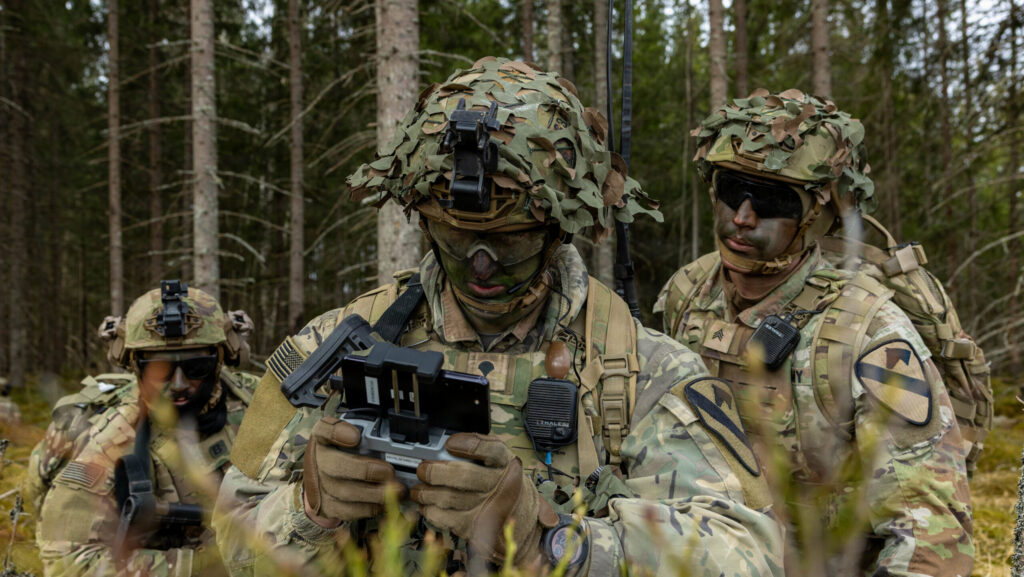
AUGUSTA, Ga. — The Army is preparing a broad outline of intelligence-related problems that soldiers currently face, from sensing and collection analysis to data exploitation, that top service officials hope private industry can solve by developing new tools.
The so-called characteristics of need (CoN) for intelligence is already “teed up” for senior Army leaders to review, with a decision anticipated soon, Joseph Welch, portfolio acquisition executive for command and control and counter-command and control, told an audience at the annual TechNet Augusta conference today.
Rather than articulating rigid requirements for desired capabilities, the Army has begun issuing these CoNs that outline broad problems and ask industry to present solutions.
“It becomes our overall guiding document. When there’s a question about, ‘is this a direction we should be headed?’ That’s what we look to as our north star,” Welch said in an interview. “They don’t explain exactly how to do everything, but when we evaluate the potential of doing things, we look at it.”
The CoN for intelligence is the third such document in Welch’s portfolio, following one for next generation command and control in May 2024 and another for electromagnetic spectrum operations in February. Those previous CoNs have already proved successful, according to Welch.
The documents “enabled us to open the aperture to a wider range of solutions than what our previously prescriptive requirements process enabled us to do,” Welch said.
The CoN for electromagnetic spectrum operations, for instance, allowed Army commanders to solicit ideas from industry for a broad range of signals intelligence and electronic warfare problems, Welch added, and that process remains ongoing.
“Commanders, they continue to highlight to us the need for improved and accelerated terrestrial SIGINT and EW capabilities,” he said.
Welch told attendees at TechNet that recent operations overseas, the southern border mission, and experimentation and prototyping efforts have highlighted the importance of having flexible, rapidly deployable intel capabilities that are responsive to changes in threat and tailorable to mission and echelon.
These documents can also be updated, Welch said, as conditions change or lessons are learned. They also help explain to the Army and stakeholders in industry and Congress the direction the service is headed, as well as how soldiers are thinking about specific technologies, Welch added.
Welch explained to Breaking Defense that the plan is to continue these CoNs for his entire portfolio, with the next one focused on training and simulation, given their success.
Breaking Defense Video